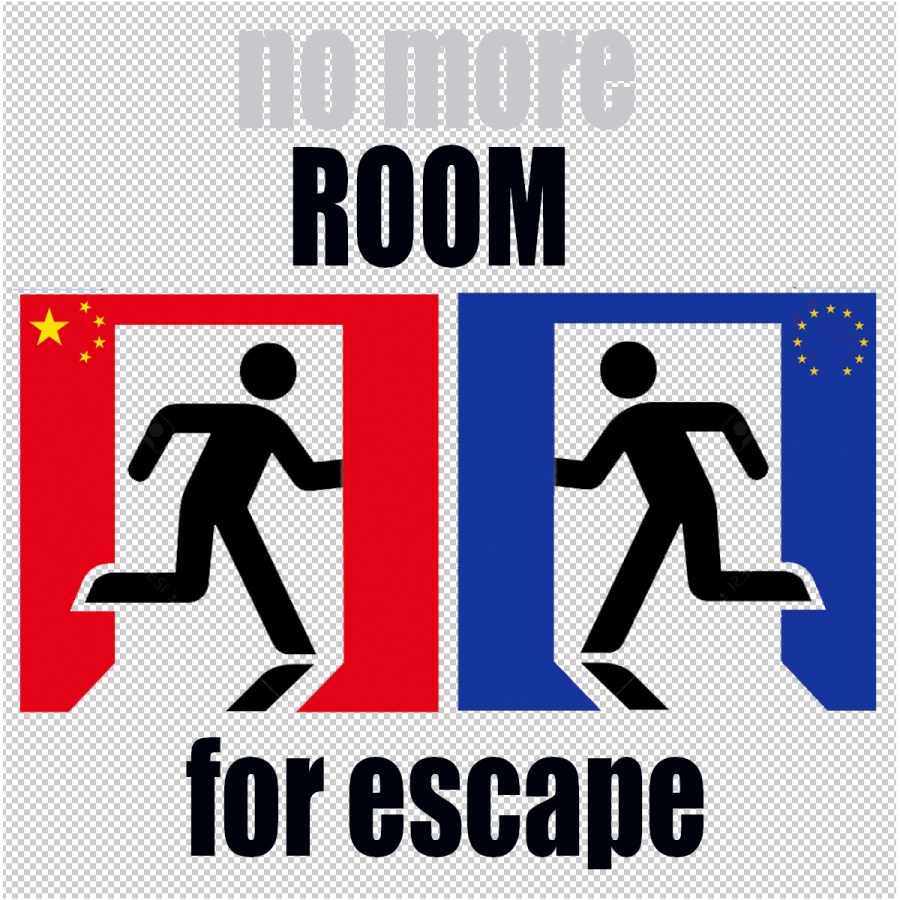
BREXIT & Hong Kong EXIT = HKEXIT
is there ROOM for escape?
Leaving the European Union…
Leaving the People’s Republic of China…
Apart from the question: WHO IS FLEEING FROM WHERE?
there is the question: WHERE CAN ONE FLEE?
– In the news-picture flow of these days we may see British Union Jack flags waving both in the UK and Hong Kong, while REMAIN partisans wave EU and PRC flags with more than one star, one having a blue, the other a red background.
“The red background symbolizes the revolution and the golden star colors ‘radiate’ on the red background representing one of the Five Elements of fire and earth. The big star represents the unity of Chinese people under the leadership of the Communist Party of China (…) the four smaller stars that surround the big star symbolize the four social classes (the working class, the peasantry, the urban petite bourgeoisie and the national bourgeoisie) of China’s New Democracy mentioned in Mao’s ‘On the People’s Democratic Dictatorship’. [wiki]
~
The EU (European Union and European Council) flag has “the blue sky of the Western world” with 12 stars that “symbolize the peoples of Europe in a form of a circle, a sign of union. Their number is invariably twelve, the figure twelve being the symbol of perfection and entirety.” [wiki]
~
I have taken out one of the twelve EU stars in this picture… to symbolize the ‘disunity’ when the UK leaves the EU. Will it be a loss of ‘perfection’ and will what is left of the EU be eternally ‘incomplete’?
The official Union Jack Flag of the United Kingdom may shed some of its constituting parts soon. “The present design of the Union Flag dates from a Royal proclamation following the union of Great Britain and Ireland in 1801. The flag combines aspects of three older national flags: the red cross of St George for the Kingdom of England, the white saltire of St Andrew for Scotland (which two were united in the first Union Flag), and the red saltire of St Patrick to represent Ireland. Notably, the home country of Wales is not represented separately in the Union Flag, as the flag was designed after the invasion of Wales in 1282. Hence Wales as a home country today has no representation on the flag.”

A demonstrator waves a Union Jack flag in front of police during protests that have once again raised issues of identity as well as hostility towards Beijing among young people in Hong Kong. VINCENT YU/AP [The Times June 14 2019]
SO WHO IS FLEEING FROM THE ‘PEOPLE’S DEMOCRATIC DICTATORSHIP’ IN HONG KONG? Which star should be taken out? Is it the ‘urban petite bourgeoisie’? Is it the ‘national bourgeoisie’? Or both?
~
Will the Brits float their island away to the West across the Atlantic? Or will the USA conquer one of the former colonial motherlands, as many are suggesting depicting Boris Johnson as the trickster that plays the Trump-card.
~
Is there any option for drifting away for the tiny islands and some bits of connected mainland territory? It is hardly imaginable that Hong Kong can catapult itself to the Western hemisphere… it can drift a fair bit south-west toward Singapore or a rather long way east toward Taiwan, or even further to Japan.
~
All of this seems far beyond the doable… especially for the HKEXIT plan. Can any nation in the world ESCAPE the globalizing market forces? There seems to be NO ROOM for it anymore. Still in this perspective one may argue that the main HKEXIT actors maybe not the inhabitants of that former British Crown Colony, but those in Beijing who are responsible for keeping the ‘peoples dictatorship’ up and running. Is it not so that by limiting what is called ‘ the free market economy’ (wrong term in fact but let’s use it here to avoid too long an exposé about the un-freedom of it) and limiting the formal separation of the law-system from the state apparatus (‘rule of law’) in Hong Kong, the People’s Republic of China is the one that forces the Hong Kong – as it is still now – OUT: EXIT HK?
Once more IS THERE ROOM FOR ESCAPE in this world?
I think there is not. One has to face up to the political and military power realities of where one lives now, seek for no relief from the past, but instead face up to the future. There is No glorious past to go back to, not for the Brits and their infamous colonial empire, not for the people of Hong Kong. Their status of voiceless subjects without a parliament in a British Crown Colony – that developed into a modern day piracy nest for the big finance – has remained unchanged, better said worsened. Hong Kong’s actual status of “Special Administrative Region of the People’s Republic of China” protocoled as “one country two systems” has seen the quality of civil rights eroding and promises for more democracy, made before the hand-over to China by the UK, thwarted. This has lead some to long for a a past that was supposedly better, but at best – only at the end of British reign – one may speak of some gestures of ‘belated enlightened top down’ delivered measures of empowering Chinese Hong Kong citizens. Before British rule of law was strongly geared toward the expatriate business community.
In the Hong Kong turmoil of the last months local social economic issues have hardly been mentioned and there are many to tackle. The exploitative housing market being one of them, as well as the impunity of aggressive capitalist ventures that are based in Hong Kong, “free” to develop their predatory practices in the Asia Pacific and beyond and are – how paradoxical – allowed to exploit the mainland workers population of China as well.
There is an aspect of ‘unholy alliance’ in the fight of Hong Kong people against the Moloch of the People’s Republic of China. All social classes in Hong Kong seem to unite, from students to bankers. ‘The enemy of my enemy is my friend’ goes the saying. Not something that can be escaped. Still, something that must be kept in mind actively. This point is proven by the support of the USA voiced by Donald Trump for the demands of the Hong Kong people’s movement. A mean and menacing gesture in the globalist power game called the ‘US-China Trade War’.
~
The BREXITers practice their own ‘unholy alliance’ by joining the ‘free-marketeers’ based in the UK whose interest is to free themselves from EU tutelage and enter into Atlantic and global joint ventures, not giving a damn about the social economic effects that will have for the less fortunate part of the British population, ready to even massacre what is left of the famous British National Health Service.
~
National states and associations thereof are means and no ends in themselves. Local communities form the basis of any state. Local level interests can only be furthered by local level changes and the national and supra national state bodies need to be forced to get geared to that.
~
The one who flees the local-level social state of affairs becomes a refugee. Refugees going elsewhere will in the end land in yet another local situation.
It is there… that change must be wrought. The actual sentiments of Britishness and Hongkongness are more products of a shared opinion of what is ‘not wanted’ than an expression of of a ‘national unity’ in the 19th and 20th century sense. It is the unwanted partnership with a supra-national conglomeration that makes people aware of their local identity, but once that partnership is broken and a single unit chooses to stand on its own, that sense of ‘togetherness’ will fall apart. Internal contradictions will take over.
The Balkanisation of Former Yugoslavia may serve as an example, whereby a federal state with multiple nations has been forced apart and some of the new nations have sought refuge in a far bigger federation of nation states (the European Union), while others stayed ‘alone’, thus losing their former close social, economic and cultural ties and markets, restraining their national identity to a single one, where it was plural before. In most cases creation and disintegration of unions of nations and states are marked by violent acts. There are exceptions like the split up of Czechoslovakia into two separate sovereign states Czechia and Slovakia in 1993 (both new states remained in the European Union), or the dissolution of the 1814 Union between Norway and Sweden in 1905 (it went into history books as a peaceful settlement, only when one neglects the suffering of the border populations). Most other cases throughout history have been bloody affairs, some of the most deadly being the result of failed imperial rule in the British empire (the partition of India and Pakistan with a death toll that has never been formally established ranging between 200.000 and 2 million and 14 million displaced persons).
Thus, the positive option is REMAIN, and adapt the rules of the supra-federation to local needs (in my view the PRC is a supra-federation which is too much centralised now).
The negative option is to leave and the hardship of confronting social-economic barriers produced by these supra-federations, which will start of with a few decades of revenge for those who have left. Of course in the global power reality Hong Kong does not stand a chance to leave the PRC. Hong Kong will not be “sold back” to Britain or what ever it is that will be left after BREXIT of the UK. Also, Hong Kong will not become a ‘City Free State’ like Singapore. Hong Kong is bound to be a ‘special region’ of that – seemingly – big state-unit and ‘unity’ called China. How ‘special’ and for ‘how long’ depends on its will and capacity to keep kicking.
NO MORE ROOM FOR ESCAPE.
Read Full Post »


 the limping messenger