Feeds:
Posts
Comments

The Dutch newspaper De Volkskrant carried today an article about the Dutch electricity firm TenneT (that manages the national high power electricity transport network over high power lines) making a settlement for possible future damages with nine inhabitants that live close to a newly planned transmission line in the province of Zuid-Holland. The electro-magnetic field of high power lines (both over-head and underground) is suspected to have negative health effects, whereby especially leukemia and Alzheimer are mentioned. Scientific prove of a direct relation between such radiation and the aforementioned health risks has been debated over decades, still the Dutch government has given in a while ago to the arguments as their monitoring institute (RIVM) also could not prove the opposite. A study on the number of people in the Netherlands living within a possible electro-magnetic risk zone counts 23.000 houses. This implies that thousands of people should move out and such a draconic measure would amount to an average cost of 650 thousand Euro for each house, with a stunning total of 15 milliard Euros. A Swiss report (the source not mentioned in the newspaper article) of last year has shown a correlation between living next to a high power transmission line and mortality caused by Alzheimer for those who live longer than 15 years within a distance of 50 meters from such a line. Of course it has not been proven that there is a one to one relationship for a higher death rate of those who are neighbors to electricity highways. The Dutch institution RIVM estimates that of the 110 cases of leukemia a year, at the highest one death a year and at the lowest one death in five years may occur.

YoungPowerOverPeople1973
The headline on electro-magnetic radiation made me think back at some work done in the Documentation Center of Modern Social Movements at the University Library of Amsterdam that I helped setting up in 1973 and whereby the then young ecological movement was one of our many focusses. Sometimes I would also buy a personal copy of a book which struck me as important and – today – I climbed my small ladder to reach into one of the top-shelves to find a copy of Lousie B. Young’s book “Power over People”. This book describes the struggle in a small village in Ohio/USA against a high power line of 765kv. The most graphic demonstration is shown on the back cover of the book… let me scan this now …

The text maybe too small so I put it again in this caption: "Louise B. Young demonstrates how "power" has won out over "people" as she stands under a 765kv power line near Beecher, Illinois. She is holding two fluorescent bulbs that are lighted without benefit of cords, batteries, metallic connections to the ground, or sleigh of hand, but by the intense electric field in the vicinity of the power line."

The text maybe too small and also for the sake of search engines, I put it again in this caption: "Louise B. Young demonstrates how "power" has won out over "people" as she stands under a 765kv power line near Beecher, Illinois. She is holding two fluorescent bulbs that are lighted without benefit of cords, batteries, metallic connections to the ground, or sleigh of hand, but by the intense electric field in the vicinity of the power line."

Now the voltage level of the Dutch lines – as mentioned in the Volkskrant article of today – is 380kV as the campaign described in the book by Louise B. Young speaks about twice that number (765kV), but here I need to mention the fundamental question whether or not it is the intensity of the radiation that causes bad health effects. It can be that so called ‘low-level-radiation’ may cause more malicious effects than certain medium or higher levels of radiation. This is for instance the case in the realm of radioactive radiation, also called ionizing radiation (subatomic particles of electronic magnetic waves). In the bibliography of  Young’s book one will find a specialist of this field of research John W. Gofman (1918-2007) a medical physicist who has been involved in The Manhattan atomic research project and who has since the sixties contested the official norms of acceptable levels of radiation as used for the implementation of commercial nuclear plants. As Gofman’s view was hampering the development of  nuclear electricity production, he has been side-tracked by the academic world and became a figure-head in the anti-nuclear movement. He has predicted high numbers of possible negative health effects and death as a result of nuclear incidents like Three Mile Island and Chernobyl, numbers which are refuted by the official data, but as this data may be open to debate and his expertise in the field of medicine and  radiation as such has never been contested, his work and proposed methods of research remain valid to this very day.

Back to the subject after this side-track. Rereading some parts of the “power over People” book, there are apart from the specific issues some general themes that may be of use in the actual situation in the Netherlands. Young describes how a whole rural area is endangered by this super high voltage system that will serve the big cities Chicago and Detroit because environmental activists in these cities had been opposing the building of local coal-based-electric power stations. The book goes also in great detail in the different kind of cables and how they differ in the amount of energy that is lost (into the surroundings) and how a more evenly adapted network of power-lines and power-plants would improve the situation. There is a special chapter on alternatives for high-power transmission lines and of course the themes may sound all too familiar: localized generation and consumption; underground transmission with special cables reducing the radiation effect; fuel-cell system  transferring gas directly to electricity; using gas as an intermediate in the transport process; development of hydrogen technology…

Overhead-electricity  masts are an undeniable part of the Dutch landscape. Distribution of electricity  has changed economies and thus landscapes all over the world. Coal and oil have been the main transportable carriers of energy with devastating effects for man and nature. Strip mining of coal, brown coal and uranium have turned vast areas of the globe into waste land.  Shipping routes, pipelines and railways form the imperial ‘high way’ of energy, linking wells and mines  to ovens, nuclear reactors and turbines producing… electricity. How many human (and animal) lives are lost in this process, how much harm is done to the environment  is hard to calculate. It certainly is a million fold more than the tiny side-effects caused by the impact of electricity ‘by-ways’ on our landscape and its inhabitants – the last part of the energy trail – as described in the article that triggered these thoughts. It raises a moral question also: are we not bound to compensate everybody in the long trail of energy?

==========Liberal Party poster in Amsterdam subwat station Wibautsraat with in the right corner a A4 leaflet stuck with a piece of tape "From now on for / everyone that deserves something lovely: / something lovely (liefs in Dutch can also be translated as 'sweet' or 'dear')

Liberal Party poster in Amsterdam subway station Wibautsraat with in the right corner an A4 leaflet stuck with a piece of tape "From now on for / everyone that deserves something lovely: / something lovely (liefs in Dutch can also be translated as 'sweet' or 'dear')

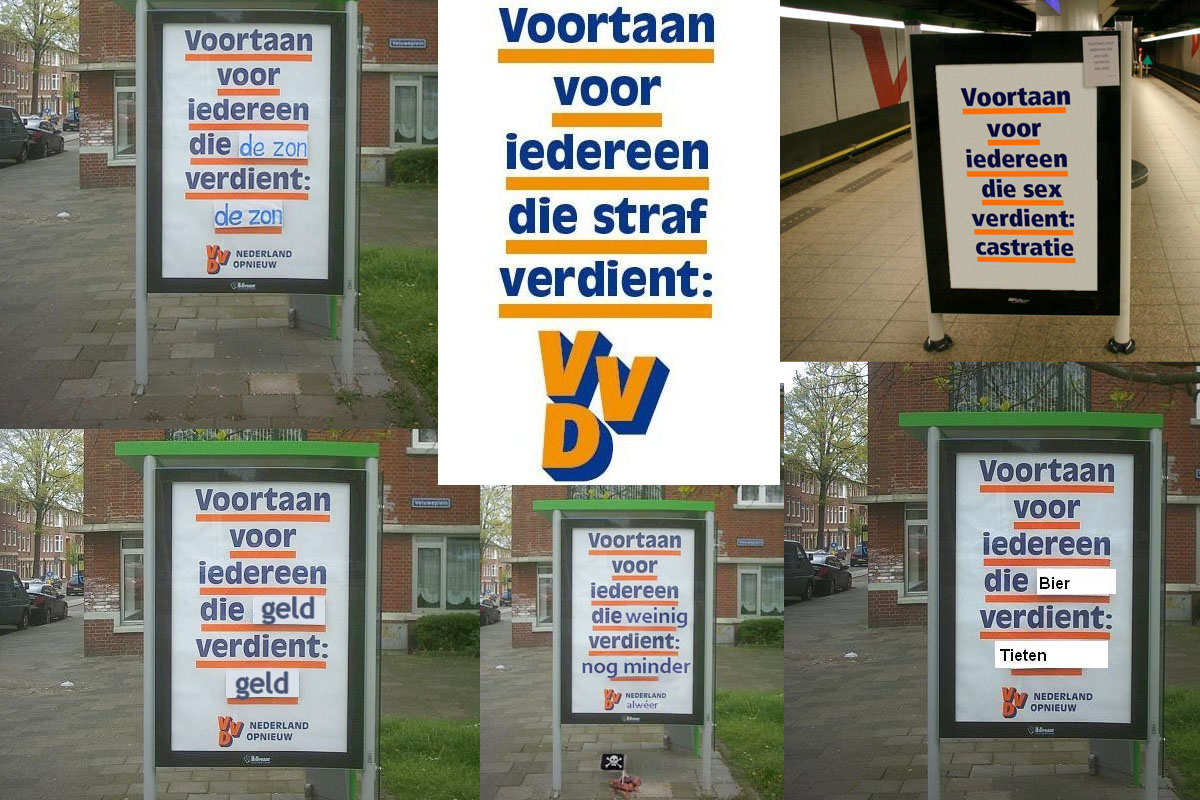
Since a week or so Amsterdam subway stations show a poster campaign by the Dutch liberal party VVD (the word liberal has everyweher in the world a different national/local connotation, I will explain later how one could read the Dutch word ‘liberal’ now). It is a text only poster with the following curious sentence:

From now on

for

everyone

that deserves (can also be read as ‘earns’)

punishment:

punishment
 

At the bottom of the poster the logo of the party is shown + two cryptic words: “The Netherlands once again” (Nederland opnieuw).
There is a flashing website of the VVD party where this, and other slogans for the European election campaign, are displayed. Interesting is that these posters seem to appear only in subway stations, bus-stops and the like, many of them providing a dreary frame for this typographic exercise that is supposed to collect votes for the liberal party. The VVD in full  Party for Freedom and Democracy (Partij Voor Vrijheid en Democratie) has been founded in 1948 and has her roots in de Vrijzinnig Democratische Bond (Liberal Democratic Union) which was founded at the beginning of the 20th century  and has at that time  actively campaigned for the right of women to vote and developed ideas of how the state should be an instrument to steer economics for the common good (so a derivation of classical liberalism). The party had limited influence in the inter-bellum and showed good democratic behavior during the Nazi occupation of the Netherlands. During that period links with the Dutch social-democrat party were forged, but at the brink of the cold war in 1948 a need for a new separate liberal party  was felt. The party held for decades some middle position in Dutch politics, being in and out government coalitions with social-democrats or christian parties. In the last decade with new right wing parties (in two cases split offs from the VVD) and neo-Dutch nationalist populism (mostly driven by islamophobia) the party had to compete with the Dutch New Right and has adapted their policies and slogans. Multi-culturalism (as practized by Dutch governments in the seventies and eighties of last century) has become a dirty word and hardliner rhetorics have found its way into Dutch political discourse.

The colors of the text and underlining (blue and orange) are in fact a historic reference to the flag of the Prince of Orange and also used by the Dutch rebels against the Spanish empire the Geuzen in the 16th century (Orange White  Blue (“Orange Blanche Blue”, or in Dutch: “Oranje Wit Blauw”/”Oranje Blanje Bleu”); the flag of the The Netherlands is Red, White, Blue). So one may ask if there is a suggestion here that us Dutch should go back to morals of the Dutch founding father, Prince Willem van Oranje? My first association seeing the poster was somewhat pleasurable I did read it as a SM reference with a slave waiting for the master to give a few pleasure whips, the master shouting “do you deserve punishment?” …. “yes master”…zackkk — “thank you master!” but that association faded away in a split second and gave way to other associations.

My second flash was of course  VVD party leader Rutte finally getting what he deserves, after years of running free, and I will not describe all the others that had to climb the scaffold of my imagination. In fact the poster faded from my mind within an hour or so, till the moment, last night, when I saw a short news item on local television of a lovely young lady taping over the words straf/punishment with the word ‘love’. The young reporter asked her why she was doing this and she answered that she did get such a dreary feeling of seeing these posters, especially in such depressing environments like the subway. She was light and joyful about her personal initiative and said she did it first of all for herself to wash off the bad vibes.

A quick check today did find of course a whole series of what the situationists call a ‘détournement’, a twist of meaning, without the authors having any idea that fifty years or so ago, some guys in Brussels thought up a theory of the ‘détournement’ as a cross-fertilization of pre-war surrealism and post-war lettrism. I just have thrown a few of these meaning twisters together, and one should differentiate between the real actionists doing it for real and the virtual activists limiting their activity just to their blogs.

For non-Dutch readers: zon = sun; straf = punishment; geld = money; verdient = derserves & also earns; weinig = litlle; minder = even less; bier = beer; and least: tieten = tits, the rest is international enough to be understood

For non-Dutch readers: iedereen = everyone; zon = sun; straf = punishment; geld = money; verdient = derserves & also earns; weinig = litlle; minder = even less; bier = beer; and ... last: tieten = tits, the rest is international enough to be understood


A bad taste remains even after seeing these often no-fun exercises twisting a party slogan around. Who is to be punished, how these punishments will be done, by whom? Is it a call for  liberal vigilantes to take to the street and catch those who “deserve to be punished”? Who will do the punishing and how? I can see nothing liberal and democratic in this unwise poster action, it thrives on rancour in general, it is much too unspecific to belong to any party political process. In short it’s a shame for what was once the Dutch liberal and democratic legacy.

At a most public moment, the opening of the Freedom-Day festival on 5 of May 2009 in Zwolle , Dutch prime-minister Balkenende claimed that the attack on April 30 in Apeldoorn was a an assault on the royal family. These are the words of Balkenende  broadcasted on Dutch television news on that day:

“This moment also we think back at last week thursday, at our queen and the members of the  royal family, because the assault was directed at them.”

This is said while several independent official investigations into the incident have been announced with the results to be made public in June this year. How is it possible that in a constitutional state, like the Netherlands, which claims to have independent courts and juridical procedures,  a prime minister gives his personal opinion on a criminal act (The Karsten T. incident)  at such a public ceremonial moment? He has created a situation whereby investigators and judges will be hampered in their tasks, because they may be forced to either contradict or approve the minister-president of the country on this case. The regular behavior in such case by members of the parliament  is that they say “I will not” or “I can not comment on something that is still in the hands of the court.” What we observe here is in fact unconstitutional behavior of the highest ranking politician of our country in a clumsy attempt to strengthen the constitutional monarchy. As the incident with Karsten T. can be explained in several ways and where doubts exist if it really was an assault on the royal family or not, such a statement may in the end weaken the position of the royal house and the victimhood which has for political reasons been imposed on them.

The broadcasted text spoken by Balkenende in Dutch was:

“Ook nu denken wij terug aan vorige week donderdag aan onze koningin en de leden van de koninklijke familie, want de aanslag was op hen gericht.”

Rifka Weehuizen, a researcher at the University of Maastricht of the joint realm of  economy and psychology, published an article today in one of the main dailies of the Netherlands De Volkskrant on the assault on Queens-day 30 of April 2009 in Apeldoorn, The Netherlands, by Karsten T. under the headline: “Of [the like of] Karst T. there are hundreds” (Van Karst T. zijn er vele honderden).  The author describes the common psychic features of people who do get unemployed and points to the fact that suicide of the unemployed is twice as high as with regular employed people. “The aim of a suicide mostly is to put an end to what is experienced as unbearable emotional suffering without a way out in sight.”  Weehuizen then sums up several common known factors in personal life, possibly in combination with personality dysfunctions, and rates them against the profile of Karsten T.. She also puts this in a wider perspective mentioning the effects of economic recession as expressed in an increase of unemployment, on mental health and a resulting increase of suicide, especially among men. She also points to the secularized society of the Netherlands where social contacts – especially of single persons – are derived primarily from the job circle. When a person loses income and has no job anymore it may result in a personal social and psychological disaster. Resulting loss of identity and meaning in life may lead to anger, aggression, being victimized, urge to revenge and loss of self-control. Weehuizen continues to argue  that such a dissatisfaction with the economical situation or society in general is too abstract for directing strong feelings against,  that under such circumstances the royal family  may have appeared to Karsten as a symbol, not only of  Dutch society, but also of people who appear to be rich, happy and loved; having everything the perpetrator was lacking. The focus of Weehuizen gets back now at the trajectory of the car of Karsten T. that ultimately crashed into an iron fence around a stone monument just after the moment the royal cortege in their special bus had passed a road with joyful bystanders awaiting an historical parade in honnor of the queeen. She proposes two interpretations of Karsten’s violent act: 1) the victims among the bystanders where just collateral damage standing in the way of his royal target; 2) they were part of his plan. Weehuizen comes to her end conclusion by stating that it is probable that the attack on this royal parade was nothing less and nothing more than [what in military terms are called ‘targets of opportunity’ (this is term is added by me here to clarify)] , that the objective could as well have been his former school, or former workplace.

Small picture of article by Rifka Weehuizen in De Volkskrant 6 of April 2009

Small picture of article by Rifka Weehuizen in De Volkskrant 6 of April 2009

You can also download the article in the orginal lay-out of the newspaper article (in Dutch) in pdf format via this link below (may take a while) d_vkkarttweeshuizen

Volkskrant
kop: Overval op Scheringa Museum: 2 schilderijen weg
Van onze verslaggever Harmen Bockma gepubliceerd op 01 mei 2009 16:39, bijgewerkt op 1 mei 2009 17:50 AMSTERDAM – Bij een overval op het Scheringa Museum voor Realisme in Spanbroek hebben meerdere personen twee belangrijke kunstwerken buitgemaakt. Het gaat om een gouache van Salvador Dali uit 1941 en een groot olieverfschilderij van Tamara de Lempicka uit 1929. Enkele gewapende mannen drongen vrijdag rond het middaguur het museum binnen en bedreigden de receptioniste en een bewaker. Ze liepen door naar een van de zalen in het museum en haalden daar de twee werken van de muur. Na de overval vluchtten ze in een kleine zwarte auto, vermoedelijk een Volkswagen Golf.
Dit bericht genereerde een woedende reactie van de specialist in museum-beveiliging Tom Cremers die tevens een goed gedocumenteerde web-site and email verzendlijst onderhoudt: Museum Security Network Ruud Spruit, directeur van het West-Fries Museum wordt door Cremers geciteerd:
“Dit is wat ik al jaren zeg: je kunt tonnen uitgeven aan beveiliging, maar
op een mooie dag lopen ze zo met een pistool naar binnen en plukken van de
wand wat ze willen hebben”

Armed robbers steal Salvador Dali painting from Dutch museum (May first 2009)
from an Associated Press release and some more musings in Dutch below.
The museum is called Scheringa Museum, after the wealthy Dutch banker with the same name that founded it. Curious detail is that the former director of this museum, Ruud Spruit, commented in the press with this sentence:
A robbery is quickly done nowadays, society did get so much harder.  Today at supermarkets you can get nothing anymore, the same for banks, and then it is the turn of museums.”
How was it that banker Scheringa amassed his fortune? Almost certainly in a legal way as this man thrives for years by his public exposure as chairman of the North Holland football club AZ (now national champion) and founder of  his own museum that is specialized in new realism forms of art. His name was mentioned last year in an academic conference of the University of Groningen on: “the Art Collector between philanthropy and self-glorification”, but also can be found on the web-site leugens.nl that claims to be searching for “the truth” (op zoek naar de waarheid). There we can read that the Dutch authorities have started (19/04/09) an inquiry into the practices of the DSB bank managed by Dick Scheringa, also known as “The-Quick-Promises-Bank” (De Snelle Belofte Bank). From several authoritative Dutch sources (NRC, TROS-Radar) can be understood that his bank was one of those too easy lenders involved in the creation of the financial bubble that somewhat has deflated in the last two years. All this generates associations like …
Museum-robber robs Credit-robber
and it was not me, but the American president Roosevelt who used another associted word: BANKSTERS, coined by Ferdinand Pecora, chief counsel to the US Senate Committee on Banking in 1929.

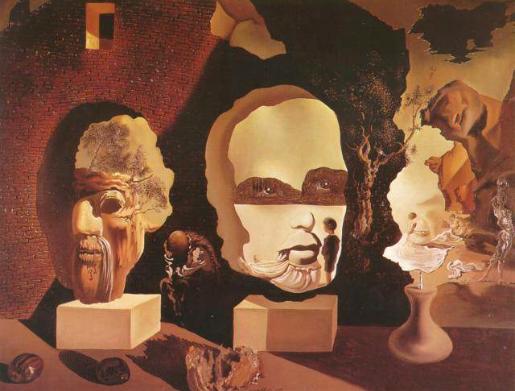
Dit lijkt de gestolen gouache of schilderij te zijn van Dali, alhoewel de datum niet klopt; het behoort tot een serie  over de stadia van het leven

This seems to be the stolen gouache or painting by Dali, though the date mentioned in the press release (1941) does not match... Dit lijkt de gestolen gouache of het schilderij te zijn van Dali, alhoewel de datum niet klopt; het behoort tot een serie over de stadia van het leven

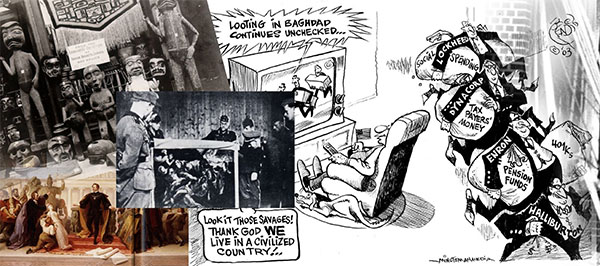
For a wide scope view on musems and looting see my 2005 visual scroll

Detail of visual scroll on the history of museums and looting for the ARCO conference in Madrid 2005 by Tjebbe van Tijen

Detail of visual scroll on the history of museums and looting for the ARCO conference in Madrid 2005 by Tjebbe van Tijen


In 2005 

Volkskrant
kop: Overval op Scheringa Museum: 2 schilderijen weg

Van onze verslaggever Harmen Bockma gepubliceerd op 01 mei 2009 16:39, bijgewerkt op 1 mei 2009 17:50 AMSTERDAM – Bij een overval op het Scheringa Museum voor Realisme in Spanbroek hebben meerdere personen twee belangrijke kunstwerken buitgemaakt. Het gaat om een gouache van Salvador Dali uit 1941 en een groot olieverfschilderij van Tamara de Lempicka uit 1929. Enkele gewapende mannen drongen vrijdag rond het middaguur het museum binnen en bedreigden de receptioniste en een bewaker. Ze liepen door naar een van de zalen in het museum en haalden daar de twee werken van de muur. Na de overval vluchtten ze in een kleine zwarte auto, vermoedelijk een Volkswagen Golf.

Dit bericht genereerde een woedende reactie van de specialist in museum-beveiliging Tom Cremers die tevens een goed gedocumenteerde web-site and email verzendlijst onderhoudt: Museum Security Network.
Ruud Spruit, directeur van het West-Fries Museum wordt door Cremers geciteerd:
“Dit is wat ik al jaren zeg: je kunt tonnen uitgeven aan beveiliging, maar op een mooie dag lopen ze zo met een pistool naar binnen en plukken van de wand wat ze willen hebben”  en “Een overval is tegenwoordig snel gepleegd, de samenleving is zoveel harder. Bij supermarkten is niets meer te halen, bij banken niet, dus dan komen de musea aan de beurt.”

Cremers reageert op zijn website en via de Museum Security mailinglist waar ik lid van ben met het o.m. volgende:
“Je moet maar durven als ex-directeur van een leeggeroofd museum. Dat museum, het Westfriesmuseum in Hoorn, kon worden leeggeroofd door wanbeleid van Ruud Spruit die stelselmatig verzaakte structurele aandacht te geven aan de beveiliging van zijn museum en daar zeker geen “tonnen” voor uit gaf. Had hij dat wel gedaan dan was die nachtelijke inbraak in zijn museum niet zo succesvol geweest ten koste van bruiklenen uit collega musea.”
 
Dit is vervolgens mijn reactie van wat meer afstand bezien:
Het is natuurlijk navrant dat musea die vaak een deel van hun collectie ontlenen aan roof en plundering – of hoe je ook vroege acquisitievormen van kunst- en natuurwerekn mag willen benoemen – daarna weer zelf object van beroving kunnen worden.

De Poolse kunsthistoricus Krzysztof Pomian (werkzaam in Frankrijk) gebruikt de term ‘semioforen’ over hoe door de collectie voorwerpen van hun gebruikswaarde ontdaan worden en hoe hun onzichtbare oorspronkelijke context een nieuwe waarde ruilwaarde op de kunstmarkt kan krijgen, waarbij dan nog de waarde van de  materialen waaruit zo’n semiofoor gemaakt is een eigen marktwaarde toegekend kan worden, wat dan meestal de vernietiging van het voorwerp inhoud: omsmelting van edele metalen, losbreken van edelstenen en dergelijke.
[De oorsprong van het Museum: over het verzamelen; 1987]
Pomian spreekt ook over het aan de handel onttrekken van zulke semioforen doordat ze permanent in een museum of andere (meestal overheids) verzameling opgenomen worden. Hoe groot de aankoopwaarde ook, die verliest haar betekenis als er verder geen handel meer is.

Ik ben jarenlang verzamelaar in overheidsdienst geweest, dan wel niet van kunstvoorwerpen, maar van documenten betreffende sociale bewegingen en daarbij was het beleid dat wat de conservator eenmaal  binnenbracht had van dat moment af aan altijd in de collectie diende te blijven. Zelfs ontdubbeling werd in mijn tijd nog als babaarse daad gezien aangezien dubbele exemplaren op de lange duur de collectie tegen vermissing door gebruik konden beschermen.

Dit laatste mag dan bij unica niet mogelijk zijn, maar het adagium “eenmaal over de drempel en er dan niet meer uit” geeft een grote rust en verminderd de handel in kunstvoorwerpen en daarmee ook de mogelijkheden voor handelaren die hun goederen middels roof verwerven.

Ik weet wel zeker dat op deze stellingname weer af te dingen valt want de werkelijkheid is oneindig meer gecompliceerd dan onze schemata waarmee wij haar proberen te controleren. Zeker is wel dat overheidsbeleid waarbij voorwerpen uit publieke collecties afgestoten en op de markt gebracht mogen worden gunstig zijn voor de niet-legale kunsthandel.

Vermindering van handel kan dan gezien worden als een diep liggende vorm van beveiliging.

Tjebbe van Tijen/Imaginary Museum projects 6/5/2009

This blog is a new place for my Limping Messenger web-pages of irregular and overdue comment that existed on my web-site of Imaginary Museum Projects for several years. It is my attempt to stop myself from cluttering my regular web-site with my regular urge to comment on actual and past affairs. Before uploading the old postal bag of  ‘the limping messenger’ I will start with reactions to the Dutch Queens Birthday, 20 of April, 2009.

Oranjelol/Orange Jinks: 1894 - 2009

Oranjelol/Orange Jinks: 1894 - 2009

Oranjelol (Orange Jinks!) is getting drunk publicly in support of the royal House of Orange, a yearly event in the Netherlands on April the 30th. This quick & dirty collage is made on ‘the day after’ the first of May, having seen the workmen cleaning the mass of debris left by the partying crowd in the center of Amsterdam, where I happen to live. The picture elements are from left to right: a drawing published in 1894 in the October issue of an early socialist paper “De Roode Duivel” (the red devil) by Louis Hermans (1861 – 1943) and reads: “Famous Temporaries: Lady Ka Flower Pot from Utrecht preparing herself for an Orange Jink (on the table a bottle of a cheap liqueur called ‘Orange Bitter’); next a mix of two Flickr photo-reportage pictures from the yearly Queens party on the Magere Brug (meagre bridge) over the Amstel river in Amsterdam with a drunken crowd and a blasting disco (2007; the parties look the same each year so why bother to find one for 2009?). Commentary in 1894 by Hermans on the Orange craze and the success of the Dutch new royals (the Kingdom has been established by Von Metternich’s Wiener Congress in 1814): “..an astonishing success, which can be understood easily because most members of the thinking part’ of the nation have as much brains in their head as the ass of the devil.”

The systematic policy of constant centering public attention on herself and her family by the Dutch Queen – who firmly believes “her task” is a godgiven one – showed yesterday (April 30 2009) its mirror side in the unwanted attention of a suicidal man who performed his yet unclear attack on an Orangist crowd and possibly the royal family – doing their waving from an open bus during a royal entry into the city of Apeldoorn. On the same day drunken crowds swarmed the street and canals of Amsterdam. In spite of the speed of news of modern media the public display of pleasure went on for several hours after the alleged attentat; the happy crowd wanted their party first of all. For the non Dutch – this alcoholistic euphoria is only a new tradition which has developed during the reign of Queen Beatrix starting in the mid eighties when supporters of the national football team manifested their support more and more through their public drinking habbits and dressing up in all sorts of orange paraphernalia. Critical distance as existed during the sixties and seventies toward a system of a hereditary kingdom, slowly evaporated. This was caused by the creation of a national football fever during international competitions: clad in orange and fed by endless amounts of beer. Commercial interests from beer companies and bar-owners combined with the acclaim of local authorities for this new Dutch nationalism which for them seemed to be a way out of the antagonizing effects of the multi-cultural society of the Netherlands. The partying under the orange banner seems to reunite what has been broken up.

A new national consciousness without any real political content, purely based on having a jolly good time together. When one observes the loud orange crowds pouring into the inner city streets of the main towns, one may smell other sentiments: this is suburbia taking over the city, you better join in and be happy with them and you better do not show any disapproval of the bad behaviour of throwing debris, public pissing, and shouting. I have not yet seen statistics on which percentage of the crowd is just merry and mellow and whether the aggressive ones are a mere minority. My impression is that the same group of persons may cycle during the day through all this behavioural stages depending on their intake of drugs, food and level of endurance during their pleasure drifting between the ultra loud music stages spread all over town. Just over half a million orange party-goers left thousands of kilos of tins, broken bottles and plastic cups all over town. Bar owners and free tstreet traders have made their big buck and leave their debris to the municipal workmen. Like real royals the orangist crowd have partied and left their shit behind for the servants to clean up. That is today the first of May, indeed a sad sight: orange Jinks!.

Just trying to move to a new version of Filemaker Pro 10 (not yet the advanced version) and I was confronted with some of my older codes that did not work anymore. Somehow the carriage return character is not recognized, or it may be that FMP 10 distinguishes between a new line ACII character (10) and a carriage return character (13) where it did not do so in earlier versions. It is a kind of odd, but maybe maybe it can be produced by the fact that I installed several language versions (including Chinese and Japanese) of this Filemaker 10 (?).

Anyhow this is the new code I did write, which I have to post here as an image file because of another annoying shortcoming of FMP the impossibility to copy and paste code as text (or at least in the non-plug-in version of it).

This is the work-around I came up with… There is one special character that was very naught the non-breaking space character used in html, which translates to an invisible character in my routine (A combined Applescript and Javascript) with which I grab blocked text from a web page… For that one I could not find an equivalent in ASCII so I just pasted it in the code (which shows up as if nothing is there)…

AMsSnoteStripperYou can click the code to see it full size.

A solution for generating emails with attachments from Filemaker Pro was needed by me… I has some problems with having unqiue name file attachments, but found a way around thanks to FM Forums.

I start with the question that was similar to mine, still I needed another solution and found one bin the following way:

07/29/09 01:33 PM – Post#337047 – Post Rank:

I’m trying to send a series of emails. Each email has a different .mp3 file attached to the email … each .mp3 is referenced to a container field (Insert QuickTime) … one container field per record. Is there a way to do an email file attachment using a calculation? It seems like the “Send Mail” script step only allows one specific file to be attached to all the emails.

==========
I came to this question because of a similar question and the answers were almost right for me, so I like to add this tiny thing to it:

A stupid thing with Filemaker is that you can noy expirt a script as text (uinless you buy somewhere a special plugin for that); so I made a screenshopt for those who are desperate enough to see the code, instead of having it explained in writing about it. So clisk picture to see it full size; also the code viewer does NOT have a soft wrap function so you need either a big screen or you have to pan the screen shot across...
A stupid thing with Filemaker is that you can noy expirt a script as text (uinless you buy somewhere a special plugin for that); so I made a screenshopt for those who are desperate enough to see the code, instead of having it explained in writing about it. So clisk picture to see it full size; also the code viewer does NOT have a soft wrap function so you need either a big screen or you have to pan the screen shot across…

Fenton wrote:

A FileMaker syntax path can be seen in the Help, and also at the bottom of all of those dialogs. In this case you’d use an full path, which might look like:

$filemac:/Macintosh HD/Users/fej/Desktop/some file.mp3

This was almost clear to me, but I had to do some try & error before I figured out what Fenton actually meant.

It is about the $ that indicates a local variable and which should not be made part of the file path string.

$filemac:/Macintosh HD/Users/fej/Desktop/some file.mp3

May suggest that the $ sign is a part of the file path string, but it is NOT.
This can be obvious for people working daily in FMP programming, but I am a user who comes back to this program only from time to time and always had had [problems with refined understanding of syntax… I need just a simple clear example.

So let me give one such an example here, so other “dumbos” like me may profit:

I use the script step: Set Variable and give the following calculation

$EmailAttachmentPath =

Substitute(AMSnote::gAttachmentFolderFilePathX; “/Volumes”; “filemac:”)

In my global field

gAttachmentFolderFilePathX

I have stored a calculated file path and name that includes a folder on a certain hard disk volume (I use InsideScan plugin for storing this and that plugin gives by default the file path in the format /Volumes/… etcetera)
As I am not yet sure whether or not FMP 10 want the file path formulated as [b]filemac:[/b] or with the [b]/Volumes[/b] format I just reformatted the folder path name to be the same as in the example by Fenton.

Almost there …

So then in the [b]email script step[/b] I simply enter as the attachment the string

$EmailAttachmentPath

… and that works perfect.

I have chosen thjs way of working as I am first exporting the image I am attaching to an email to a directory that is stored in global field and want the names of the attached image files to correspond with the unique indicators of the fields in my database (I use sets of repeating fields to store my data).

Last I keep wondering why in newer versions of Filemaker the option of a variable file attachment is not included. Now we have something that is in fact such a function, but seems to be more of a workaround (so freuqnetly needed in Filemaker… which I use for over a decade now).

It started of with stripes (horizontal lines mostly) on my 30 inch Mac monitor; next came freezes out of “nowhere” it seemed, often occuring when a heavy graphic duty needed to be performed (like the unnecessary but elegant  animation of  a window on your screen being put into the Dock); then more freezes especially while using Adobe Photoshop 3; etc..
The culprit turned out to be the graphic card: ATI Radeon X1900 XT . The reason overheating of the card, or better said bad cooling. Not enough air coming in, so dust.
atiradeonx1900xtfirmwareupdate_20071016142010Opened up the G5, made from a piece of cardboard a sucking device that fitted my home vacuum cleaner and took out an awful  lot of dust. This helped a bit; but soon the problems reoccurred and this time more frequent. Now this is the lesson: I started to look for other causes than the graphic card… spending a day or so on this exercise. That was wrong. The card must have been damaged because of overheating in an earlier stage, still functional up to a certain level and I mislead myself looking for another source of trouble.

The “proof” is when the earlier mentioned freeze midway of the animated trajectory of an open window on the desktop to the Dock halts midway. That is a hardware failure of the graphic card and nothing else.

I ended asking my dealer to get me the same graphic card to test is and YES all problems were gone.

One of the sources that put me on track was at Apple Discussions

mouseprefs-708699
Action: turn the mouse on its head. Have a piece of soft cleaning cloth (no liquids) and softly turn around the small scrolling knob in all possible directions. The grease and other stiff from your fingers will thus be removed and the mouse starts working again…

Thanks to MacRumors Forum

Visualizing information, a short lecture on the basics, for the exhibition InfoArcadia on information-design in Stroom Center for the Visual Arts, The Hague in the year 2000 (21 designer-artists from 6 countries.). An exhibition curated by Ronald van Tienhoven en Maarten de Reus.

Language is Dutch with English sub-titles. The video is posted on Vimeo.

a composite photograph of what became a remarkable event in its time

a composite photograph of what became a remarkable event in its time; click picture for full size view

I was not a part of this “crowd” at that time, and can identify only a few of the people by name:
-first row after Phil Bloom: (?), Johnny van Doorn, Simon Vinkenoog, (?);
-second row idem: (?). (?). (?), Reineke Vinkenoog, (?), (?).

Some more names and reminiscences would be nice…

A picture showing many people of the VPRO Hoepla crew can be found in several archives, but as far as I know all the names have not been kept for posterity. Such pictures are rather rare and even the website of the photographer Cor Jaring lists only the obvious ‘happy few’ in the crowd. I managed to catch somewhere a reasonable resolution copy of the picture and have nicely numbered all the people (one person is hiding behind a pillar). As the blog software does not allow to insert a special zooming software page. I will make a link to my archive-website. Finding out more names (and of course what their role was) would be nice. My impression is that the equalitarian mood of the time allowed for the porter and the coffee ladies to be included as well … would be nice to reintroduce such a habit again. Click the picture below to go to the external link…

HoeplaStatieFotoJaring


PhilBloomBoat1967

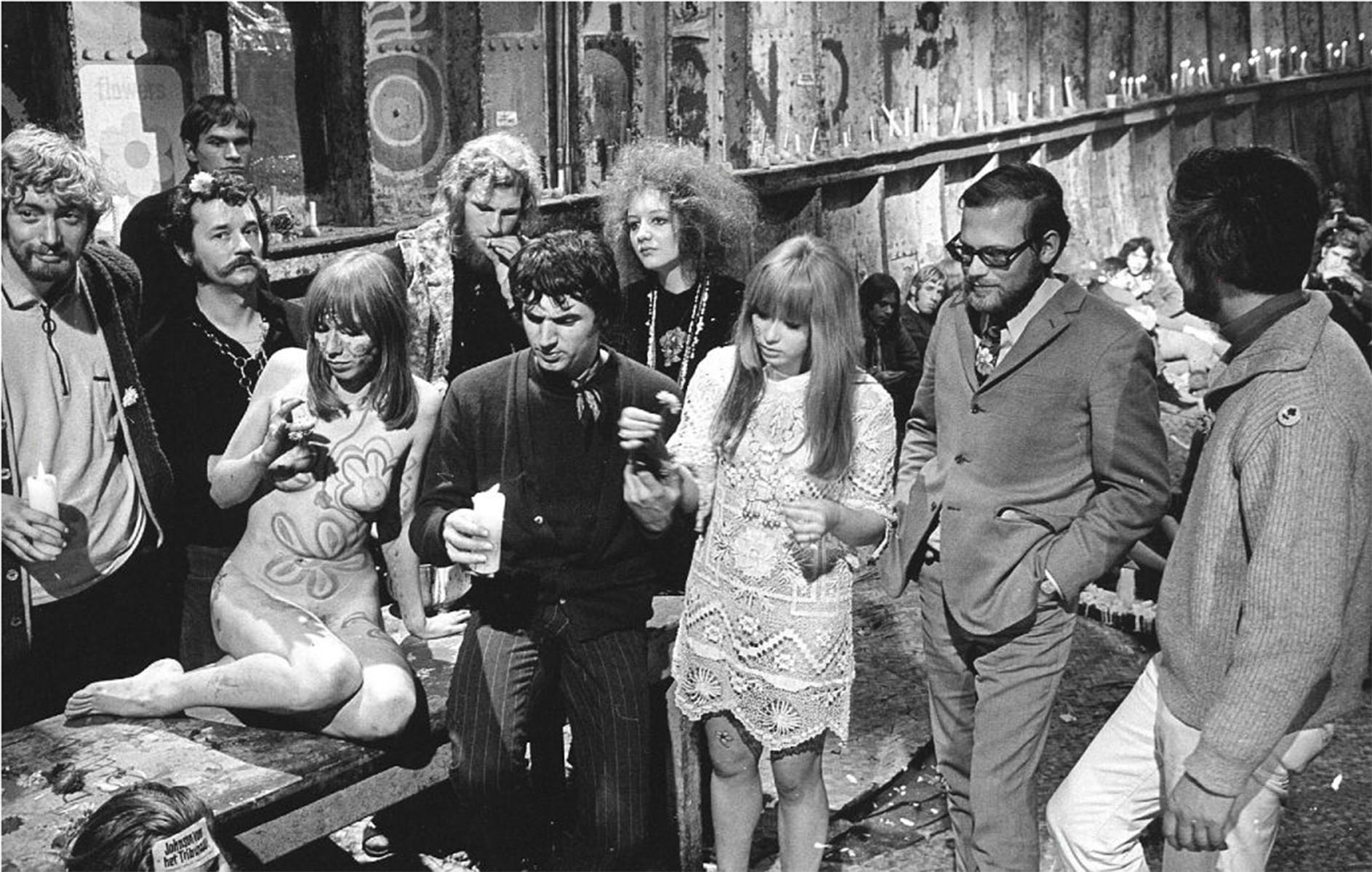
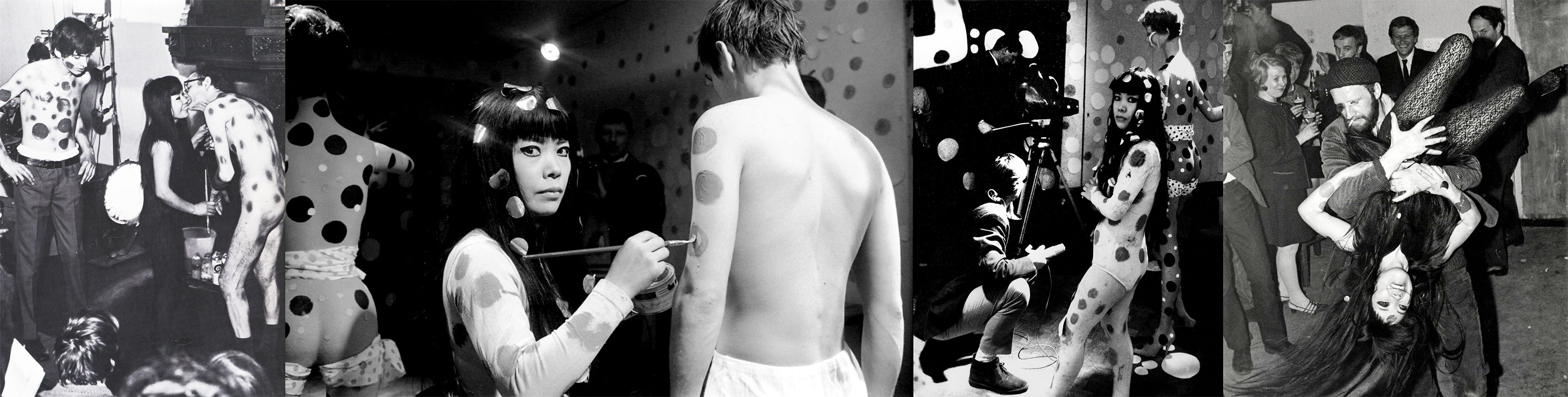
This photograph shows Phil Bloom in a less known setting, a boat, possibly moored in some waterway in the Dutch town of Dordrecht, whereby the date seems to be October 29, 1967. It is 1967 for sure as the man with the “artistic” small scarf around his next to the right of Phil Bloom is Matthijs van Heijningen with whom I shared in those days the small office space in the Sigma Center in Amsterdam on the Kloveniersbugrwal (Matthijs is a movie producer now). As far as I remember Matthijs – who was married with Roos at that time  – was charmed very much of Phil and if I am right they ended up living together for some time later on. Also on the forehead in the left under corner one sees a person with a sticker on his/her forehead that reads “Johnson voor het Tribunaal”, which point to Lyndon B. Johnson American president who was accused of war crimes by peace and left activists of that time. It is just after the world wide (Western world to be precise) ‘flower power’ summer of 1967, so the body painting confirms that. Now I was not there, but my guess is that this ‘happening’ must have been an initiative of the Dordrecht Provo-movment of that time, with one of its activist being Joop Wilhelmus. They were publishing a magazine called Gnot for which Pieter Boersma and me once made a small photograph reportage of a ‘continuous drawing’ system, including drawings in the snow and on – also – a naked lady, being Saar Stolk. This was the time of us male “sexists” being dressed ourselves while painting on nude ladies (though there was in the same time a Japanese artist Yayoi Kusama who was painting colorful dots everywhere including on men who agreed to strip naked in public, as happened during some show of her in the Netherlands with the far from macho body of – if  I remember it correctly – Jan van Schoonhoven/Nul-groep).

— interlude Jan van Schoonhoven – – –
I just did a a quick search and here we are into the power of  Boolean logick combined with modern computers through smart indexing techniques… out comes a nice text in PDF format with this quotation on Jan van Schoonhoven:
“Who was this man, who one day spontaneously let world-famous Japanese artist Yayoi Kusama paint his nude body with Polka dots to appear the next day neatly dressed at the office?”
source is “HOW JAN SCHOONHOVEN – THROUGH AN ACT OF FAITH – BECAME A FAMOUS ARTIST.”

A bit more of research just for my personal ‘divertimento’. The catalogue of the exhibtion “Actie, werkelijkheid en fictie in de kunst van de jaren ’60 in Nederland” (action, reality and fiction in the art of the sixties in the Netherlands), Museum Boymans van Beuningen Rotterdam, 1979/1980, has a short description on the Yayoi Kusama & Henk Peeters artistic exchange. The event took place in Delft in the Novum Jazz Society and was a celebration of a price Jan van Schoonhoven did get at Biennale of Sao Paulo (1967) with an exhibition of his work in the Gemeente Museum Teh Hague and the Ortiz Gallery in the same town. Afterwards a party was thrown in the nearby town of Delft. Yaoi Kusama is one of the guests and she performs her trade mark happening of that time: painting fluorescent color dots on male bodies. Jan van Schoonhoven undresses almost completely (leaving his socks on – the well known male flaw of making one self look ridiculous) . Some younger men only bare their chests or keep as a last resort their  white (Tilanus) panties on. The first picture on the left is by ‘Fotobureau Den Haan’, photographs two and three are by my friend Pieter Boersma and one can see that the event has been filmed as well. The last photograph came up in a search of the Spaarnestad Photo Archive (photographer Theo van Houts) and has an apparent wrong caption, it identifies the ;wild man’ dancing with Yayoi as Jan van Schoonhoven, who has – as e can see in picture one – a complete different posture.
There are two press articles related to this event which I need to delve from some archive yet: Betty van Garel in the Haagse Post (11/111/67) “De bandeloze liefde van Kusama”  (The boundless love of Kusama; and A. Wagenaar in Vrij nederland (2/12/67) “Yayoi en de blote mannen” (Yayoi and the naked men).
KusamaSchoonhovenDelft671103
— end of interlude —

My guess is that Joop Wilhelmus is also somewhere in this picture (is the fourth person from the left with the blond curly hair?) Joop did get very fat later so I am hesitating here. He was the founder of one of the first no style sixties sex-magazines called “Chick” and maybe one of the other ladies has been involved in that emancipatory project also. It was almost half a decade later that the Dutch feminist movement started to demonstrate against porn (with some actions involving public burning of porn magazines).

The picture has been made press photographer Dick Coersen (ANP, the main Dutch Press Photo Agency in those days). I could find little information about Coersen apart from the fact that he has held this profession for several decades and has been w while the chairman of the association of Dutch press photographers.

This photograph has hardly been documented though it is an entry point to several personal stories that met for that one odd moment in autumn 1967. What was the ceremony with the candles? How does flower power relate to the anti-Vietnam war actions of that time? This last question I know something about because I remember some pamphlets by the Action group Vietnam in which the Amsterdam family Hofman (Hans and Tini) was very active that also had in these months simple drawings of peace signs and flowers.

Any information will be welcome ….

———-
An answer came in through a Facebook posting I did from the person who is the central focus of this photograph: Phil Bloom… it is a set photograph during the making of a movie “Professor Columbus”, directed by Rainer Erler, written by Rainer Erler and Guido Baumann and poduced by Rob Hauer. It was a German production, released in May 1968 in Germany and in the Fall of 1969 in the Netherlands whereby tow Dutch titels are mentioned: “Alle hens aan dek” (All hands on deck) or “Laten we lief zijn voor elkaar” (Let’s be nice (give love) to each other). Knowing this it was easy to find refrences in the on-line information sources on movies. So this is one of the summaries of the plot:

“A scholarly library researcher inherits a steamship from a distant relative. The mild-mannered man is compelled to sail away to fulfill his lifelong dream of adventure on the open seas. He arrives at the boat to find it is being inhabited by a group of hippies. He and the psychedelically inspired crew set sail for a mythical port of paradise in this only slightly amusing comedy.”

and this more extensive viewer’s account:

“‘Professor Columbus’ is an old librarian, played by German movie veteran Rudolf Platte, who just wants to go to the sea once in his lifetime. So he buys a big ship and takes a boat trip across the North Sea to London, accompanied by a bunch of stoned hippies and chased by the police.When you read this short description, you might guess that this German movie was filmed back in 1968. There is no real plot at all, but it’s rather a collection of slapstick and improvised scenes. The main focus of this early film by German seventies cult director Rainer Erler (“Das blaue Palais”, “Fleisch”) was to show what’s possible beyond the limits of a conservative society – a typical topic of the late sixties like film experiments, mind expansion via drugs, sex, inner journeys, happenings, etc.In that relation, this movie might be an interesting example to watch (especially a really weird hippie drug orgy on the boat), but otherwise you will get bored soon after a few minutes. Watch out for Dutch actor Jeroen Krabbé (“The Fourth Man”, “The Living Daylights”, “The Fugitive”) in one of his early roles, and for Dutch actress Ankie van Amstel as a bare-breasted, carnaby-street-like dressed girl digging coal into the boat’s steam engines. Unbelievable!!”

The movie flops and is not something that is proudly presented by those involved. The Dutch Wikipedia page of producer Rob Hauer does not even list this production of him. From a historical viewpoint I am still curious to see it once, to study the representation in its time of the phenomenon of “hippies” and “flower power”. As such it fits in a further interest, which is the commercialization of hippies and flower power – as its original impetus was anti-commercial. Recuperation can not be escaped that is for sure…

Something more about related boats in those times …
One of the original inspiration sources for the “Professor Columbus” movie must have been the provo-boat, bought by Hans Tuynman end 1966 (or was it beginning of 1967) a core figure of the Amsterdam provo movement, who had been imprisoned for  two months and wrote a book on this experience and his experience as an activist in the Provo movment. The book called “Full-Time Provo” was published by the lietray publishing house ‘De Bezige Bij’ and had a reasonable success (a few editions saw the light). From the money eraned with the book Hans Tuynman bought an old river freight ship which was moored near the Haarlemmerstraat in Amsterdam and soon became the new headquarters of the provo movement. It is said that another Provo, Duco van Weerlee, who published at the same publishing house a booklet under the title “Wat de provo’s willen” (what the provos want) also helped with his his author earningswith the buying of the boat.

Aseries of pictures of the Amsterdam Provoboot "De Witte Neger" which was mostly parked next to a lock at the Korte Prinsengracht next to the Haarlemmerstraat. The name was taken from the African art gallery of Tom Bouman "De Witte Neger" on the same spot in a cellar that also functioned as a rallying point for the provo movement (provokelder). There have been some hostile actions against the boat and its inhabitants with one incident whereby the ship hatches were thrown in the water. Luud Schimmelpennink who had diving equipment managed to salvage them.

A series of pictures of the Amsterdam Provoboot "De Witte Neger" which was mostly parked next to a lock at the Korte Prinsengracht close to the Haarlemmerstraat. The name was taken from the African art gallery of Tom Bouman "De Witte Neger" on the same spot in a cellar of one of the houses at the lock that also functioned as a rallying point for the provo movement (provokelder). There have been some hostile actions against the boat and its inhabitants with one incident whereby the ship hatches were thrown in the water. Luud Schimmelpennink who had diving equipment managed to salvage them.

A few years later yet another hippie-boat theme movie also related to the Netherlands saw the light” “Sweet Movie” by the Yugoslav director Dusan Makavejev released in 1974, described as a “taboo-busting” and “art house” movie combining the sexual with the political. It uses action-art elements and non-scripted imrpovised parts involving people from the Austrian commune started by Otto Muehl with their “Selbestdarstellung durch Materialaktion” (self-realisation through material action). I remember the movies of Muehl and other members of what was at that time the group ‘Wiener Aktionismus’, with Hermann Nitsch (Das Orgie und Mysterie Theater, katharsis like enactments involving slaughtered animals and naked bodies), Günther Brus (the most artistic and painterly of the group), Kurt Kren (mostly an experimental filmmaker) and happeninsg artists and photographer Rudolf Schwarzkogler (who is sen by many as the most original creator of this radical and provocative artist group).

A selection from small size bad quality p[ictures related to "Sweet Movie" of Makajevev that can be found on-line

A selection from small size bad quality pictures related to "Sweet Movie" of Makajevev that can be (still) found on-line.