Feeds:
Posts
Comments

Archive for the ‘Uncategorized’ Category

EGYPT: holidays extras ((updated version):

bombed or shot down tourist airplane; bullets fired at tourist bus; attackers with knifes in Red Sea beach hotel…

References: http://www.bbc.com/news/world-middle-east-35268713

EgyptHollidays2

Of course the iconic silhouette of Egypt could be replace by that of Tunisia, Syria, Yemen, Mali… except for the pyramids.

Exclusive mass-mobility for the affluent (a relative economic term, a lower middle class person can be “rich” elsewhere) always had it’s side-effects. The targetting of tourists is not an ISIS invention, it is a constant since the beginning of organised leisure travel. Mass-media combined with the new form of low-fare mass-travel do give it another dimension. What it lays bare as well is the economic structures of countries under attack, the problem of their (growing) dependancy on tourism, the social-economic division in the tourists countries themselves, those that profit, those that suffer. The impact on culture, habitat and environment geared to produce short-term profits.

We may well also consider reflecting on what makes up the demand & supply of the tourist industry. How dissatisfied are those mass-tourists with their local environment and life…. why it is that they like to play ‘king’ elsewhere, while abiding with their social status at home. Is the last thing not a deep structural meaning of the whole phenomenon of tourism, or is there also a genuine interest in how people live elseweher? The luxury “high security” (sic) ghettos of our days, which most of the mass-destination tourist resorts are, answer the last question.

If there is a vision on tourism of those who are trying to establish a new caliphate under the reign of ISIS-leaders is not clear to me, or it must be a special tour to the remaining debris of historical monuments blasted and looted by the troops of the new caliphate.

This brings to mind the observation that many of ‘historical monuments’ have been erected on the fundaments of preceding cultures, religions and reigns, with the reuse of older materials in newqer constructions. The academic term for this is ‘spolia’. Examples are the Al-Aqsa mosque on the Temple Mount in Jeruzalem (an almagate of building materials originating from times of Judaism, Roman rule, Crusaders ending up as a mosque under Umayyad Caliphs in the 7th century), the Cathedral and/or Mosque of Cordoba (starting off as a Roman temple for the god Janus, turned into an early Christian church by the Visigoths in the 6th century, changed into a great mosque by the exiled muslim rulers from damuscus the Umayyafs in the 8th century and becoming a christian church once more after teh Reconquista of Islam Spain in 1236). The Hagia Sophia in Istanbul was at first a Greek Orthodox cathedral, until it’s reconstruction as a mosque by Sultan Mehmed II in 1453.

Now Islamic State of Iraq and al-Sham (ISIS) with their declaration of a new caliphate see temselves treading in the footsteps of other great Muslim conquerors, one of the most famous being the beforementioned Sultan Mehmed II, who as far as destruction of historical monuments of infidels go, did the opposite… he just recycled a Byzantine christian cathadral into a mosque. Would that mean that The Hagia Sophia (now a Turkish state museum) will become the future destination for a new form of caiphate tourism of the ‘umah’ travelling en masse to Istanbul…. The excerpt form a recent article on how some Turks see their realtionship to ISIS explains this idea…

Al-Monitor, a well established Middle East news source, published an article on November the 14th 2014 under the header”Turks increasingly sympathetic to Islamic State”, from which I take the following quotation:

“The caliphate is not a recent issue for some Muslims in Turkey. A global Islamic organization, Hizb ut-Tahrir, which was established in 1953 and has branches in 50 countries, has been openly calling for a caliphate. In an interview with Al-Monitor, Mahmut Kar, the head of Hizb ut-Tahrir’s media relations in Turkey, explained in detail not only how his organization views IS’ decision to declare a caliphate but also its own struggle for a caliphate.

Kar said, “[Hizb ut-Tahrir] was established in 1960 in Turkey and when we started speaking about the caliphate in 1967 it was the first time the word had been brought back into Turkish public space since 1924. Once the idea of a caliphate was out in the open again, Islamist movements in line with the Muslim Brotherhood started emerging in Turkey.”

(…)

He (Mahmut Kar tj.) emphasized that for the “ordinary” Muslim and non-Muslim the association of the caliphate with IS has been detrimental. “As the world is leery of IS violence, the caliphate is now associated with blood,” Kar said. Yet, for those who had been living with the dream of revival of the caliphate, IS could be a promise.

http://www.al-monitor.com/pulse/originals/2014/11/turkey-growing-support-for-isis-caliphate.html#

Even when ISIS blasts away the Haia Sophia because of its christian origins, it may well become a destination for another  – growing – part of tourist ondustry: ‘disaster toruism’ also called ‘dark tourism’. Apart from the Great Chinese Wall (which has the skeletons of generations of enslaved labourers in its fundaments) despotism draws great crowds, be it the Nazi KZ’s, the Gulag, or the Red Khmer execution fields….

Read Full Post »

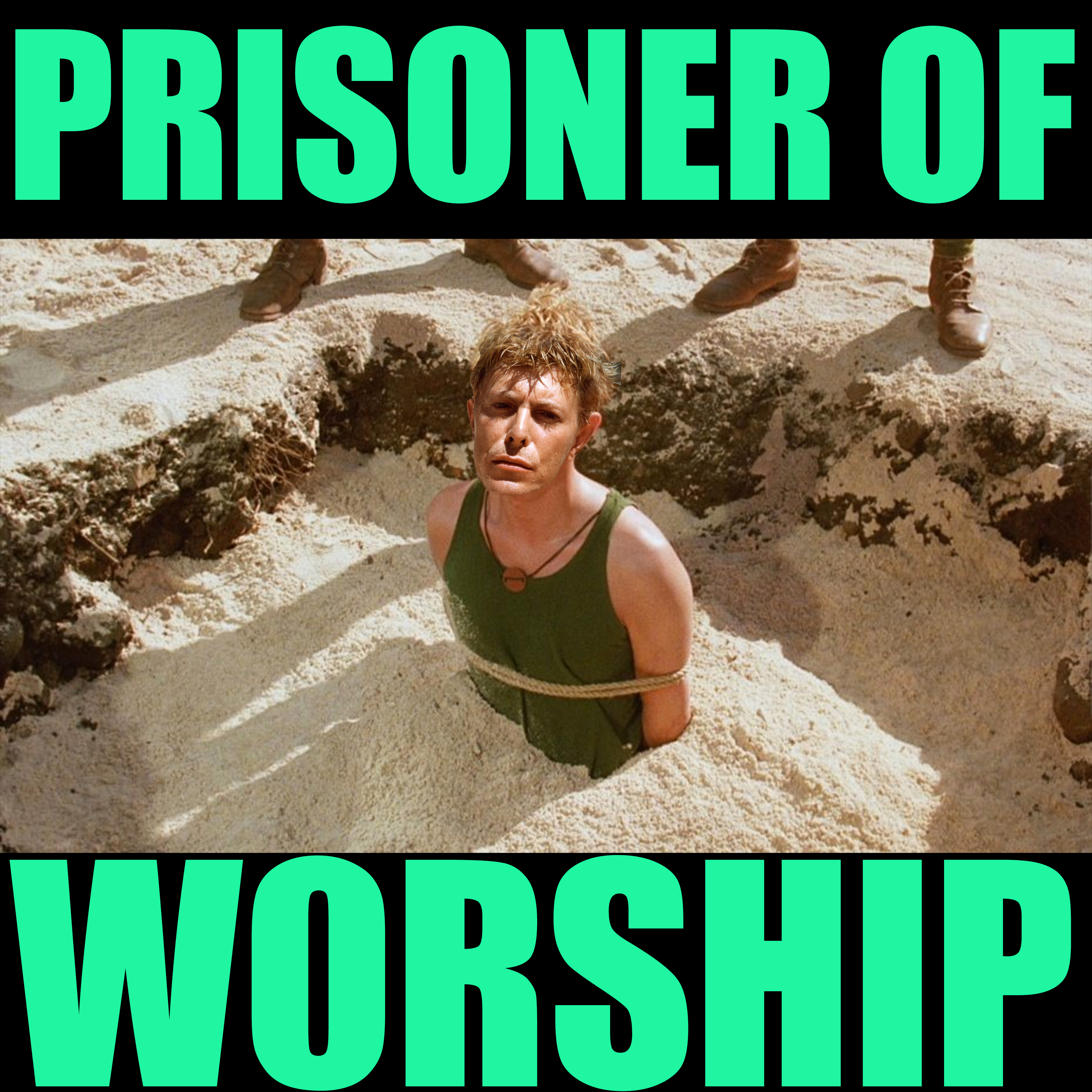
POW – DAVID BOWIE – Prisoner Of Worship
DavidBowiePrisonerOfWorship
Last night Dutch television VPRO channel broadcasted an odd movie on British soldiers in a Japanese POW (Prisoners of War) camp. At first I could not figure out why this movie (“Merry Christmas, Mr Lawrence” (1983; also known in many European editions as Furyo (俘虜, Japanese for “prisoner of war”) was shown a few weeks after the yearly tsunami of those unbearable stupid & bad Christmas-time movies, as this certainly was not masterly cinema…
Then it transpired that one of the characters in the movie was David Bowie, so the movie was broadcast as a homage to the deceased. No great photography, no great plot, no great acting, odd yes, that it was. The movie, a British Japanese co-production directed by Oshima Nagisa, was of course 90% fictional and what was left of depiction of war reality of a Japanese POW camp, was meagre indeed. It does not even inspire me to check the two novels (merged into one) of the South African British writer Laurens van der Post (1906-1996) “The Seed and the Sower”, whose long and complicated life story is certainly more interesting than the the derived product of this movie which references Van der Post his own experiences as a British officer in Japanese custody on Java during WWII,
Interesting is to not that the fame of Laurens van der Post during his life time did get partly overcast by the discovery/disclosure of his real life after his death. Biographers found his trait to be ’embellishment of his own deeds’.
This fits well with the biography of David Bowie and the battalions of hagiographers that swarm our social media these days, glorifying his art of eclectic plagiarism (recognised by himself in his often quoted ‘bringing high art to the street’).
Maybe his role as a Prisoner Of War (POW) symbolises the relationship between Bowie loving individuals – conflated into a mass audience – that act like ‘camp commanders’ imprisoning and commanding “their” cult hero, forcing him to respond to their greed for ‘novelty’,  thus burying him – when still alive.
Bowie was a ‘nipponophile’ early on. Kabuki theatre with it’s grotesque stylised forms of dance and make up is one of his inspirational sources. His role as an actor in a movie directed by Japanese author can thus be explained. Let me end with quoting the Dutch author – with a good Japanese education – Ian Buruma, writing about this movie and Bowie’s role in in it, as part of a review of the book “The invention of David Bowie” published in the New York Review of Books in 2013.
“Filmmakers used Bowie’s alien androgynous quality for their own purposes and enhanced his reputation for strangeness. Bowie’s best-known film is Nicolas Roeg’s The Man Who Fell to Earth (1976). In this science-fiction story, Bowie plays a man from another planet who lands in the United States to become first very rich and then an alienated alcoholic obsessed by television and imprisoned by government agents in a luxury apartment. What Roeg exploits is not Bowie’s acting ability, which is ordinary at best, but his image and his body language, his genius for posing.
Oshima Nagisa did something similar in his movie Merry Christmas, Mr Lawrence (1983), based on a Laurens van der Post novella about the experience of a British army officer in a Japanese POW camp during the Pacific war. One way—the banal way—of doing this would have been to make it into a manly story of rugged endurance. Oshima’s idea was to cast Bowie as the officer and the Japanese pop/rock musician Sakamoto Ryuichi as the cruel camp commandant. Both pop icons are equally androgynous in their own ways—Sakamoto wears makeup. In the climactic scene of the film the British officer tries to disarm his enemy by planting a kiss on his lips, an act for which the blond hero then has to undergo some ghastly tortures. Again the acting is only so-so, but the posing, the “look,” is brilliant.”


Read Full Post »

FrankrijkRegionaleVerkiezingen2015 Roulette democracy in France once again…

… the departmental/region elections of December 2015 with it’s rise of the Front National in the first round and the media-demise of the same party in the second round, whereas the Front National gained 800.000 votes in the second round, and the Socialist Front gained just over 200.000 votes the second time.

What we see is a an election system that strives for a contest between two major parties, neglecting all other shades and colours of opinion. It is used for the presidential elections, as well as for de departmental ones. It dates back to what some call the ‘legal coup-d’état’ of the Fifth Republic by general De Gaulle in 1958. This changed a more full parliamentary system with a system with more central power executed by the president. It was triggered by the crisis France found itself in with the Algerian War and internal political strive, at the edge what some called ‘a civil war’. The aim of the Fifth Republic was ‘majority rule’, throwing out all ideas of more party coalitions, of proportional representation, of government by any form of consensus.

I will not explain here the vicissitudes of the so called binomial electoral system, it suffices to know that it has been implemented recently by countries trying to get out of a history of dictatorship like Chile and Poland. A system that may be of use during an initial period, but which – over longer time – hampers the very thing it claims to implement: parliamentary democracy.

This morning I was driven to make this info-graphic as I could not make good sense of all the comments, statistics and incomplete electoral maps I was presented with (both in French and English language newspapers).

On my mind was the first round of these elections – that also served as a test of the popularity or unpopularity of the sitting government of the ‘socialists party’ lead by François Hollande. As was to be expected the first round saw a great gain of the non-governing opposition under Marie Le Pen, her niece and some even more far right parties associated.

Next was a week of state propaganda against the Front Nationale… even while this party (if we like it or not) became in the first round the third political force in the country, nearing the socialist bloc in number of individual votes. Le Pen was not even invited to sit at the desk of the national/state television news after her success (imagine the reversed situation…). Everything was mobilised during one week to prepare for the second round with plenty of (state) media-space for the anti Le Pen camp and see, the Front Nationale did not loose votes, they gained 800.000 or so. Now the bad surprise of this semi-dictatorial system of binomial elections made it that the Front National (as a third political force in France) did not come back in any of the combined-departments/regions. The ‘bi’ polar system eliminates major players on the field.

What to think about such a system? What about the electoral force… how they can have any direct influence in such an abominable system?

It suffices to check out who did give their mandate for this new political departmental region constellation. It appears that roughly 50% of the electorate did NOT vote and half a million in the first round and three quarter of a million in the second round decided to give a blank vote.

So is all this ‘representational government’? It is not. Even when one dislikes or abhores the Front Nationale, one should keep up minimal standards of democratic respect for those playing in the election games.

Now the rules of the election games’ themselves should cone up for scrutiny. As it is now with the binomial system (*)  I give it the name:

ROULETTE DEMOCRACY — rien ne va plus.

statistical date source: 
Élections régionales françaises de 2015
https://fr.wikipedia.org/wiki/Élections_régionales_françaises_de_2015

(*) A useful introduction to the impact of ‘two rounds’ voting and the ‘binomial election system’ is on the site of ACE-electoral knowledge network: http://aceproject.org/ace-en/topics/es/onePage

Read Full Post »

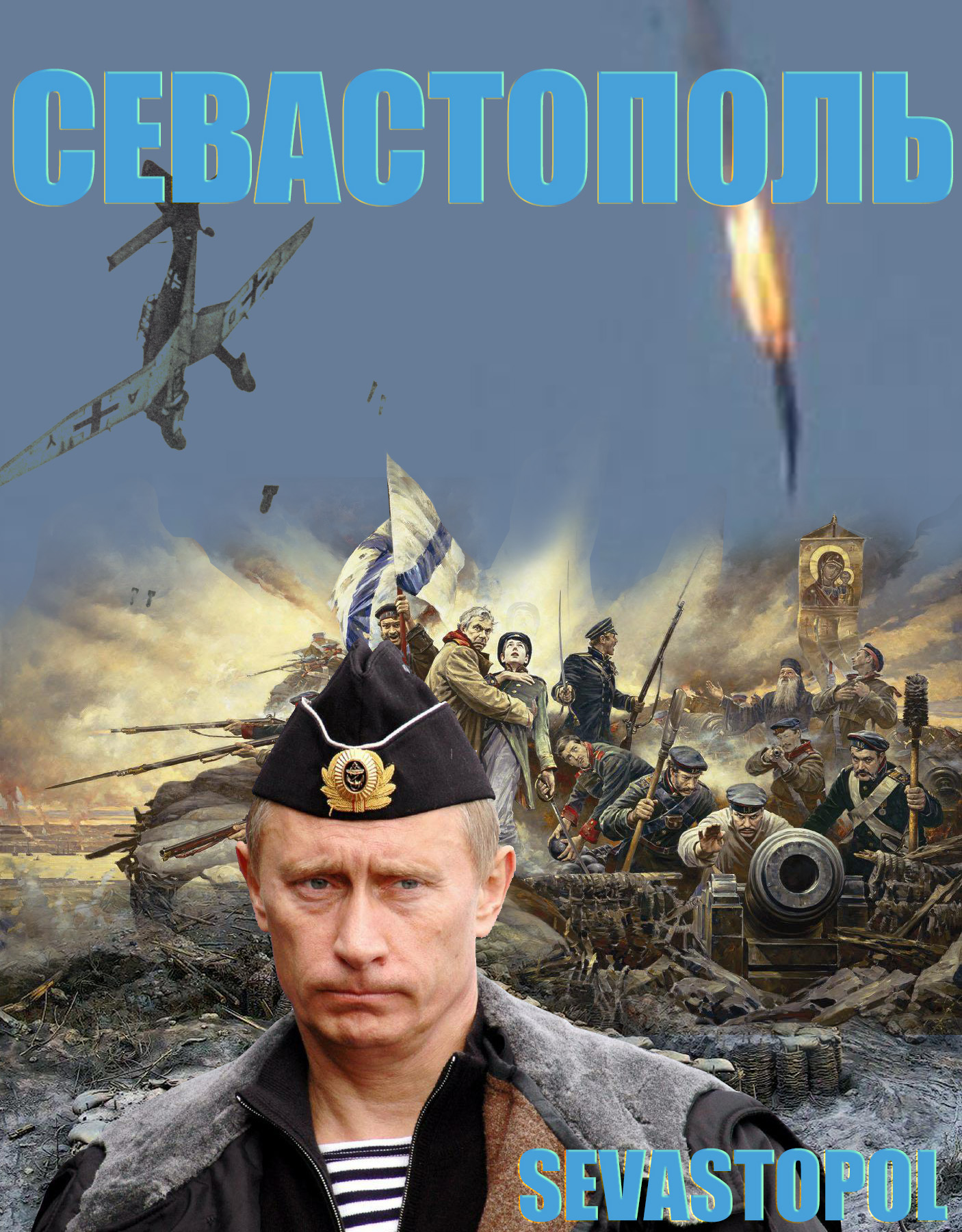
A SYRIAN SEVASTOPOL?
Allied Forces including France and soon Britain (again) together with Turkey on a battlefield not far from the southern border of what became Russian territory by annexation in by the end of the 18th century: the Crimea.
PutinSevastopolNotAgain
The downing of a Russian airplane by the Turkish today may be seen as a step toward another Russian heroic stand a new Sevastopol?
Russians defending what all imperial nations like to call the mother or fatherland. Thus in the 19th century the French, British, Ottomans and Sardinians laid a siege to Sevastopol in the years 1854-55, so did the troops of the Third Reich in 1941-42. In both cases the Russian troops supported by most of – except the authochton Crimean Tartars – the local population, held heroically out for a long time, in the end losing these prolonged and murderous battles. Sevastopol thus became a symbol of Russians defending their values from Tsarist led Orthodox Christianism to Bolshevist led nationalism and beyond, with the new mix of Russion nationalism, corporate state system and revived Orthodox Church values under Putin.

The Crimean War saw the unholy alliance of Western European empires with the Ottoman Empire against what they saw as ‘a threat of Tsarist Orthodox Christian Russia. The Middle East War of today again has such an alliance in the form of NATO with the new Ottomans, the last under the new strong man of Turkey Erdogan, shooting down a Russian war plane.
NO MORE SEVASTOPOL can be read from Putin’s eyes.

Where can we situate that ‘new Sevastopol’ of the 21st century?
In Syria, the Russian naval base at Tartus leased from the (socialist) Syrian Ba’at party of the Assad dynasty since 1971. It is very close to Turkey. It gives Russia a free access to the whole of the Mediterranean waters, without being forced to go through the Turkish controlled Bosporus.

EU/USA and NATO have been destabilising the Southern part of Russia by discarding the Cold War entente for a Hot War future scenario. Russian’s long involvement in Syria is strategic. So is it’s actual alliance with the Assad regime. The downing of a Russian war plane (over Turkish territory) is a step toward an unwanted war, that reminds of the disasters of the Crimean War in the mid of the 19th century.
Historic battles lost tend to become mythical references of nationalist history.
There was a lack of any anti-warmongers movement during the Crimean War of the 19th century, even when many Russians, Turks, Brits and Frenchmen, African troops, died in battle and of disease.
We seem to have very little real size opposition against what I like to call from now on THE MIDDLE EAST WAR… time to change that.
NO MORE SEVASTOPOL!

Read Full Post »

BOMBING FOR PEACE

dedicated to all who think that aerial bombardment is the right answer to ISIS terrorism
AirStrikeRightOnTarget03

Read Full Post »

Holy lands and Jerusalems have multiplied over millennia and the urge to go out conquer and subject them has not diminished.
CRUSADERS01

Read Full Post »

This is the ‘appartement de repli’ (safe house) of a group of terrorists linked to the Paris attacks besieged on November the 18th by a police force of over one hundred.
A large scale picture, taken at night, of a corner house of Rue du Corbillon and Rue de la République in Saint-Denis, Paris metropolitan area, published in the Washington Post (printed edition and on their web-site).
Why?
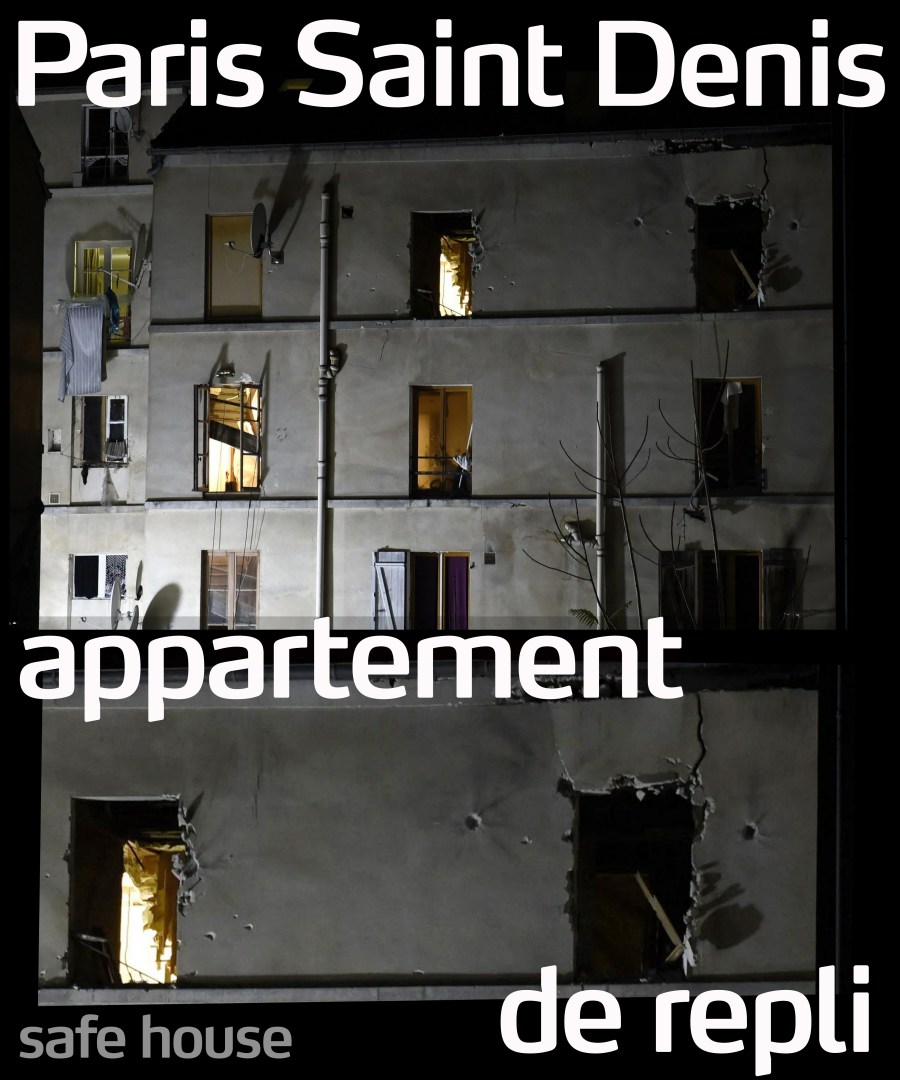
ParisSaintDenisApartmentDeRepli
Because alleged terrorists who might relate to the horrendous attacks in Paris on friday the 13th of November had hidden themselves in this building so a spokesman for the French justice system told the press after a siege of over one hour, starting at four o’clock in the morning.

Would a picture of such a downtrodden sad housing facade ever have reached the front pages of the world press if it was not for this spectacular incident? It would not.

We see four floors of the facade of the dilapidated house with flood lights directed at it. Some windows have lights on, others are dark. on the third visible floor the the last window at the right is dark and the window panes are gone, the next one has some lights on showing us a ravage with what seems to be of a smashed ceiling. The outer walls around these two windows are pocked by the impact of bullets or other projectiles.

What happened inside? What we are told is – as mostly in such cases – partial and contradictory (there was mentioning in an official statement of a woman with a bomb-belt that had exploded herself, which was later retracted by the same source). (1)
We know, even can hear and see it on amateur videos posted on Youtube, that not less than 5000 rounds of shots were fired. How many by the assailed persons in the building and how many by the police, we do not know. The traces left on the wall show more than just bullets from a pistol.

How come that these terrorists sought refuge in such a non-strategic bastion, as this corner house? Four satellite dishes can be counted in the picture, maybe more that fell down during the exchange of fire explosives. Which satellite they were pointed at, to which stations they tuned? Are houses with such a disk inhabited by people who have direct linkages to regions of the world that can not be accessed by regular cable radio & television systems? Living ‘here’ physically and living ‘there’ electronically at the same time.

Are we not all doing that in our saturated electronic environment by means of the internet? One does perceive sometimes city areas where such satellite dishes have grown into a forest of information reflectors, also indicating a neighbourhood with many recent migrants. Is that due to the lack of normal public access to television stations from home countries of big part of the (former migrant) population? We may need to reconsider the content management of our public television networks, to give more space to those with a migrant background, instead of raging about “needed integration.” That would be a deep structural change needed in our society, to make these satellite-dish forests redundant. When we non-migrant integrate more that would send a positive message.

We see several windows open, some show parts of a staircase. Is it to air the corridors from battle gasses pumped in?
Imagine the fear of the neighbours, who most probably had no knowledge of one of the apartments used as a safe-house for terrorists. On what information did the police act? Consider the bad chance of a mistake made in intelligence gathering.

Now what kind of terrorists are this who in their flight end up in such an apartment block? Is that proof of a high-level international network? It seems all very clumsy to me. Is this clumsiness, this lack of professional conspiracy to commit violence part of a larger strategy? (2)

I mean that someone clever has come to the insight that building a whole network – even by using a system of dispersed secret cells who do not know about each other – is an outdated concept. It is sufficient to pass on a general call to commit violent acts on non precise targets at no precise moments in time. Basing this method on the fact that it is not to difficult to get access to weapons and explosives, that some explosives can even be produced in a home laboratory or acquired indirectly through contacts within the building or mining industry (dynamite or similar type of explosives).

It may well be the case and that explains the great fear that did strike the conglomerate of state security systems. This combination of destructive acts based on a willingness for self-destruction do not fit the routines, strategies and tactics of state security organisations, of regular police control and all that comes with it.

A Washington Post article of November the 21. quotes an anti-terrorism specialist who sees it different:

For such an attack, involving so many people, it must have been decided near the highest level,” said Claude Moniquet, a former French intelligence official who heads the European Strategic Intelligence and Security Center. The Islamic State’s military operation, whose senior leaders include numerous former military officials from Iraq, “would never let someone below them direct a strategic operation.

It is a known fact that officials tend to see all that what is a threat to the reigning system as a mirror image of the system they are part of, the system they believe in. Hence this ‘top down vision’ of Claude Moniquet. He sees a vertical line of command directly from ISIS in Syria. This analysis also supports the ‘revenge aerial bombardments’ that are presented to us as ‘legal self-defence’ targets (in spite of the fact that according to international law and the ‘charter’ (chapter 7) of the United Nations these bombings are not-legal).

I do not claim that my view of the danger of the unpredictability of ‘grass root terrorism’ is correct in this particular case, but the opposite can not be proven either. The amateur and clumsiness aspect can be supported by the cases of the shooting on French army personal and Jewish civilians in Toulouse and Montauban in 2012 (by Mohammed Merah) and the attacks on the Jewish Historical Museum in Brussels in 2014 (by Mehdi Nemmouche), remain open to multiple interpretations and ambiguity, ranging from ‘jihadism’ and ‘anti-semitism’ to ‘tribalism’ and ‘insanity’.

Consider also an article in Le Monde about the same siege in Saint Denis of November 18., concluding:

“…rudimentary logistics with neither a safe-house nor a support provider: one seems here to be far away from classical urban warfare.” (2)

The walls of this apartment building must have heard enough during the few days or hours when this group of terrorists stayed there. (We may say that they were not longer ‘alleged terrorists’, as they did fire back to the police, there was an explosion, though we can not know for sure (yet) what they had done before or were really planning to do). A justice spokesman has told the press an act on Charles de Gaulle Airport was on their agenda.

What else could these walls tell? What about the regular lives of all those living around there? What about the person who let these terrorist group in, what did he/she know? This last thing we might get to know soon. It always takes several days more than the ‘latest news’ to be sufficiently informed on such matters.

There is a pattern in the social strata of this new generation of terrorists. This means that there is also a pattern in the habitat where these people – who so easily sacrifice the lives of others and their own – live. When I have understood it well the places where they were born, lived and died are identical in social status. (3) In the case of the ‘safe-house’ of Saint Denis that house failed its function utterly.

What sadness to consider while at the same time being abhorred by the savage nature of the terrorist attacks related to this group.

I focus now on this black hole where was once a window, in the bullet puckered and cracked wall. Imagine the last thoughts of those been killed in this battle. Was there anything left of ‘the cause’ for which they had chosen to fight? Or had their choice to put their own life at risk, taken over as ‘a cause’ in itself? These questions remain open.

There is failure in understanding these wasted lives. It all ends in the black hole of what once was a window on the world from a house, in a street, in the Parisian suburb Saint Denis, however inglorious this direct view, there was a wide world of other opportunities beyond, which have now all vanished in this black hole.

—-
(1) Trois terroristes sont morts dans l’assaut. Un homme (initialement présenté comme une femme), retranché dans l’appartement, qui a activé son gilet explosif, et un autre, touché par des projectiles et des grenades, dont les analyses ont ensuite conclu qu’il s’agissait d’Abdelhamid Abaaoud, instigateur présumé des attaques du 13 novembre. Après deux morts annoncées, les fragments d’un troisième corps, celui d’une femme, a été découvert dans la nuit de jeudi à vendredi. (three terrorists died in the assault. One man (initially presented as a woman), that hat withdrawn into the apartment, had triggered his bomb-vest, and another hit by projectiles and grenades, of whom analysis have concluded to be Abdelhamid Abaaoud, presumed instigator of the attacks of November the 13th. After these two deaths had been announced a third corpse, that of a woman, has been found in the night of thursday to friday.)
http://www.lemonde.fr/attaques-a-paris/article/2015/11/18/assaut-a-saint-denis-ce-qu-on-sait-ce-qu-on-ignore_4812399_4809495.html

More sensational press agencies and news channels did make up their fantasy of a young ‘kamikaze woman’ like in the Daily Mirror with this long summing up header:

EXCLUSIVE: Extraordinary selfie of terror mastermind’s cousin shows girl blown up in Saint-Denis siege who never read the Koran, liked to drink and smoke and had a reputation for having lots of boyfriends

  • Hasna Ait Boulahcen, 26, was killed by a suicide bomber during siege
  • Screamed ‘Help me!’ before blast in which her head flew through window
  • She was described by friends as an ‘extrovert’, and booze-loving party girl
  • Neighbour said she smoked and ‘went around with lots of different guys’
  • Her nickname was ‘The Cowgirl’ as she liked to wear big cowboy hats

http://www.dailymail.co.uk/news/article-3325180/Two-fingers-world-Pictured-Europe-s-female-suicide-bomber-booze-loving-extrovert-nicknamed-Cowgirl-love-big-hats.html

 (Many newspaper are still similar fantasy stories without correcting their the mistake )

(2) Le Monde had an article on this aspect of the Saint Denis siege ending with this conclusion:

Une logistique rudimentaire, sans appartement de repli, ni équipes en support : on paraît loin d’une guérilla urbaine classique.(rudimentary logistics with neither a safe-house nor a support provider: one seems here to be far away from classical urban warfare).
http://www.lemonde.fr/attaques-a-paris/article/2015/11/21/hasna-ait-boulahcen-entre-vodka-et-niqab_4814800_4809495.html#farA7dRgooQVXSPQ.99

(3) See my images & notes on other similar examples:

– 4/6/2014: “The crime of Mehdi Nemmouche his Maison/Prison & the structural evil of French society”
https://www.flickr.com/photos/7141213@N04/14344535364

– 11/1/2015: “”Je Suis Charlie” The I AM has turned into I FOLLOW – protest canalised”
https://www.flickr.com/photos/7141213@N04/16067193958

– 19/1/2015: “Carceral University of France: courses in hate & breeding ground for terrorists”
https://www.flickr.com/photos/7141213@N04/16315233801

Read Full Post »

ARMAND: “…spaced out als ik”
uit een liedje “Ben ik te min…” ooit gelanceerd door Philips/Fontana records in Eindhoven (die zijn pleidooi voor softdrugs niet waardeerde)
ArmandSpacedOutAlsIk
Zijn final high en mijn eerbetoon voor een dwarszinger (mijn softdrugs liggen meer in het bereik van franse kaas en japanse sake, maar ieder het zijne, zolang er maar niet onder mijn raam op een hashterras gehinnikt wordt door de stoonde italianen; ik vind dat hash stinkt, een ander weer kan niet tegen de geur van een uitgelopen frans kaasje).


Dan nog even een check van mijn bronnen… de strofe die ik hier aanhaal komt van een Youtube filmpje met een re-take in 2005 van zijn eerst hit uit 1967 :ben ik te min…”, waarbij dit deel van de oorspronkelijke tekst gewijzigd is, in plaats van
“Je bent nu net zo idealistisch als ik maar, hoe wil je het in godsnaam anders gaan doen?”

zingt hij
“Je bent net zo spaced out als ik en hoe wil je dat in godsnaam anders dan?”

‘spaced out’ is een weinig vaststaand begrip:
Mettriam/Webster:
– “dazed or stupefied by or as if by a narcotic substance : high” of
– “of very strange character : weird”
The Urban Dictionary has this odd statement:
– “1) Absentmindedness in the form of a personality trait.
Note 1: People who are spaced out are usually considered to be stupid by their peers, although often these people are actually very smart.
– Note 2: Incorrect usage of this term has been applied to people on drugs. There are terms for that, so do not to confuse them with “spaced out.”
Cambridge dictonaries on-line:
– “Someone who is spaced out is not completely conscious of what is happening, often because of taking drugs or needing to sleep”

Dus we wen niet echt wat Armand bezielde in 2005, wel dat hij na zijn eerste hit bij Fontana/Philips van label veranderde om te kunnen zingen wat hij wilde en uiteindelijk zijn eigen platen ging produceren….
Hij begon als en bleef een protestzanger, heel zijn leven.. begin dit jaar nog trok hij naar het bezette Maagdenhuis, laat ik dit fraaie statement citeren van een VPRO uitzending/web pagina uit juni dit jaar:

“Het werd godverdomme weer eens tijd, zeg”, zegt hij. “Sinds de bezetting van ’69 hebben we genoegen genomen met repressieve tolerantie. Het is een vruchtbare strategie gebleken van de bestuurders: net doen of je meebeweegt, maar stukje bij beetje de kraan steeds verder dicht draaien. Het heeft ons gemaakt tot wat we nu zijn: een stelletje bange zeikerds. Juist daarom was het zo fantastisch om te zien dat de studenten eindelijk durfden. En toch zag je ook dat ze hartstikke bang waren. Ze durfden niet eens te roken binnen. Tegen mij zeiden ze het ook: je moet buiten blowen. Ik heb gezegd: no blow, no show.”

2015: Anders dan in 1967 wordt hij niet meer door Philips gelanceerd, maar door zichzelf in een final ‘space-out’.

Wie zijn jongste foto’s van zijn te vroege oude dag bekijkt ontkomt niet aan het zilvergrijs laten uitgroeien vanaf zijn kruin van de henna waarmee hij decennia lang zijn lange haren verfde… deze groeiende vergrijzing was als een voorbereiding op een ander bestaan, in ‘outer space’.

Read Full Post »
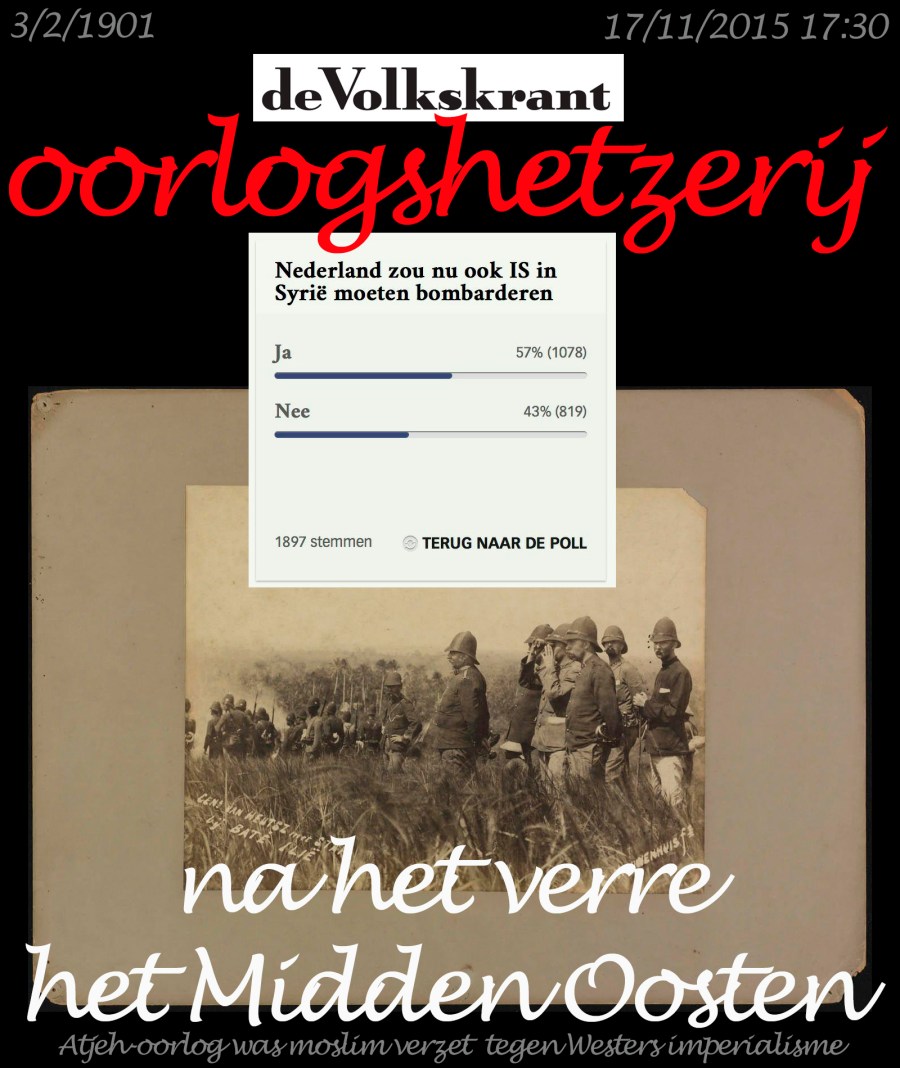
Nederland vocht al eens een oorlog tegen moslim-opstandelingen in den Oost…. tijdens de bloedige Atjeh-oorlogen op het einde van de 19e tot aan het begin van de 20e eeuw. Echter, bij De Volkskrant ontbreekt – zoals zo vaak – ieder historisch besef en zij legt haar lezers middels een enkel druk op een web-site knopje de vraag voor of Nederland ditmaal ook weer opstandige moslims dient te bombarderen.

Enkel al het stellen van de vraag binnen een dagenlange buiten-proportionele overreactie van de media op de – overigens gruwelijke – moordaanslag in Parijs. Ik noem het reduceren tot een simpele Ja/Nee vraag over het al dan gewenst zijn van een een oorlogshandeling buiten enig mandaat van de Verenigde Naties, niets meer en minder dan OORLOGSHETZERIJ.

VolkskrantVanHeutszOorlogshetzerij

Was Van Heutsz ooit niet onze ‘nationale held’? Hoe lang duurde het totdat Provo symbolisch een stukje van zijn monument in Amsterdam Zuid opblies?

AMSnote5627.09

Rookbom bij het Van Heutsz-monument in Amsterdam (waarschijnlijk 1966/67; foto bijschrijft bij het Geheugen van Nederland zegt 1968, maar dat lijkt mij onjuist; foto uit collectie fotograaf Bert van Meerdonk bij het IISG/Amsterdam

Hoe lang duurde het dat op de Oosterbegraafplaats in Amsterdam de praaltombe van Van Heutsz die direct bij de uitgang van de Aula aldaar geplaatst was, verwijderd werd? Langzamerhand werden wij ons bewust van ons kwalijk koloniaal verleden.

En nu opnieuw in gevechtstuniek, niet met snelvuurgeweren en kanonnen maar dan hoog boven bewoonde gebieden, niet meer met de laarzen in het veld, gebieden die zo tot slachtveld gemaakt worden met bommen en raketten uit vliegtuigen? Wie worden er geraakt? Wat wordt er kapot gemaakt in Syrië? Sinds wanneer los je een groot en complex langlopend conflict op met luchtbombardementen?

Heeft zich iemand bij die krant zich rekenschap gegeven van hoe kwalijk deze mini-enquete is?

Moesten ooit niet die woeste en bloedzuchtige Atjehers een kopje kleiner gemaakt worden. Viel die koloniale oorlog niet onder de leuze “Daar werd iets groots verricht”?

Gaan wij dat nu weer in het ietsje minder Verre oosten, in het Midden Oosten herhalen?


Als antwoord hier een bericht dat gisteren op Twitter circuleerde van een inwoner van wat nu het belangrijkste bombardementsdoelwit is.


This is just one of many possible examples about non-intended victims of “just warfare dated November the 6th 2015:”

“Air strikes by Russian warplanes on the Syrian city of Raqqa, which is controlled by the Islamic state of Iraq and Syria militant group, killed 42 people earlier this week, including 27 civilians, monitoring group the Syrian Observatory for Human Rights said on Friday.”
http://english.alarabiya.net/en/News/middle-east/2015/11/06/Russia-bombs-Palmyra-eastern-Syria.html

Read Full Post »

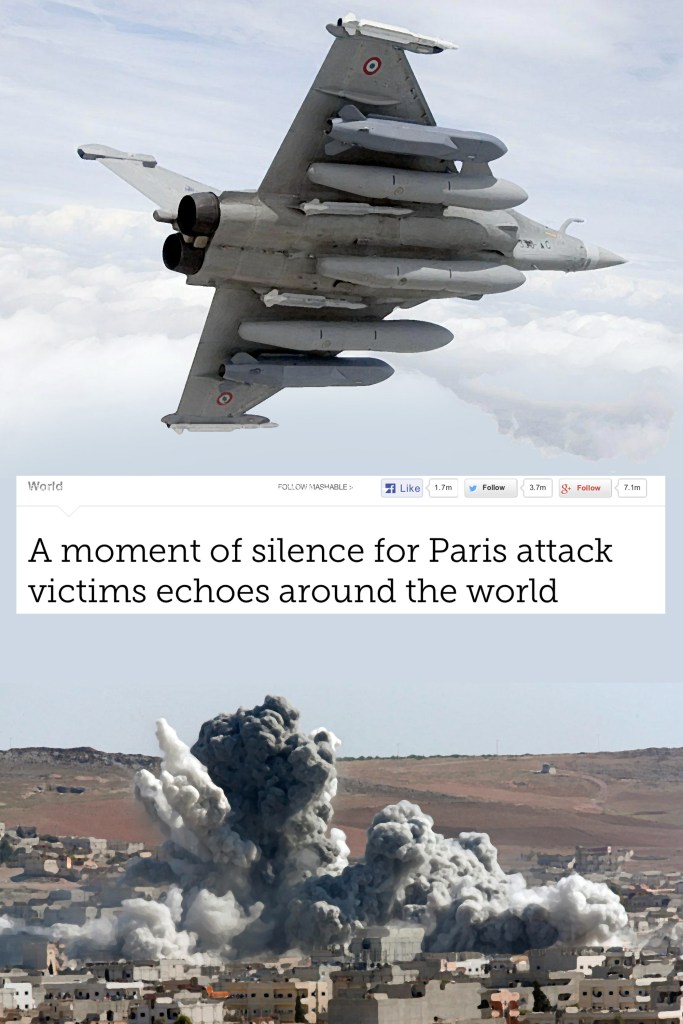
“A moment of silence for Paris attack victims echoes around the world”
Header of Mashable.com did get 667 shares on Facebook…. today
aMomentOfSilenceForParis
NOT EVEN SECONDS OF SILENCE OVER RAQQA.
“A moment of silence for Paris attack victims echoes around the world”
Header of Mashable.com 667 shares on Facebook…. today
we should be inquisitive always about aerial bombardments, there is hardly such thing as a pin pointed correct targeting without any collateral damage or victims… for a collateral victim of a so called ‘justified’ aerial attack it does not make any difference if the bomb was launched by the Assad troops, one of the opposing fractions, ISIS, the French. the Brit of the USA air force. The battlefield almost never is a separate spatial entity… it is part of human habitat. And… even when an ISIS stronghold has been hit, what about people around it, maybe family, kids, elderly… and in the end, when one is serious about a humanitarian stance, even the lives of ISIS soldiers do count…

This is just one of many possible examples about non-intended victims of “just warfare dated November the 6th 2015:”

Air strikes by Russian warplanes on the Syrian city of Raqqa, which is controlled by the Islamic state of Iraq and Syria militant group, killed 42 people earlier this week, including 27 civilians, monitoring group the Syrian Observatory for Human Rights said on Friday.
http://english.alarabiya.net/en/News/middle-east/2015/11/06/Russia-bombs-Palmyra-eastern-Syria.html

Or just get aware of the consequences of aerial bombardment by reading one of the many campaigns by the United Nations against the use of high explosives in or near populated areas:

Explosive weapons in populated areas A total of 41,847 people were reported killed or injured by explosive weapons during 2014 When explosive weapons were used in populated areas 92% of the casualties were civilians From Afghanistan to Iraq, Libya to Palestine, Syria to Ukraine and elsewhere, the use of explosive weapons in populated areas is a major cause of civilian deaths, injuries and displacement.
http://www.unocha.org/what-we-do/explosive-weapons-populated-areas

ALJAZEERA of 17/11/2015 had this comment on the aerial bombing of Raqqa, showing how problematic aerial bombing always is. Locals need to fear all those who claim to be fighting there for the ‘right cause’:

Raqqa is devastated’ The Syrian activist in Raqqa said that in the past few days Russian air strikes had caused the most destruction. “Last week Russian air strikes destroyed one of the main bridges in the city in addition to the national hospital. Most hospitals in the city have been destroyed in Raqqa,” he said. “Russian air strikes have resulted in so much destruction. If these countries want to bomb the heartland of ISIL, they could have, but they still have not targeted the group’s most important bases. “This is what we do not understand. The targets bombed by French warplanes were mostly abandoned by ISIL fighters. French jets pound ISIL targets in Raqqa “The US, Russia and France are all bombing Syria. How many more countries want to bomb us? “Raqqa is devastated. Raqqa has endured the unbearable and we live in fear under ISIL’s dictatorship. “A lot of people fled the the city. In fact, most refugees heading to Europe are from Raqqa. That is how desperate they are to leave here. People are fed up here and just want to live normal lives. “Our lives are all under a threat. ISIL controls every aspect of our lives and we are not allowed to expose the truth.” Separately, the anti-ISIL group Raqqa is Being Slaughtered said on Sunday that overnight air strikes hit a stadium, a museum, several clinics, a hospital and a governmental building. The group told Al Jazeera that no civilians were hurt or injured in any of the latest French air strikes. “Of course we do not like to see people afraid of air strikes and explosions, but we support any actions that will take ISIL out of Raqqa,” the group said on its Twitter account. The UK-based Syrian Observatory for Human Rights said activists reported hearing explosions in Raqqa resulting from air strikes. The activists’ network said no civilian death toll has been recorded due to the strikes.
http://www.aljazeera.com/news/2015/11/syrians-insane-nights-french-bombing-151117052945111.html

Read Full Post »

EIFFEL-TOWER & TRI-COLORE CAN BE NO SYMBOLS OF PEACE
ParisNaJamaisEteeUnSymboleDePaix
I see popping up on Facebook and other social media this emotionalisation and sentimentalisation of a gruesome act, with a symbolism (the Eiffel-tower made the centre of the ‘peace symbol’) that prooves that those who make such a – well intended – gesture, understand neither the actual nor the historical meaning of the symbols they use.

The Eiffeltower was made as a commemoration of the ‘Centenaire of the French Revolution’ combined with a World Fair in Paris. It stood for the colonial and imperial France of that time with it’s scramble for colonies in Asia and Africa. It is anything but a symbol of peace.

Using this symbol seems also to deny the reality that the French governments (both Sarkozy and Hollande) that engaged in recent conflicts from Libya tot Syria and in African countries that belong to it’s old colonial empire, has seen no mass peace protests in the streets from the population against them, calling for other means than just advanced weapon systems to help solving conflicts. Also it seems to me that people using this new combined symbol are not aware of the aggressive weapon export role of France, showcasing their newest products on the military intervention battlefields of Africa and the Middle East (Dassault selling a whole bunch of Rafale fighter jets to Qatar recently, or Egypt buyingFrench Mistral helicopter-deck warships).
The Eiffel-tower stands both for Paris and for France as a symbol… for France as a state, France as a world-power, not for France as a nation of peace, or France as a “peace-maker”, or the French nation as a nation of victims… also just the French tri-colore as a symbolic gesture after the murderous attack, fails as well to have a critical differentiation between citizens and “their” government.

Read Full Post »
tekst volgt, dit is een test exporteren vanuit Flickr naar WordPress 31/5/2013

Read Full Post »

Discriminatie begint in de taal met het benoemen van mensen en hun handelingen. Het jongste wetsvoorstel van ‘de Staatssecretaris van Immigratie en Asiel’ Fred Teeven (VVD) voor “strafbaarstelling illegaliteit” is daar een voorbeeld van. Dit wetsvoorstel is een erfenis van het Kabinet Rutte I dat onder druk van de PVV in het regerinsgprogramma opgenomen was. (1) Juridische verfijning van een begrip uit de taal leidt – in dit geval – uiteindelijk tot gevangennemening en opsluiting.

TeevenIllegaalIsStrafbaar

Een lesje taal en logica voor Staatsecretais Fred Teeven:

“Wat niet mag is illegaal” ~ “Wat illegaal is mag niet”

“Wat wel mag is niet illegaal” ~ “Wat niet illegaal is mag wel”

Hoe je de reneertrant ook draait, het ene woord zit vast aan het andere als waren zij door een ketting onverbreekbaar aan elkaar geklonken.

Als nu een – naar wij mogen aannemen – gestudeerde man als Teeven komt met een wetsvoorstel om ‘illegalen’ en de door hen bedreven ‘illegaliteit’ strafbaar te stellen, wat was dan de betekenis van het woord ‘illegaal’ voordat die mogelijk nog aan te nemen wet bestond ?

Was -en is tot nog toe – ‘illegaal’ zijn in Nederland ‘onwettig’, maar toch niet strafbaar? Dat moet wel zo zijn, anders had de staatsecretaris zich al die moeite van het opstellen van een nieuwe wet wel bespaart.

Is het wellicht zoiets als het verschil tussen ‘een overtreding’ van het burgerlijk recht en het plegen van een delict dat behoort tot ‘het strafrecht’?

Lijkt het nu voorgestelde strafbaar stellen van illegaliteit, op de verschuiving van de beoordeling van een handeling, van ‘overtreding’ naar ‘misdaad’, zoals kort geleden ook het geval was bij de aangenomen ‘anti-kraakwet’? Hierbij werd het oude grondrecht (op wonen, zoals na te lezen valt in het proefschift van Professor Tak uit 1973) buiten werking gesteld. De mogelijk om zich te beroepen op het ‘huisrecht’ en zich zo te vrijwaren tegen binnentreding door wetsdienaren van een woning, ongeacht de eigendoms- of huur-status van een bewoner van een in gebruik zijnde/genomen woning, was immers de juridische basis die het ‘kraken van woningen’ mogelijk maakte? (2)

Is dat de tendens in Nederland om grondrechten stapje voor stapje te ondergraven door bij het niet voldoen aan gestelde regels (aantoonbare vergunning, bezit- of gebruik-status, enzovoort) de status van een persoon niet te zien als die van een ‘overtreding’, maar als ‘strafrechtelijk vergrijp’. 

De ‘overtreder’ wordt daarmee opgewaardeerd tot ‘misdadiger’.

Het voorbeeld in het woordenboek dat bovenstaande plaat laat zien, van hoe je het woord “strafbaar” kunt gebruiken, is tekenend: 

“de meeste vormen van discriminatie zijn strafbaar.”

Discriminatie is dus soms wel en soms niet strafbaar.

Discriminatie – op grond van huidskleur, geloof, gedrag, seksuele geaardheid, ga zo maar door – is niet toegestaan. Dat is bij wet geregeld. Discriminatie is dus onwettig. De ‘strafbaarstelling van discriminatie’ is door de staat vastgelegd. Toch zijn de woorden ‘discriminatie’ en ‘strafbaar’ niet onverbrekelijk aan elkaar geketend, zoals nu in het voorstel voor het ‘strafbaarstellen’ van ‘illegaal zijn’ dreigt te gebeuren.

Er zijn kennelijk vormen van discriminatie die op de één of andere manier weliswaar niet mogen, maar toch – al dan niet oogluikend – toegelaten worden.
Al te strakke regelgeving creëert immers meer problemen dan er door opgelost worden.

Zo is het ook met iemand of iets dat ‘illegaal’ genoemd wordt. Ook daar kan een al te ver gaande regelgeving een nog enigszins aanvaardbare situatie in haar tegendeel doen omslaan.

Het ‘pleonasme, de dubbelop-redenering-wet van Teeven is een wangedrocht. Het is ook een drogreden, in de orde van een stelling als “alle raven zijn zwart.” Dat zijn ze meestal, maar wie durft categorisch te beweren dat er helemaal nooit witte raven zijn, waren of kunnen bestaan?

AMSnote3555.08

Hongerstaking in de Mozes en Aaronkerk in Amsterdam door merendeels Marokkaanse gastarbeiders, die lange tijd in Nederland gewerkt hadden, maar onvoldoende papieren hadden om dat te bewijzen, of door seizoensarbeid niet aan de al te strakke regels konden voldoen.  Affiche voor Platform van demokratische organisaties van buitenlandse arbeiders (Amsterdam) gemaakt door de kunstenaarsgroep TSTORT (Amsterdam)  1979 – 1980. Ten tijde van een krappe arbeidsmarkt werd er door de Vreemdelingen Politie en andere diensten bewust weinig opgetreden tegen buitenlandse arbeiders en hun bazen. Toen de economie echter veranderde en er minder ‘goedkope/buitenlandse’ arbeidskrachten nodig waren, werden er nieuwe regelingen en scherpe handhaving ingevoerd.

Het dichtstoppen van de kieren van de rechtstaat met iedere keer weer nieuwe regels, verpest de luchtkwaliteit van het huis waarin wij samenleven en leidt uiteindelijk tot verstikking, als er geen frisse lucht meer is om in te ademen. 

Is het vaak niet ‘de uitzondering’ die de regel bevestigd?

De wet is geen doel maar middel. Daar zijn de mazen in dat netwerk van voorschriften en regels voor. De veelvuldigheid van omstandigheden van zoiets ingewikkelds als een samenleving in een land met een overheidsapparaat en grenzen, binnen- en buitenland, andere landen met andere regels en andere situaties, ga zo maar door, is iets dat nooit geheel in wetten, regels en protocollen is vast te leggen. 

AMSnote3557.01

Een spotprent uit het jaar 1994 gepubliceerd in een blad van het CDA die toen deel uitmaakte van het Kabinet Lubbers III. De politieagent is de Staatssecretaris voor Asielzaken en Vreemdelingenbeleid Kosto (PvdA) die iet enkel illegale arbeiders wilde aanpakken, maar ook de werkgevers die hen in dienst namen, Het is curieus hoe in deze prent waar de sympathie ligt bij de benadeelde ondernemer eerder dan bij een illegale gastarbeider, hoe inconsequente dwaasheden van het overheidsbeleid met betrekking tot arbeidsmigratie hier mooi opgesomd worden. Het toont aan dat welke gezichtshoek je ook neemt, er steeds weer een andere mogelijk is op migratie en arbeid, legaal en illegaal. Dat geldt niet enkel voor hen die buitenlandse arbeiders willen steunen, maar ook voor een regeringspartij als het CDA.

Illegalen die terug willen maar dat niet kunnen is slechts één voorbeeld daarvan. Omstandigheden in een mensenleven zijn maar deels te vatten in regels en principes worden soms beter gediend met het toepassen van een uitzondering, dan dwaas, star en dom de letter van de wet te volgen.

Redelijkheid en wijsheid zijn waarlijk niet het monopolie van het justitieële apparaat. De vele voorbeelden van practische burger- en gemeentelijke initiatieven als het om ‘illegalen’ gaat, tonen dat aan.

Wat vroeger mocht is nu illegaal en omgekeerd. Hoeveel voorbeelden zijn er daar niet van en hoeveel leed werd, wordt en zal er niet aangedaan worden door het vastklinken van woorden tot wettelijke regels die maar al te vaak wat nog een beetje recht was, krom buigen?


—-
(1) “In het eerste kabinet-Rutte was het CDA-minister Gerd Leers die de strafbaarstelling van illegaliteit moest regelen. Het kabinet zou toen overwogen hebben om onrechtmatig verblijf als misdrijf te kwalificeren, onder druk van gedoogpartner PVV. Uiteindelijk beperkte Leers zich, onder druk van zijn eigen CDA, tot het opleggen van een boete.”
NRC/Handelsblad 6/12/2012
http://www.nrc.nl/nieuws/2012/11/06/teeven-houdt-optie-celstraf-illegalen-open-samsom-voorbarig/

(2) “Het karakter van het huisrecht als grondrecht moet worden gezocht in de sfeer van de persoonlijke vrijheid van het individu, een erkenning van de wezenlijke behoefte van de mens om een plaats te hebben waar hij ongestoord volkomen zichzelf kan zijn…” onder aanhaling van het Verdrag van Rome artikel 8 lid 1. [pagina 9]

“Het verlies vande ‘vrije mogelijkhei tot gebruik’van een pand zou bij redelijke afweging van de betrokken belangen in vele gevallen wel eens minder zwaar kunnen wegen dan een ‘sociaal grondrecht’ op een menswaardige woning. Het bestaan van de Woonruimtewet 1947 geeft in deze reeds een duidelijke vingerwijzing.” [pagina 41]

“Het huisrecht/the inviolability of the home – proefschrift”;1973 Rijksuniversiteit te Utrecht; p.280; Antonius Quirinus Cornelis Tak.
http://www.worldcat.org/oclc/781255580

Read Full Post »

klik plaatje om deze man van formaat in vol formaat te zien…

Ook Jan Kees de Jager heeft gisteren geoefend op het strand van Scheveningen (*), samen met zijn tassedrager, om op het ergste voorbereid te zijn nu de Kunduz-Wurg-Begroting voor het jaar 2013 de openbare weg opgaat…


(*) Met dank aan de web site van De Hoefslag: “Prinsjesdag-paarden trainen op strand ~ De paarden zijn voor het grootste gedeelte eigendom van de ruiters of van particulieren en werden onderworpen aan harde muziek, rookbommen, vuurwerk en ander groot lawaai.”

Read Full Post »

‎11 November 2011 ~ 11 November 1911, today is the centennial of one hundred years of aerial bombing, the first example being the bombing of Turkish troops by Italian airplanes during the Italo-Turkish War in Libya in 1911. Some grenades hand held, dropped onto troops below. Aerial bombing is in fact incorrect as the launching of airborne missiles date back much further in time. Balloons have for instance been used by the Austrians when they beleaguered Venice in 1849 using unmanned balloons filled with explosives that could be triggered by electro-contacts using long wires (the idea of drones which are used in a more advanced way nowadays is born here). So today it is the centenary of airborne attacks by humans launching explosives from flying contraptions. The idea of airborne attack goes back into mythical times, though.

Seven years ago I made two visual scrolls telling the long story of aerial bombardment. The thunderbolts of Zeus thrown down from the Olympus, the ‘vajras’ of the Hindi Lord of Heaven and the God of War, Indra, the apocalyptical revelations of St John (“the stars of heaven fell unto the earth”), imagery of winged angels with revenging swords to punish earthly sinners, all these mythical tales and images of cruel gods and other divine beings, have later been translated into human warfare technology.

Primordial air power, a fragment of scroll 1

There are also ample examples of plans for warfare from above: – many made during the Napoleontic campaigns against England, with whole armies transported on gigantic ‘Montgonfliers’; – 17th century Italian priest and inventor Lana Terzi who designed an airship for war; – the Chinese – far before that – with all kind of launched flying devices that delivered fire into beleaguered cities; – huge kites that have been part of warfare from the Chinese and Japanese to Europeans, and in 1886 Jules Verne, who describes in one of his futuristic books the flying ship Albatros shooting down rebellious indigenous people in Africa…. All this and more can be seen in these two scrolls…

fragment of scroll one: "Primordial air power and God's judgement"

The second scroll depicts and describes the terrifying results of the advancement of the technology of destruction from the air, from a support of ground troops on battlefields during World War I to  making whole cities into battlefields, changing the target from soldiers to civilians. The application of the theories of the Italian general Douhet with his 1921 publication “Il domino dell’area” (Domination from the air) where the ‘will of a nation’ is that what needs to be attacked, its civilian and cultural centers, this in order to cut war short, ideally just the threat of aerial bombing or hitting some example target would be enough for a nation to give up any resistance to another nation having superior air power. A doctrine that is exemplified  on up to this very day by the United States Air Force. The devastation wrought over decades is immeasurable: by Italian air power in Ethiopia, Japanese airpower in China, German air force, starting in Spain and continuing over Poland, Yugoslavia, Netherlands, Great Britain, France and so on; early use of  ‘air force’ to police “rebellious natives” from Sudan and Mesopotamia to Afghanistan by the Brits and later Anglo-American joint operations over the whole of Nazi occupied Europe,  pioneering ‘terror bombings’ of vast cities, torching most of Germany’s cities, with only a few cases remembered: Hamburg, Berlin, Dresden. Arson from the air again in Japan by the American Air Force, generating possibly more victims during the fire bombing of Tokyo (estimates run from 80 to 160.000 dead), than the two atom-bombs that closed the curtains of the World War  Theatre  II on Hiroshima (estimates from 80.000to 160.000) and Nagasaki (60.000/180.000).

In 1995 I started to make a database of victims of aerial bombing and in 2003 a preliminary first overview has been put on line in PDF format.  The real list is still in the making. My first research dating back to 1999 used a system of lowest, highest and most probable estimates of death toll from aerial war, resulted in a total of over one million of death and the devastation and erasure of over one thousand square kilometers of townscapes, …human habitat. This leaves out the rural bombardments during the wars fought in Korea and Indochina, the mining of  land, the defoliation and poisening of forests, the breaking of dikes to inundate agricultural land. 

Visual summary of the installation ‘Unbombing the World 1911-2011″

Especially the Indochina Wars have resulted in widespread criticism of indiscriminate forms of aerial war fare, something the staffs of air forces and the weapon industry have been taken to heart in the last decades, resulting in endless propaganda representations of new “clean” and “precise” forms of force from the air. Precision bombardments are presented as ‘humanitarian’ having taken the place of primitive wholesale ‘carpet bombing’. Guided missiles do come to us with guided press campaigns to cover up what has widely come to be known as ‘collateral damage’, attempts at control of targeting goes together with control of news agencies with the ultimate military control instrument of the ’embedded journalist’, who signs away his/her independence for the comfortable war-spectacle offered by the military staff.

This text, meant as a short reminder, will expand beyond its boundaries when I would go in any further detail on the use of aerial power in the last three decades, Gulf Wars, Balkan Wars, Russian air force obliteration of the capital of Chechnya Grozny, Turkish raids into Kurdish rebellious areas, Sudanese civil war bombardments, Sri Lanka government attacks on Tamil strongholds, Israeli high tech bombings of Lebanon and Gaza in response to low tech rockets fired at Israel, and the continuing military test ground of  Afghanistan having been battered from 1925 to this very day by the air forces of the British, the Soviets, American Air Force and NATO.Last Syria and Iran in the waiting room after ‘imperial’ aerial employments in Libya earlier this year.

We are one century from the moment that a grenade was dropped by hand from an Italian airplane circling over an oasis in the Libyan desert onto the heads of a few Ottoman soldiers. The Italian colonization of Libya that followed the break down of the Ottoman empire – at that time – created the circumstances that lead one century later to renewed usage of aerial power to force ou yet another reign, that of Gaddafi and his Green revolution. We may have progressed in technical sense a lo tin one hundred years, but politically speaking we have not yet freed ourselves of a system of crude imposture of imperial military power.

—————–
Scroll 1 = http://imaginarymuseum.org/OpenSKOR/UBWa.html

Scroll 2 = http://imaginarymuseum.org/OpenSKOR/UBWb.html

Context of scrolls = http://imaginarymuseum.org/OpenSKOR/index.html

Unbombing the world 1911-2011 project =  http://imaginarymuseum.org/UBW/ubw01a.html

Read Full Post »

MIJN LEREN IS SPELEN & OMGEKEERD: het was bijna spelenderwijs dat eindexamen halen begrijp ik – hoera! – en dan te bedenken dat leren iets is dat niet in tijd en ruimte valt af te perken….


MY LEARNING IS PLAYING & VICE VERSA: I understood it was almost a playful act doing your  final exam – hurrah! –  and then realising that learning is something that can not be confined, neither in time nor space…

Een Montessori-kind de hele weg van 4 tot 18 jaar ~ A Montessori-child all the way from 4 to 18 years.

Tjebbe van Tijen just hearing the good news in Hong Kong, June 16th 2011, 23 hrs. 

Read Full Post »

WAR WITHOUT BODY COUNT IN LIBYA:

The number of civilian death as result of the Allied bombings has according to the propaganda machine of Gaddafi reached 718 or so. The NATO bombing machine does give us nice numbers of strikes and the objects that have been struck but NO number of victims. Other sources say that there may be a total number of 10.000 violent death since the rising in Libya in February 2011. All numbers remain vague and contested from this or the other side in the conflict.

But let us be clear about something when it comes to mapping human violence. The total number of people that found their lives ending suddenly counts in the thousands. The factor may be 5 or 10 of thousands, but thousands for sure. The number of victims – collateral or not – as result of the NATO interventionist enforced change of regime, counts in the hundreds at least and the factor may be 7 or more. The number of soldiers and insurgents falling in this Civil War mixed with Western intervention is not given by any of the warring parties. And each human life should be considered as sacred – at least that is what my system of ethics says to me.

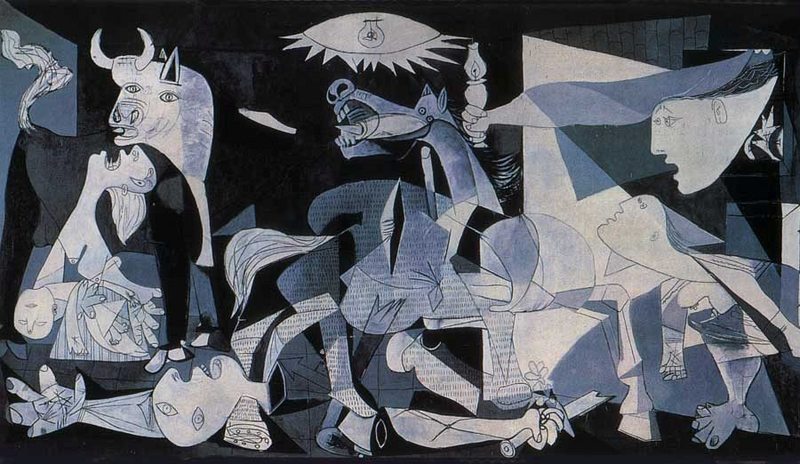
The Guernica of Picasso was painted after the Nazi bombing of this little town in Basque country  in 1937 during the Spanish Civil War and the involvement of German and Italian military airplanes was a clear interventionist action on behalf of the Nationalist Spanish government of General Franco, who was fighting the Republican Spanish Government. The number of victims that fell has never been firmly established, according to different sources in different times, between 400 and 1600 people are said to have been killed by this Luftwaffe bombardment, which was at that time described as a barbaric act unto a defenseless population.

So what about people dying unwanted by high tech destructive devices thrown from the air in the year 2011? Is their inflicted death a barbaric act or is it not? Where is the public outcry against it. Or are we lead to believe that there are either no victims at all of NATO bombing, or that each victim is a soldier supporting dictator Gaddafi, so it is a victory for democracy when such a ‘stand in the way of democracy in Libya’ will be blasted away from the air?

Comparative interventionist historical policy studies should be undertaken to answer this question.

Painting by Pablo Picasso. It was created in response to the bombing of Guernica, Basque Country, by German and Italian warplanes at the behest of the Spanish Nationalist forces, on 26 April 1937, during the Spanish Civil War.

Read Full Post »

37e dag voorarrest 10 juni 2010:

De Damschreeuwer = VRIJ maar nog niet vrijgesproken.

416 mensen ondertekenden de petities gestart door Hen Krol, talloze commentaren en veroordelingen van zijn gijzeling/voorarrest waren in de eerste twee weken te horen, later verminderde de belangstelling, zoals fraai te zien is op de petities.nl web site. Voor het digitale nageslacht hierbij de belangstellingscurve… van de petitie-site.

De conference van Freek de Jonge aan de vooravond van de verkiezingen zal zeker aan de overwegingen van de rechters om hem niet langer in voorarrest te houden hebben bijgedragen. Toch nog de macht van het woord? Wel versterkt door geconcentreerde media-aanschat (1.6 miljoen kijkers) denk ik mij als getal te herinneren. De zaak zelf is nog niet afgedaan. Het is van belang om ook de nu intredende vertragingstactiek van het rechtssysteem bij te houden. De zaak begint nu overeenkomsten te vertonen met die van de wegens majesteitsschennis op de Dam in Amsterdam opgepakte Uruguayse demonstrant tegen “De Domme Prins” en zijn ontkenning van enige betrokkenheid van zijn schoonvader bij de Argentijnse genocide tijdens de vuile oorlog (in het jaar 2002). Waarmee we tevens in de toekomst kijken en luisteren en een schreeuw over de Dam denken te horen “Nunca Mas!” tijdens de kroning van Willem Alexander met Pa Zorreguieta op het bordes van het paleis. De lieden die dat mogelijk gaan roepen zijn waarschijnlijk meer nuchter dan de Damschreeuwer op de vroege avond van 4 mei 2010.

[Deze tekst werd geschreven voor de Facebook campagnepagina: DE DAMSCHREEUWER MOET VRIJ!]

Kort videofragment met verklaring advocaat van de Damschreeuwer voor lokale televisie AT5

Read Full Post »

OnTheirWayToTheFront

click the picture to enjoy all the details of these rather high res pics...

Doing almost daily intensive searches for pictures for the different projects I am involved in, often there are those pictures that do not fit in any way that what you are actually looking for, still some images that pop up are so gripping and surprising combinations may appear shortly within a few minutes, pointing you in a direction unknown before… so today serendipity brought me these two pictures of warriors on their way to the front; one is US soldiers in Afghanistan, the other had no caption but seems to be in Brazil and most probably a indian delegation on their way to Brasilia, the seat of the government on the Alto Plano… way back in the 80s I have travelled such busses over endless slippery red earth roads in Amazonia…

Read Full Post »

Simon Vinkenoog (1928-2009) is op weg naar weg en dat zijn wij allen…
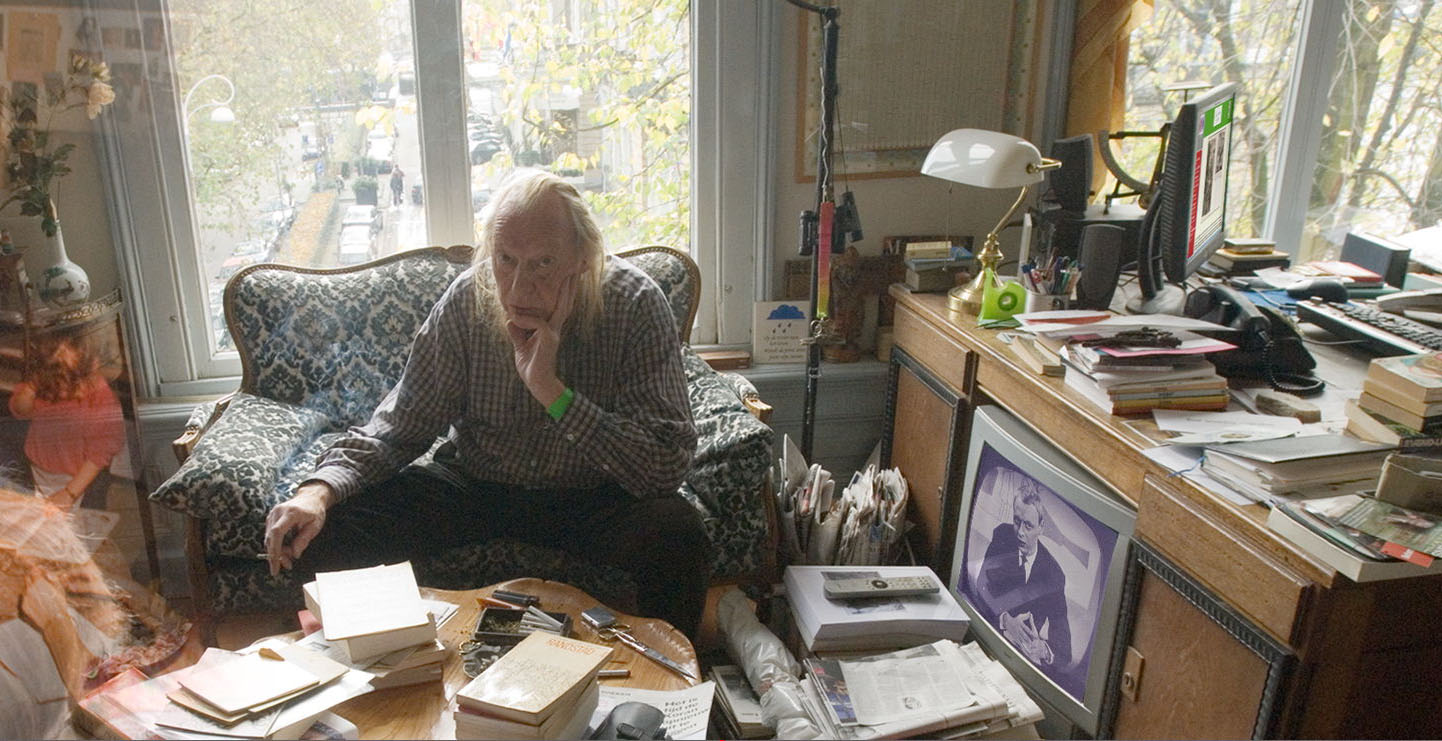
Simon kwam op mijn weg in 1966 toen ik belangstelling had voor zijn initiatief voor een  ‘Sigma Centrum’ in Amsterdam (zoals gepubliceerd in het Randstad 12 nummer in 1966 Manifesten~Manifestaties samengesteld door Simon Vinkenoog, naar een idee van Alexander Trocchi “de onzichtbare opstand van een miljoen geesten”). Ik werd uitgenodigd zijn documentatie van nieuwe kunststromingen en andere sociale, religieuse alsook politieke bewegingen te komen bekijken. Mijn eerste bezoek was in in zijn huis aan de Noordermarkt, toen al volgestouwd met betekenisvol papier, gemapt en gerangordend. Knipsel, krant, pamflet, foto, folder, brochure, brief , kattebel en tekening werden onder een zwierig geschreven noemer vereenigd in een map. Mappen regen zich aaneen, verhuisden naar dozen en een groeiend aantal kasten waarvan op een gegeven moment de bovenste plank enkel nog met een laddertje bereikt kon worden. Stapels kranten en bladen vermengden zich met boeken, kussens, lage tafels en ander huisraad  tot het voortdurend in beweging zijnd gezellig informatielandschap dat ook al al zijn latere woningen beheerste. Noordermarkt, Weesperzij, Sarphatistraat, domeinen van de schrijver en huisdocumentalist die met het geheugenwapen – de schaar – dat wat met de waan van de dag vervluchtigt een toekomstwaarde wist te geven: piepkleine politieberichtjes vanaf de vijftiger jaren over drugs in Amsterdam, allereerste happenaars in de States, jazz & poetry, Rimbaud, Artaud, situationisten, raketvaart vanaf Cape Kennedy, hipsters van het Leidseplein, diggers in Zwolle, biodynamisch boeren in Drente, stemmen van gene zijde, kruidenbulletins van Melly Uildert, kosmisch humanisme van Oliver Reiser … Knip, knip weer een gat uit het tableau van de dag, voor een nieuwe samenhang, een ander inzicht…, bewaard voor later. Als er al een beperking was van zijn aandachtsgebied, dan lag dat buiten de perken: les terrains vagues. Simon was niet enkel een knipper, plukker, lezer, vergaarder en bloemlezer, maar tegelijk een vrijgevig doorgever aan anderen van al zijn kennissprokkel. Meervoud is zijn stuwende kracht, wijzen op de overstelpende rijkdom aan mogelijkheden. Daarmee is de opsomming zijn stijlkenmerk, zoals in zijn voordracht – de gestaag toenemende snelheid, die vanzelf tot cadans wordt. Gedichten als dansende kaartenbakken. Romans die zijn eigen dagelijkse leven boekstaven en die je tegelijkertijd als verlokkelijke niet verplichte bibliografie kunt gebruiken. Hoeveel mensen heeft hij zo al niet op een nieuw spoor gebracht? (*)

klik op de foto voor een grotere versie ... click the image for a bigger version

Op deze foto van Pieter Boersma zie je Simon met zijn geheugenwapen: de schaar. Dit is herfst 2006, een opname-sessie ten behoeve van een tentoonstelling over de Nederlands/Vlaamse connectie met de ‘situationisten’ in het Centraal Museum Utrecht. De telefoon van zwaar bakeliet, het Amstel Hotel in het verschiet en op het bureau een nog steeds gevulde dikke kantooragenda. Geen spreekbeurt, geen forum, geen happening was hem te min of teveel, van schoolklasje in de provincie tot televisieshow, van kraakpand met punkdichters tot universitair literair symposium. Veel van die spreekbeurten waren voor de eigen kost en de gastvrijheid die zovelen in de verschillende  ‘huizen Vinkenoog’ hebben genoten. De archieven van Vinkenoog (**) herbergen veel schoolblaadjes,  correspondentie en ander verslagen, waarin met enthousiasme teruggeblikt wordt  op deze – vaak nederige – optredens. Het is een onderbelichte kant van Simon als cultuurspreider van onderop, die bij zijn verscheiden gemeld moet worden, opdat wij in hem eren wat de literaire establishment van Nederland nooit heeft willen erkennen, laat staan belonen.

Klik/Click Scroll voor/for link

klik plaatje hierboven voor boekenkast scroll; het laden van deze scroll kan even duren, naar gelang de snelheid van uw aansluiting. Klik op het beeldvlak om de scroll in gang te zetten, stoppen klik weer. U kunt uw browser – als u een groot scherm hebt – zo breed mogelijk maken en ook desgewenst via de onder schuifbalk de scroll naar een gewenst punt bewegen. De hoogte van de scroll 1: 1 is 740 pixels… desgewenst kunt u via (view) opties het beeld wat vergroten. Zal eens een nieuwe versie maken met meer ‘reoslutie” (detail. Deze scroll dateert al weer van 8 jaar geleden.

Verzamelaars en veellezers omgeven zich – al de electronische wonderen ten spijt – met kasten en kasten vol met boeken en andere herinneringsobjecten die in de loop der jaren zich nabij de boeken op de planken genesteld hebben. Soms heerst er orde op de plank, soms enkel wanorde, meestal een intrigerende combinatie van verwante schrijvers, naastgelegen onderwerpen, half doorgevoerde  op rij gezette classificaties, vrolijke combinaties en dwarse verbanden. De regel lijkt wel te zijn dat, hoe minder systematisch hoe beter de eigenaar gebruiker er de weg in terug weet te vinden. Ons geheugen is immers ruimtelijk en tijdens denken en gesprekken fladdert onze geest over planken, langs banden en door de pagina’s. Nu drie jaar geleden legden wij (***) een stukje van zo’n persoonlijk informatielanschap van Vinkenoog vast en als klein monument voor Simon nodigen wij u hierbij uit met uw eigen associaties langs de planken van zijn boekenkasten te dwalen en zo zijn en uw eigen leven even terug te denken…

Tjebbe van Tijen 11/12 juli 2009 bij het krieken van de nieuwe dag

(*) De beste bibliotheek-catalogus ter wereld worldcat.org geeft 356 titels/hits met Simon Vinkenoog als auteur; Google Books geeft 855 (deels doorbladerbare) boeken en tijdschriften met Vinkenoog als auteur of genoemde persoon; Deze twee links halen een heleboel internet-ruis weg die bij een gewone Google zoekactie opkomen.
(**) Het merendeel van de archieven van Simon Vinkenoog (Collectie Vinkenoog) zijn nu bij het Internationaal Instituut voor Sociale Gschiedenis in Amsterdam (60 strekkende meter archief); ook is er archiefmateriaal bij het Stadsarchief Amsterdam en het Letterkundig Museum in den Haag te vinden.
(***) “Situationisten op drift” een interactieve installatie voor het Centraal Museum Utrecht (Tjebbe van Tijen/Imaginary Museum Projects, i.s.m. Pieter Boersma en Rolf Pixley; 2006/2007)

Read Full Post »

« Newer Posts