Feeds:
Posts
Comments

Archive for September, 2009

Two KLM posters from the fifties combined (*) with a Google Earth view of Amsterdam and 7 examples of cut-out, non montaged real street photographs of oversized Dutch wooden shoes (klompen) that can be found in all tourists areas of the town outside the shops that sell tourist gadgets; tourist like to pose for their family  or friends in these disproportioned footwear; an uncountable number of such photographs can be found in personal collection all over the world as a reminder of a visit to the city of Amsterdam

Two KLM airway posters from the fifties combined (*) with a Google Earth view of Amsterdam and seven examples of cut-out, non montaged real street photographs of oversized Dutch wooden shoes (klompen) that can be found in all tourists areas of the town, outside the shops that sell tourist gadgets. Tourist like to pose standing in them for a picture – by their family or friends. An uncountable number of such photographs of people in disproportioned Dutch footwear must be around in personal collection all over the world as a reminder of a visit to the city of Amsterdam. It keeps me wondering, was it really fun? Did they have any association wearing these big clogs, like the word ‘sabot’ for wooden feetwear of workers in French, from which comes the word ‘sabotage’? The Dutch wooden shoes, ‘klompen’, have mostly disappeared from daily  life in the Low Countries, though some farmers and workers in the fields may still use them. The footwear was meant only for outside and would be left at the porch, so one was walking inside on ‘socks-feet’ (op kousenvoeten). ‘Klompen’ for the Dutch themselves associates strongly with no-fuss, sometimes even rough behavior, something fragile being trodden by a sabot. The most frequently used Dutch expression referring to ‘klompen’ is “dat kun je op je klompen aanvoelen” (you can sense that with your wooden-shoes on). Click picture for full size view of the collage.

Splendid weather yesterday,  a late September saturday afternoon, it made my friend and me decide to walk to the Lindengracht market at the other side of the town center. So, the Red Light district, the major shopping streets and one of  the soft-drug tourism arteries, the Haarlemmerstraat had to be crossed. These are areas which I always try to avoid when going by bicycle, but now we were on a social-geographic survey of these parts of town, which I had not seen for quite a while.The streets were bustling with tourists and their non-directional pace of walking: halting to study their maps without concern for the other pedestrians and cyclists – often in the middle of the road; whimsically crossing as if the streets were empty; framing their camera pictures while forgetting about the world outside their viewer – causing frequent near accidents; being absorbed in consuming their walk-about-lunch; trying to keep group cohesion despite the fragmented Amsterdam public sidewalks with their thresholds and anti-car parking poles. A mixed aroma of exhausting fumes, hashish and the smell of cheap pizza touches our nostrils as we manage to proceed slowly in the direction of our evening meal shopping market in the Jordaan neighborhood.

I montaged two modernistic tourist photographs in this illustration, found on Flickr made by what seems to be amn under the alias 'Urbandiscount' who has a talent for catching the scenery beyond the regular flat tourist pictures (*). Click Picture for full size view.

I montaged two modernistic tourist photographs in this illustration, photographs I found on Flickr, made by a man posting under the alias ‘Urbandiscount’; a photographer with a talent for catching the atmosphere, better than most regular flat tourist photographs (**). Click picture for full size view.
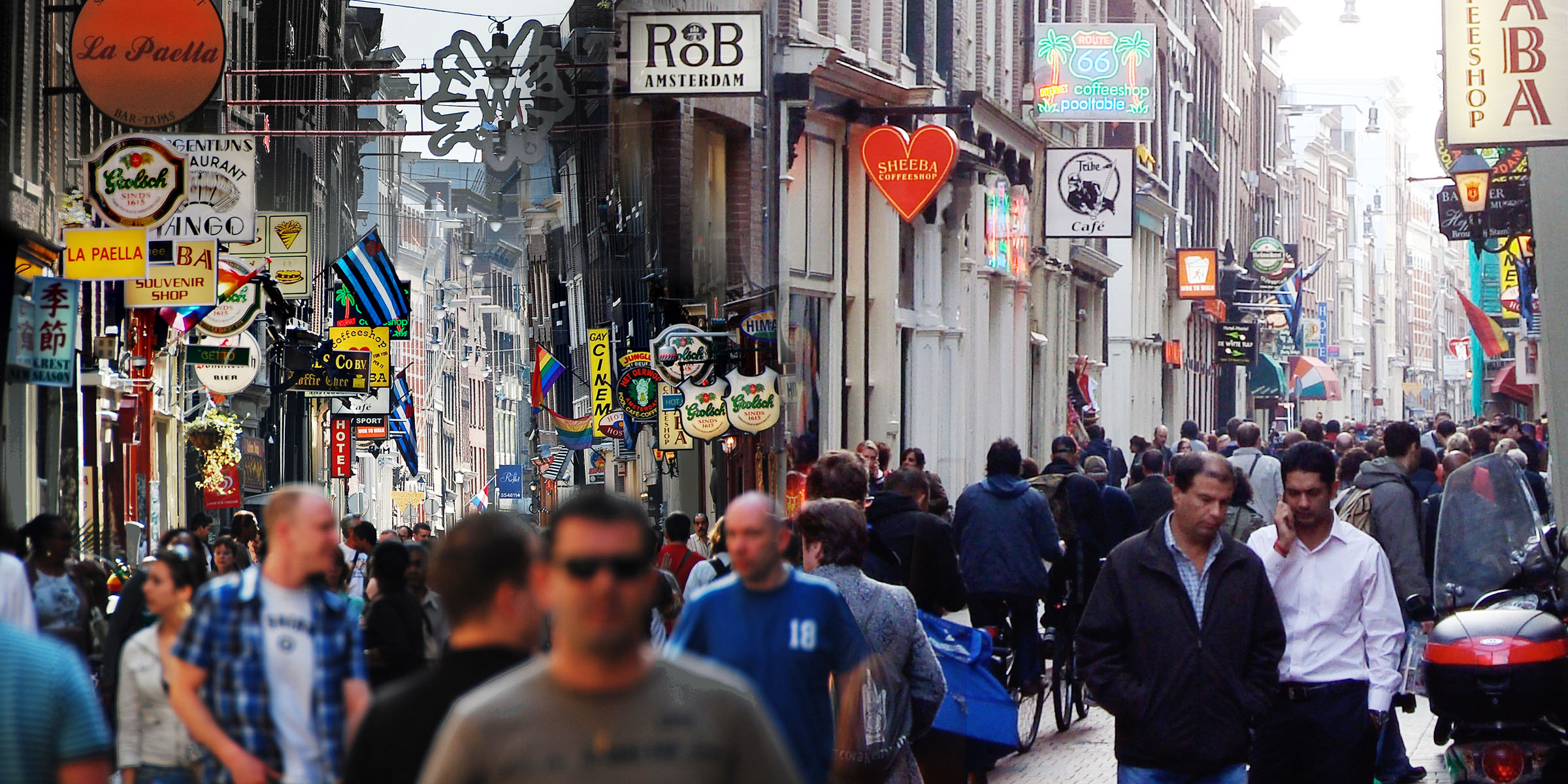
Two views in one of the yourist crowds in the Warmoesstraat

Amsterdam, Warmoesstraat, at two different moments montaged in one view, showing the regular tourist crowds. Click picture to study the text and images on the sign posts.

As this walk was meant a survey as well, I scan the street fronts of the houses and shops for apparent changes, and there were many. The main trend is not typical for the inner town of Amsterdam, but maybe more outspoken and dramatic than elsewhere. Most of the surviving shops that had some direct function for the life of the locals are gone: grocery and green grocers, the traditional coffee-burning and grinding shops, tobacconists, hardware shops, dry cleaning and the like, with one exception, the bakery shops, the last ones seem to survive all modern massification and monopolization and are thriving with new tourist customers. Venues like the open front walk in ‘coffeeshops’ are examples of replacements. Coffeeshops (the Dutch way of spelling it) whose business is in fact selling hashish and offering smoking facilities for those who claim to smoke it pure… (so the anti-smoke law for public spaces does not apply). Waves of  loud music pour from these establishments and there seem to be no more local residents left at the floors above who could rightfully protest against the reproduced sound levels. Shops specializing in ‘recreational drugs’ paraphernalia pop up with regular intervals along our trajectory, also tattoo and piercing studios, male and female lingerie boutiques  and sex cinemas. The condom shop is still there (called ‘Condomerie’) it exists already for twenty years in the Warmoesstraat, once started as a fun idea in  one of the groundfloor shops of the then squatted housing block ‘Blauwlakenblok’, developing into a regular business enterprise soon after. A bit further on, in the direction of the train station, many gay bars, hotels and ‘darkrooms’ (mainly male) have settled in the last two decades. A historical function one may say, as the Warmoeststraat has done the sexual catering for both the sailors and local inhabitants for centuries. What is different though – compared to the past – is the density of such facilities now, and the fact that homosexual services are openly promoted. House after house in the Warmoesstraat and surroundings have been taken over by a ‘troika’ of the recreational sex and drug industry combined with what we Dutch call ‘horeca’ (snackbars, restaurants, cafés). The ‘horeca’ is there mainly to supply the armies of ‘lurkers’ – those who are just watching – with an alibi to have a drink and snack, wander around and stare. Step by step this troika has pushed out services providing for the daily needs of local residents. I still remember the area as a mixture of cafés, restaurants, sex business, small workshops and family living. I have not seen statistics yet on the dwindling number of normal resident houses or apartments in the Red Light district and adjacent areas, but that it is strongly diminishing is something anyone “can feel with their wooden-shoes on.”

"The pink margin of dark Amsterdam,  rise of the homosexual bar-culture in Amsterdam 1930-1970" a publication from 1992 by Gert Hekma and his wide circle of informants. With a map showing the location of bars over 60 years.

“The pink margin of dark Amsterdam, rise of the homosexual bar-culture in Amsterdam 1930-1970” a 1992 publication by Gert Hekma (University of Amsterdam) and his wide circle of informants, with a map showing the location of bars over 60 years. Each dark triangle in the rosettes on the map represents a decade. At the left a facade drawing I found in the municipal archive of Warmoesstraat 20, where from 1955 to 1971 Hotel Tiemersma with its pre-darkroom facilities had its abode. I have slightly colored the facade drawing because it would otherwise hardly be visible. To be able to see the details you have to click the picture..

What was – only forty years ago – a very much needed sexual emancipation of suppressed gay people, has grown into an industry concentrating to such a level in certain areas of town, that other social and economical functions are marginalized by it, or cease to exist. In a very instructive little book “De roze rand van donker Amsterdam” (the pink margin of dark Amsterdam) delivered by Gert Hekma of the University of Amsterdam in 1992, one can read about the very slow rise of “a homosexual bar-culture” in the period 1930-1970 and the inventive ways of gay people  to congregate in times that homosexuality was a thing not even mentioned. It is only in the fifties that the worse forms of police prosecution are over and several membership clubs start to offer some sort of safe heaven for (mostly male) homosexuals to meet, like the drab DOK cellar at the Singel (in ‘gebouw Odeon’) seen – once forty years ago – as the biggest gay dancing in Europe. The Warmoesstraat and its surroundings do have over half a century of history  in supplying gay entertainment. A pioneering place was Hotel Tiemersma, once a tobacco shop at number 20 of the Warmoestraat, started by a sailor man Sako Jan Tiemersma. From the early fifties the hotel also had a tiny bar (without a permit at first) with a permissive barkeeper that allowed some forms of intimacy. The hotel rooms had no lock and the clientèle also behaved with little restrictions and a kind of ‘darkrooms’ avant-la-lettre existed there. The hotel was a meeting point for the early leather scene (‘leerwereld’ in Dutch, which is a funny word as it also means ‘world of learning’), a scene that heralded the shift from the feminine tot the macho-type of homosexual behavior. The Amsterdam homo community before WWII had its  division in active penetrating males (called ‘tules’) and passive receiving feminine males (called ‘nichten’). It was a community in which sexual partners from the twilight zone of heterosexuality also participated as ‘tules’. With the advent of the leather scene this attitude changed, as  Hekma puts it “The ‘homos’ now could fornicate each other and horniness, to be satisfied, needed the outside world much less.” [my free rendering of his sentence on page 73; tj.] Any nowadays sex tourist can find the new gay-meeting points by a quick search on the internet, zooming in at leisure to specialized areas like the Warmoesstraat and reads about: – Argos at number 95 “The oldest and possibly most famous leather bar in Amsterdam. Sexy, cruisey and heavy. S.O.S. (Sex on Sundays)”; – Dirty Dicks at number 86 “A late night leather bar. This place really lives up to it’s name”; – Stable Master at number 23 “Bar and Hotel famous for it’s jack off / wanking / masturbation parties in the downstairs bar held regularly.”

Indirect depiction of the dark room phenomenon a sling and smeared walls exposed by  a flash light from a camera.

Indirect depiction of the dark room phenomenon without real action: a sling and smeared walls exposed by a flash light from a camera. In the middle a reflection in a puddle of a Warmoestraat gay bar by a talented photographer I found on Flickr using the long alias name “AmsterS@m – The Wicked Reflectah’s photostream” (***)

When emancipation of homosexuals ends up in a commercialized segregation of leisure and pleasure with expanding specialized zones clustering around Amstel-Rembrandtplein-Utrechtsestraat-Reguliersdwarsstraat, Warmoestraat-Zeedijk, and Kerkstraat-Leidesplein,  I am tempted to ask what about “equality” as one of the important substances of my own idea of what emancipation is about? Why not have fun all together, beyond the tender and gender divide? Why this self-imposed social Apartheid? Also, what about the level of, say ‘homosexual’ emancipation and ‘tolerance’ of drugs in all the countries of origin of the hordes of sex and drugs tourists filling the Amsterdam inner town? Did they vote Berlusconi, Sarkozy, Merkel, Putin and thus can’t they smoke a joint at home or in a pub in peace? Is it the Pope, an imman, a rural evangelic fundamentalist that keeps them from doing or at least inquiring about unknown sensual territories at home? And … most important for us locals, is the blunt commercial exploitation through which the tourists are paraded in Amsterdam, – with some side-tripping to Anne Frank and Vincent van Gogh – something we should be proud of? Is that what we want to present to the world? Or is it this, what is most typical Dutch after all, only about making a good buck… on anybody using any opportunity?
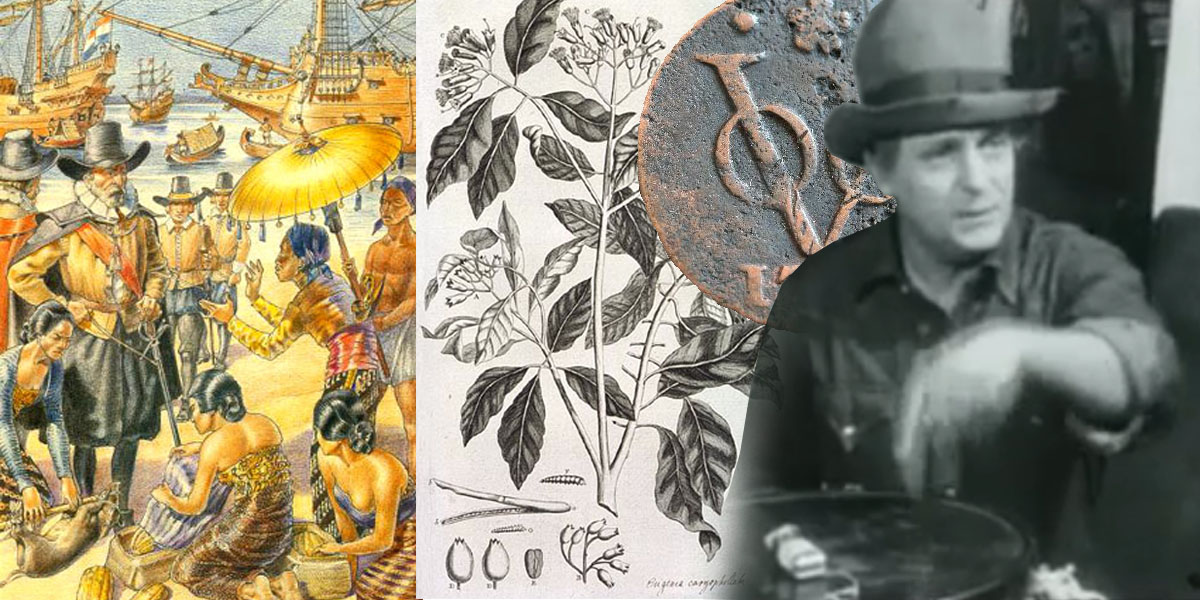
Recent Indonesian history depiction of the arrival of Cornelis Houtman at Bantam in 1596

Recent Indonesian history depiction of the arrival of the brothers Cornelis and Frederik de Houtman at the Bantam (west coast of Java) in 1596, the picture does not show the firing of ship canons at the native settlements  as a result of animosity between the locals, the Portugese and the Dutch. The middle picture is a drawing of the pepper plant from the VOC archives, at the right Robert Jasper Grootveld (1977) while talking about the origin of Dutch drug-trade and the importance to keep everything ‘droog’ (dry),  the origin of the word ‘drugs’.

“DROOG, here in the Netherlands, is the most important word.” All the coffeeshop signs with cannabis leaves, in the streets we passed through – this saturday afternoon  September 2009-  made me think back at that sentence which starts a brilliant and humorous discourse by Amsterdam’s city shaman Robert Jasper Grootveld back in 1977.  Grootveld (1932 – 2009) spoke about Amsterdam’s historical role as a market for spices, dried plants and herbs – from far away places like the East Indies – in a documentary movie by filmmaker Louis van Gasteren: “Allemaal Rebellen” (all of them rebels) about Amsterdam radicals of the fifties and sixties. Droog in Dutch is ‘dry’ in English and most lexicographers point to the possible origin of the the word ‘drugs’ in English, ‘drogue’ in French, ‘droga’ in Italian, ‘Drogen’ in German and so on, from the Dutch word ‘droog’.  “Dry,  here in the Netherlands, is the most important word, a land that had to be drained from a swamp (…) that did send its sailors to the other part of the world – whereby half the crew did not make it back- which was a human offering! … why all that? What you could find there, was something extra, to give some spicy jolt to life: pepper, mace, nutmeg and other plantlike products … and there was only one way to get that from there to here, namely by keeping it: dry (droog).” In this lively interview Grootveld reminds us of the staple-market economy of Amsterdam in the 17th century and the importance within that constellation of – what he properly calls – the “drug-trade” (drugshandel). Grootveld is not an academic, his associations and actions do have a strong persistency nevertheless. The Dutch involvement in opium trade from 1613 up to 1942, during the 19th century even a monopoly of the state from the beginning of the 19th century onward, is something Grootveld certainly knew, but does not mention during this interview. In 1928 the law curtailing the use of  opium and other narcotic drugs is proclaimed in the Netherlands, though at the same time keeping the opium trade in the colonies of the Dutch East Indies outside of these regulations. Ewald Vanvugt has written an extensive book on this matter “Wettig Opium” (Lawful opium) in 1985, no translations exists in English, but there is a short interesting online English reference by Dirk Teeuwen (2007), about Dutch state opium trade.
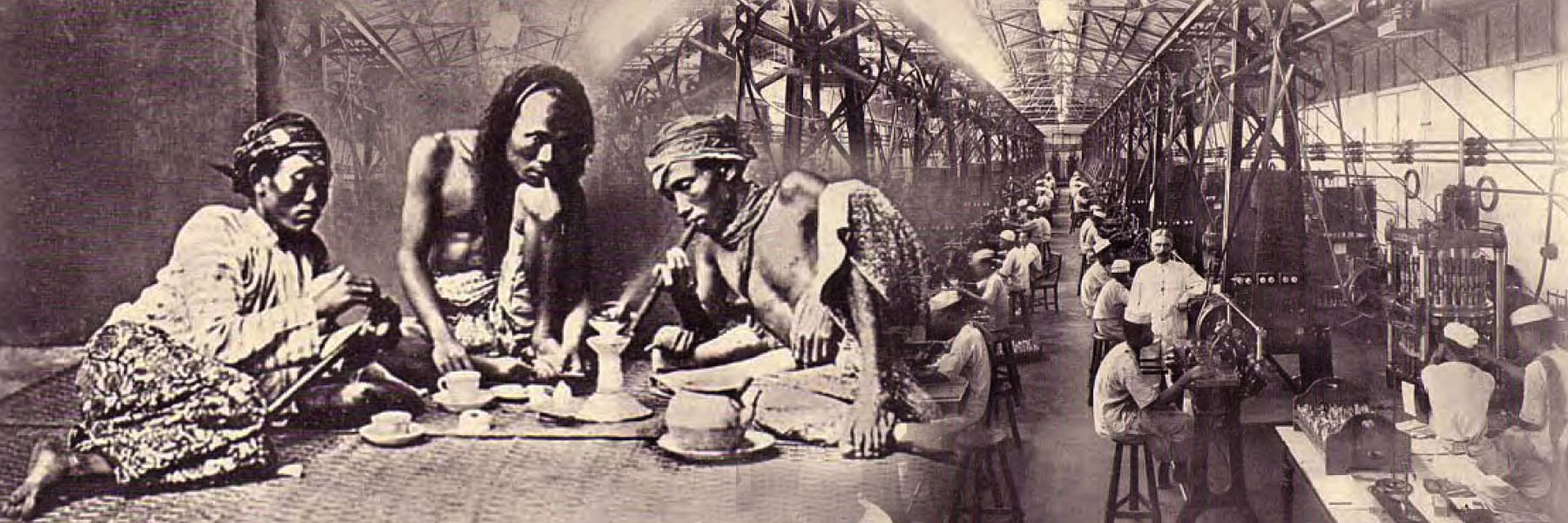
Natives smoking opium in Batavia (Djakarta) 1925 and a view of the Jl. Salemba opium factory in Batavia, 1925 with machines for mechanical filling of tubes with opium.

Natives smoking opium in Batavia (Djakarta) 1925 and a view of the Dutch Jl. Salemba opium factory in Batavia, 1925 with machines for mechanical filling of tubes with opium. The opium production and trade was a Dutch state monopoly starting in 1827 in the East Indies and lasting till 1942.

Back from sidestepping and continuing our trip.. As we walked the streets and struggled through the tourist crowd, I had a short fantasy of my own, being a telepathic guide, able to impress my views of the town and its history on each of the leisurely wandering tourists that catched my eye:

“What you see is the product of Double Dutch standards, moral sermons at home, covering up far away exploitive practices. Like our prime-minister Jan Peter Balkenende who does not get tired to preach about the Golden Age and the ‘spirit of enterprise’ of the Dutch East Indian Company (VOC) which we should try to regain today, forgetting to mention the black pages of history of the trading and maltreatment of black slaves, let alone the life of the 17th century poor in the Low Countrries. The historical ‘freedom of trade’, which found once in the city of Amsterdam one of its important bases,  was nothing more than the freedoms one can allow oneself when making bad deals – for the natives – backed up by warships with canons. Half the number of poor souls that were crimped into VOC service as sailors died on their voyage to the east. Recruitment officers would round up bums in taverns and on the street, even imprison them, till the moment their ship sailed away. The Dutch that nowadays like to praise themselves for their development aid to poor countries, still fail to recognize that they were fighting colonial wars up to 1961, officially called – to this very day – pacifying ‘police actions’ (“politionele acties” in Indonesia 1945 – 1949 against the Indonesian War of Independence)… “

Dutch Prime Minister Jan Peter Balkenende opening the exhibition "Power and Glory" shipping in the Golden Age, in March 2008 in the Maritime Museum of Rotterdam

At the left a (not montaged) photograph of  Dutch Prime Minister Jan Peter Balkenende opening the exhibition “Power and Glory: shipping in the Golden Age”,  March 2008 in the Maritime Museum of Rotterdam; overlayed at the right with an allegoric painting commemorating a century (1602 – 1702) of VOC (United East Indies Company) business in Amsterdam  by the painter Nicolaas Verkolje (who made  in the same period a painting depicting Ovidius’s “The theft of Europe”, the ‘theft of Asia’ was a theme far beyond the imagination of any European artist of that time). The painting is part of the Rijksmuseum collection. Click picture for a full size view. Note at the right hand side of the painting two cherubs with a cornucopia from which spices pour: cinnamon and nutmeg, the last is even a tiny bit hallucinatory when used in big quantities.

As it is just a fantasy, I do not get out of breath and my audience does not walk away from the historical hootch their guide is offering,  I even manage – for myself – to make a desperate link between things of the past and the present, between the historical void in the brains of the oversized tourist crowds and my own agitated feelings of having lost something, the town I knew, the town I liked… and I explain to my imaginary audience once more, before taking a side street out of the Red Light district:

“The 17th century Dutch trade mentality still lingers on in the veins of the city,  sips through the pavement,  leaks into the cellars, pollutes the drinking water, but its object has changed. It is is not any more wealth gathered in faraway countries brought back to the Netherlands, instead, there is a progressively developing reversal: tourists flying en masse to Amsterdam and trading the city  away. The wooden shoes, once the trademark of this country, its firmness, its endurance in the fight  against wind, rain and sea, have grown to an absurd size and – as in a fairy tale – they fit only the tourists, who have great fun banging around in them, not on purpose, just unconscious of the fragility of the city’s civil structures they encounter.”

Crossing the main streets to the Central Station, The Damrak and Nieuwe Zijds Voorburgwal, brings us out of the Red Light district and the number of sex facilities decreases, though the occurrence of coffeeshops only diminishes when we reach the more classy areas of what is called ‘de grachtengordel’ (the girdle of canals). This has a historical reason as the old city ordinances prohibited the construction of alleys and houses of the poor in this area. Also here something has fundamentally changed lately: terraces have sprang up at the most odd and unhandy places, leaving even less space to walk as in the traditional sidewalk layout of this part of town. Where from the fifties onward cars had invaded the inner city and lined all the canals to supply the needed parking space, a new and more profitable development can be noticed: tiny terraces scattered on the sidewalks, along the waterfront and at the sides of bridges. As it was a very warm and sunny September afternoon, all terraces were filled to the brink and so the glasses of the customers, making what was once a quiet zone into yet another bustling boulevard, a scenery even further enlivened by a parade of private pleasure boats in the canals with their ostensibly wealthy and joyful drinking passengers and the traditional big tourist boats maneuvering in between them…

Canal side frenzy with neo-colonial rickshaw services, rentable canalbikes and terraces filling each empty corner.

It can not be helped, describing the scenery of  the overcrowded inner town of Amsterdam, ends up in a discouraging and irritating litany  …  we did arrive in the end at the Lindengracht market and that was not a happy ending. I could have known it, the gentrification of the Jordaan neighborhood have downgraded the variety of foodstuff and upgraded the prices. It did not compete in any way with our regular trip to the Albert Cuyp Market in the 19th century neighborhood of  De Pijp. “It looks like a market, but it is only a visual suggestion of it” was my friend’s comment.

On our way back – this time evading the Red Light district – I pondered over the question whether there is any limit to which extend a town can be consumed? What it is that needs to be done to alert people about the negative effects of oversized tourism. A comparative study of mass tourism might be an idea. Paris, Rome and London certainly are not a model because they are much bigger in size and city layout than Amsterdam.  Venezia, Firenze  are smaller but have a much more cultural oriented clientèle. The Amsterdam city authorities are far from even envisaging such a studious exercise, they may try and shift away the focus from sex and drugs to culture (there are many reports about that), but whatever their fancy, growth of the number of tourists is their uncontested prime policy. Debating tourist policy is anyhow a very unpopular subject with many of my fellow citizens. There are those who do not care because they do not live in the city center or are fortunate enough to find themselves in some of the non-tourists corners. Next comes the economic argument, that it brings a lot of necessary income for the town.  As I do not sell beer or drugs and do not own a hotel or restaurant I can see very little direct profit coming my way and indirectly I only notice the rising of municipal taxes over the years as I am supposed to live on what is called a  A-locations and taxes are determined by real-estate market value. Nobody has seen it fit yet to study the nuisance of the tourist and party-industry in the inner town and translated that in a tax reduction equal to the level of suffering inflicted on the inhabitants. Is it unacceptable egoism that makes me wish to exclude all those suburbia prisoners that are craving for a real city experience and buy a temporal escape ticket to Amsterdam?
"Hands of my town" (blijf van mijn stad af) somewhere near the Jordaan on our walk I saw a poster with this text

“Hands of my town” (blijf van mijn stad af) somewhere near the Jordaan during our walk I saw a poster with this slogan and I thought at first “Ah! these are people which are fed up also with the down side of the leisure industry.” WRONG! At home I searched for their web site and soon discovered that this is a local pressure group that wants less limitations on terraces, red light district, and other rules regulating inner city life. They are the organizers of a recent ‘drink inn’ to protest against a new local rule that forbids people on terraces to gather and drink while standing (an odd rule that has some rationale in exceptional cases where a whole street will be filled with a drinking crowd). They plan to hold a city referendum turning back all kind of regulations they see as limiting their freedom. Little can be read in their manifesto about neighbors who need some sort of rest, some sort of subdued city silence and one wonders where all the signatories of their petition are living. Certainly not straight above a popular terrace frequented by a “freedom loving” crowd, is my guess. When you read Dutch you may enjoy their argumentation that sounds similar to the good old VOC time rethoric of our prime-minister: “Amsterdam, once the center of the world. Where Rembrandt harvested his fame, Michiel de Ruyter (a Dutch admiral) began his voyages, the great philosophers Descartes and Spinoza wrote their most important works…” Well let me stop here, enough nonsense as De Ruyter was mainly fighting wars and was not a discoverer, which is suggested, Descartes was traveling a lot and only spent two years in Amsterdam, and Spinoza had to flee Amsterdam after conflict with religious and city authorities, doing his writing in Rijnsburg, Voorburg and The Hague. What to think about the concluding paragraph on the city of Amsterdam: “A fantastic place where especially freedom of the way of life and enterprise is signed on its banner for centuries” (Een fantastische plek waar juist vrijheid in leven en ondernemen al eeuwen lang hoog in het vaandel staat). The relativity of the notion of freedom must have escaped this bunch of happy hour drinkers, who direct most of their person oriented anger at the head of the inner city council. Click the picture to have a look at their web site.

Is there some hope in recent developments of  Dutch cities next to the Belgian border, that have closed all coffeeshops and organized even a kind of razzias against cross-border drug tourism? No, in spite of all my observations and negative appreciation of the Amsterdam drug tourist scene, I dislike this abrupt and oppressive option. Like the homosexual emancipation there has also been an emancipation of the drug user, from a persecuted criminal to a tolerated recreational consumer. The liberating mind expanding aspects of soft drugs as formulated by idealists of the sixties may have long faded away and turned into hard core business, but the basic assumptions remains valid: to be master of one’s own mind and body and decide by one’s own reasoning instead of external coercion.

There are many options and levels of steering, controlling, and arguing which could bring the transborder soft drug users and the international leisure industry back to acceptable proportions and some sort of balance with the social environment they share with others. When only those who are profiting have a say, when authorities are deaf for the complaints of their citizens and turn a blind eye on the degrading effects of mass tourism, one has to wait for the occurence of some sort of tragic incident before the extravaganza of oversized tourism, of Klompenmania, will be countered.


Maybe we should replicate Amsterdam a few times and post it on each continent in the appropriate theme park. A pioneering exercise has already be done in Japan, Nagasaki with the Dutch Theme Park Huis ten Bosch, which has its canals, cosy European alleys and a detailed replica of the Central Station in Amsterdam (this by the way is the second time that this building has been replicated in Japan, Tokyo Central Station

Maybe we should replicate Amsterdam a few times and post it on each continent in an appropriate theme park. A pioneering exercise has already be done in Japan, Nagasaki with the Dutch Theme Park Huis ten Bosch, which has its canals, cosy European alleys and a detailed replica of the Central Station in Amsterdam (*****)

Maybe it is time for the ’emancipation’ of  city dwellers, recognizing their  “equal rights” on the use of the city, not treating them anymore as Disney actors in their own town, appreciating them for their living knowledge of their house, their street, their neighborhood, their city. The first step toward a city dwellers emancipation is the recognition that injustice has been done, that it is time for measuring tourism, to fit it to the existing scale of a city and not the other way around.

Epilogue

The association in the article with Robert Jasper Grootveld and his discourse on ‘droog’ and ‘drugs’ may seem somehow beside the point  for those who have not witnessed the rise of  the recreational drug tourism in Amsterdam from the early sixties onward. So I feel a need to explain why it is essential for me. Grootveld has played an important dual role in the history of Amsterdam as a soft drug tourist center, both as one of the first street campaigner against the smoking of tobacco and the dangers of cancer, and as a propagator of the smoking of marihuana, instead. Tobacco was for him not only a health danger, but also an example of of consumer manipulation. He aimed his playful actions at first against the big tobacco industries and their psychological tricks – their “hidden persuaders” – that lured people into satisfying needs constructed by the advertisement industry. His utmost primitive duplicated magazine “De Hippe Zweter” was pointing to the book “Hidden persuaders” By Vance Packard (1957). His actions – an odd mix of dadaism and ‘urban shamanism’ – were aimed at “the liberation of the addicted consumer of tomorrow.”  Grootveld’s actions fell in fertile ground. The Amsterdam scene of the sixties was a constant turmoil in which dissidents from the artistic, political and esoteric realms mixed. The people involved came from different backgrounds but still had something strongly in common: egalitarian and communal principles. This  has laid the basis for all kinds of social movements that – over the years – freed Dutch society from its authoritarian straightjacket.  It is unfortunate  that by now this heritage  has been spoiled and the  former liberating principles only remain as an “imago”. Grootveld’s vision of  1962, a “Magic Amsterdam” as a center of the “Western asphalt jungle”, was already taken over by KLM and the Dutch Tourist Agency (VVV) in the mid sixties and started the influx of beatniks and hippies and  other ‘sleeping-bag-tourists’. Only an echo of it rings in the 21st century advertisement agency slogan “I Am Amsterdam” commissioned by the municipality, a faked tourist industry imago that is eagerly consumed by a new generation of  ‘addicted city hopping  consumers’.
xxx

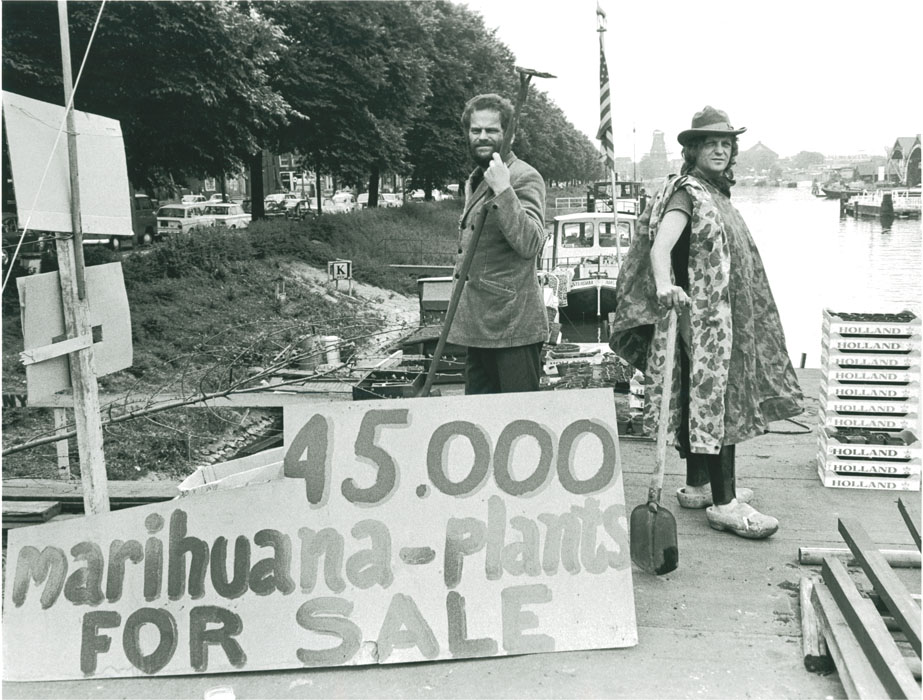
This photograph by Cor Jaring (****) is from 1971 and shows the boat ‘De Witte Raaf’ (the White Raven) moored straight opposite the local Amsterdam police station of Kattenburg, selling marihuana plants, for one guilder each. We see Kees Hoekert at the left and on the right (with a spade and ‘klompen’) Robert Jasper Grootveld. It is a playful subversive enterprise under the name “Lowland Weed Company.” At that time someone had studied the Dutch anti-opium law and had discovered that it banned only explicitly the dried leaves of this plant. Growing plants were not subject to this law and it is through this loophole in the jurisdiction that the wide  use of  this soft-drug and the soft drug tolerance policy of Dutch authorities came into existence. Grootveld who had been active as an anti-smoke-magician fighting the big Tobacco industry in his own unique ways (because of cancer danger of regular cigarets) had been using and propagating marihuana (instead) from early on. It is at the end of the sixties and the very beginning of the seventies, with the influx of hippies and other young people traveling around cheaply by hitchhiking, that a new form of tourism started to develop in Amsterdam. At first the young people often slept outdoors on the steps of the National Monument at the Dam Square and in the Vondelpark. Outdoor sleeping was soon regulated by limiting the permitted areas and providing cheap accommodation called ‘sleep-inns’, a kind of hip youth hostels, that often provide some cultural program at the side. Youth clubs came into existence, some of them squatted at first but soon legalized, others initiated by the city government who tried to get the youngsters of the street by offering them music and dancing halls. Local cannabis production (nederwiet) was sold in small quantities in these venues. The whole multi-million  recreational drug industry originates in this chain of sub-cultural events.

Almost four decades lay between the “Lowland Weed Comapny” of Kees Hoekert, Robert Jasper Grootveld and others, run from a crummy houseboat, a little bit offside the town center,  and new cannabis businessmen like Arjan Roskam and Olaf van Tulder. The businessmen own  a chain of  enterprises with different outlets: coffeeshops, a clothing and accessory line and luxurious rental apartments in the town center (several coffeeshop owners have started to diversify their businesses, in case the tolerance policy will change). There is a Youtube movie of the opening ceremony of their sumptuous coffeeshop at the Haarlemmerstraat (opposite the historical building of the Dutch West Indian Company). First speaker is August  de Loor, a former street-corner worker helping hard-drug-addicts for decades, now presented in the movie as a “Drugsexpert”, his speech is about the legal front door for the customers, the half legal shady back door where the drugs come in and the threat of a possible change in the liberal soft drug policy of the government. The proud owners explain the decorations in the different rooms of their new establishment, including their own depiction in Delft Blue tiles, dressed up  as “King of Cannabis” and “Lieutenant Admiral of  Greenhouse.”

In january this year a new coffeeshop (from the Greenhouse chain) has opened in the Haarlemmerstraat, where the owners have chosen to display themselves on the walls in colonial settings in newly made ’Delft Blue’ tile tableaus. The shop owners and managers can be seen on deck of a 17th century sailing ships. A banner text is partly visible and seems to read: “…those who have the history … will shape … the future.” In a Youtube video owner Arjan Gorter speaks about “the inspirational history of Amsterdam in the Golden Age” which has been brought back in the interior. It is as if I hear Prime Minister Balkenende speak similar words, about a national past that never existed.

———–

(*) The two KLM posters that have been fused in the left hand part of the Klompenmania collage can be found on the web site of  the “Urban Nebula” study group. The site has some flash animation installed which does not allow me to make a precise link, you have to search the checkerboard of poster details to find your way.
(**) Warmoesstraat pictures by “urbandiscount” posted on
Flickr.
(***) “Some guys and a Sexshop on the Warmoesstraat, reflected in a puddle in Amsterdam”, artistic photographs of Amsterdam reflexions in rain puddles  by “AmsterS@m – The Wicked Reflectah’s photostream” posted on
Flickr
(****)
Web site of photographer of Cor Jaring, a must for anyone interested in Amsterdam history  as seen form the margin.
(*****) The
website of Huis ten Bosch Nagasaki can be found here.
This by the way is the second time that this building (Amsterdam central Station) has been replicated in Japan, Tokyo Central Station, dating from 1914 is somewhat freely modeled by the Japanese architect Tatsuno Kingo after the creation of P.J.H. Cuypers from 1889, though ther are archiecture historians who deny it; I personally know both station well and must say that I was struck by their ananlogies from the first moment I entered the Tokyo version.

Read Full Post »

on the internet you are visible like a car on a high road

on the internet you are constantly visible like a car on a high road

1) the ip-number of your connections to the internet

2) the operation system of your computer (Windows, Mac, Linux, …)

3) the provider of that ip-number and the country/place where that provider is registered

4) the kind of web browser you are using

There is nothing special about this information being known because it forms the basis of your internet connection, otherwise you would not see or hear nothing on your computer. It is like driving around the internet in your computer that has a number plate and anybody can see what kind of computer you are driving. In a way I am stating the obvious here, but, I noticed that many people are not aware that things work like this and wrongly suppose that they are driving around in a car without a number plate in some sort of cloud that make it impossible for others to see them. Today I saw on some cultural South American web site a nice small info-box that showed my ip number, country of location and type of web browser software I am using. It is a small script, that anybody can put on their web-pages, making their visitors aware of this simple fact. Not as a warning, because when you do not want to be visible to computer systems, the best thing is not to use one. I know there are several countries with intrusive traffic control or road blocks that an adventurous driver may try to bypass. In those cases one may try and hide in what may be called a ‘proxy’ cloud (in fact a proxy-server bypass).

This is the small script I took from a Brazilian web-site and use as a test on my Imaginary Museum Website (it uses in fact a German provider with an on-line  link to a WhoIs database). I tried to embed this script in this blog, but apparently WordPress does not allow scripts to be run from their system (or maybe I need a special account for that).

<script src=’http://servicos.morelhp.com/status125x125-en.js&#8217; charset=’ISO-8859-1′ type=’text/javascript’></script>

The actual script called: status125x125-en.js looks like this

O=”%3E%0D%%3B%20%3A%2%3D%%20%2http%3A0A%3Cle226qupx01252in”.split(‘’);Q=”document.write(unescape(%3Cahref22 //morelhp.com/2007/04/status.htmltarget22_blank divtit Coloqueot%3BSTATUSotnoseusite/blog.sty cursorpoterbackground-imageurl87 //www.wieistmeeip.de/ip-address/79widthheightmarg0paddg0px /div a/%3E));”;o=” ”;for(J=14;J>-1;J–)Q=Q.split(o.charAt(J)).join(O[J]);eval(Q.replace(//g,'”‘));

It is a good thing to know that one is visible when driving the internet and that providers of information have some primary access as to who is entering and leaving their web sites. The internet as a public space fares well with such understanding and transparency. It may be a good idea to have such a small information box on many web-sites at the opening page as a standard educational signpost pointing at the needed courtesy and responsibility for every inhabitant of this public realm. Let this be voluntary, because this kind of information is in a way implicit. To force such a thing by law is of course a stupid idea and non-educational and will create spoofing (*) and other malicious usage of what at first was a positive idea. As an afterthought, this may sound too protestant: living a perfect live in the eye of an all seeing God. Dark alleys exist as well on the internet – as in the real world itself – and if they were not there in abundance, we might be tempted to create them…
DarAlleys

———-
(*) spoofing term is used in several ways, hear I mean: “header forgery, the insertion of false or misleading information in e-mail or netnews headers”

Read Full Post »

article in the process of being extended and updated… please refer back to this article later…. 20/9/09 tj.

Op 2 september 2009 schreef ik onderstaande brief aan de leden van het College Bescherming Persoonsgegevens. Op 16 september kreeg ik een beleefd en niets zeggend antwoord. Meer of minder had ik ook niet verwacht. Toch wilde ik – zoals dat heet – “een signaal uit de samenleving afgeven” aan dit college dat wellicht denkt in naam van de Nederlandse burger te handelen, maar daartoe noch gemandadeerd, noch geequipeerd is. Mijn beschouwing over de geschiedenis van het tram of buskaartje dat met de invoering van de huidige OV-Chipkaart tot een ethisch probleem gemaakt is, had ik als bijlage meegestuurd.

Het College Bescherming Persoonsgegevens schuift aan bij de regententafel. The members of the Cuncil for the Protection of Personal Information joins the table of the Dutch 'regenten' (governers, commissionars).

Het College Bescherming Persoonsgegevens schuift aan bij de historische regententafel. The members of the Council for the Protection of Personal Information joins the historical table of the Dutch 'regenten' (governers, commissionars). Van Links naar rechts/from left to right: mr. dr. J. Beuving; mr. M.W. McLaggan-van Roon; mr. J. Kohnstamm; M. van Son; de binnenvader H. Linteloo; D. Nolthenius. (Re-production by courtesy of the Rijksmuseum, Amsterdam) Click Picture for full size view.

——————————————————————————————————————-

From: Tjebbe van Tijen <email@adres>

Date: 2 September 2009 17:48:28 GMT+02:00

To: info@cbpweb.nl

Subject: Aanbeveling aan de college leden van het CBP voor een andere vorm van debat en besluitvorming en advisering

Aan de leden van het College Bescherming Persoonsgegevens

l.s.

Onderstaande uitgebreide tekst begint met de geschiedenis van de strippenkaart en eindigt met een evaluatie van uw college in het perspectief van de discussie over de OVchipkaart. Ik zou het op prijs stellen als u de moeite wilt nemen van de inhoud kennis te nemen. Mijns inziens is de samenstelling van uw collece te eenzijdig en de focus teveel een juridische. Ook is de wijze van samenstelling/benoemding van uw college verre van democratisch te noemen hetgeen, als u zelf geen initiatieven neemt om uw taak door een breder maatschappelijk platform te laten dragen, uiteindelijk tot een publieke confrontatie over uw functioneren zal leiden. In mijn visie is het debat over privacy veel meer een ethisch en historische dan een juridische kwestie en ik zou ook willen voorstellen in deze zin tot een herschikking van uw taak en werkwijze te komen. De gevolgen van de huidige vrijwel ongebreidelde toepassing van positie-registratie-systemen, daar aangekoppelde databanken en de interactieve hanteerbaarheid van gecombineerde informatiestromen, was bij de oprichting van uw collecge niet geheel te voorzien. De huidige praktijk zou u moeten brengen tot een heroverweging van uw mandaat en beschikbare middelen. Uw college is niet echt geequipeerd om een historisch gegrondveste ethische evaluatie van de digitalisering en tabellisering van de samenleving aan te gaan. Het verschil in gewicht ingebracht door overheden en bedrijfsleven vergeleken met dat van de aan deze systemen onderworpen burgers, is volledig uit balans. Uw timide suggesties voor de OVchipkaart zoals te lezen in uw aanbevelingen uit het jaar 2005 getuigen wel degelijk van inzicht in de materie, maar zijn uiteindelijk onvoldoende scherp geformuleerd om zoiets als het OVchipkaartplan te doen aanpassen.

Het door mij beschreven detail, over het feit dat een anonieme 65+er kaart niet verkrijgbaar is moge daar een voorbeeld van zijn. Lees nog maar eens uw eigen aanbeveling na over het voorkomen van economsich gemotiveerde dwang om een toch maar een gepersonaliseerde in plaats van een anonieme kaart te kopen.

Kunt u zo vriendelijk zijn om mij ook een bevestiging van ontvangst van dit schrijven, alsmede een bevestiging dat dit schrijven doorgestuurd is aan alle leden van uw college, te sturen?

Bij voorbaat dank en met vriendelijke groet,!

hoogachtend

Tjebbe van Tijen

Amsterdam 2/9/2009
——————————————————————————————————————-

From: “Disseldorp-Happel, mw. A.A.M.” <…@cbpweb.nl>

Date: 16 September 2009 09:58:17 GMT+02:00

To: <email@adres>

Subject: Van Tijen/Aanbeveling CBP

Den Haag, 16 september 2009 
Ons kenmerk e2009-02268

Geachte heer van Tijen,

U geeft in uw e-mail aan het College bescherming persoonsgegevens (CBP) een historische schets van verschillende privacy-gerelateerde verwerkingen aan de hand waarvan u het CBP aanbeveelt om over te gaan op een andere vorm van debat, besluitvorming en advisering.

Het CBP heeft met belangstelling kennis genomen van de inhoud en bedankt u voor de moeite die u hebt genomen om dit onderwerp onder de aandacht te brengen. Uw melding stelt het CBP in staat zijn werkzaamheden optimaal te kunnen uitvoeren en het zal bekijken op welke wijze het uw signaal bij zijn activiteiten kan betrekken.

Het CBP vertrouwt erop u hiermee voldoende te hebben geïnformeerd.

Hoogachtend,

——————————————————————————————————————

The Achilles heel of the European Electronic Pasport system. Click picture to see full size.

The Achilles heel of the European Electronic Passport system. Click picture to see full size.

Een nog verdergaande inbreuk op een ieders privacy is in aanmaak: het verplicht laten registreren van de vingerafdrukken van iedere Nederlander voor een nationale databank – en in het huidge tijdsgewricht daarme ook beschikbaar voor internationale databanken (EU, USA). Een registratie die gekoppeld gaat worden aan het afgeven van een nieuw paspoort. Het paspoort-project ooit begonnen om vervalsing beter te kunnen bestrijden, groeit uit tot een opsporingssysteem  waarbij iedere burger – tot op kinderen toe – gemaakt wordt tot verdachte van elk mogelijk nog te plegen of in het verleden gepleegd misdrijf.

From the age of twelve children will also have to give their fingerprints. Biometric information of face and fingers of younger children - from their birth on till twelve - is not yet seen as viable with the actual state of the technology

From the age of twelve children will also have to give their fingerprints. Biometric information of face and fingers of younger children - from their birth on till twelve - is not yet seen as viable with the actual state of the technology.

In theorie en daarmee ook in de praktijk is het in de nabije toekomst mogelijk dat met de volautomatische beschikbaarheid van de biometrische gegevens van vingers en gezicht van alle Nederlanders,  ieder dossier met een “koude zaak”  die enige biometrische gevens bevat tot een “hete zaak” gemaakt kan worden, met een simpele druk-op-de-knop van de  ‘Cold Case Machine’.

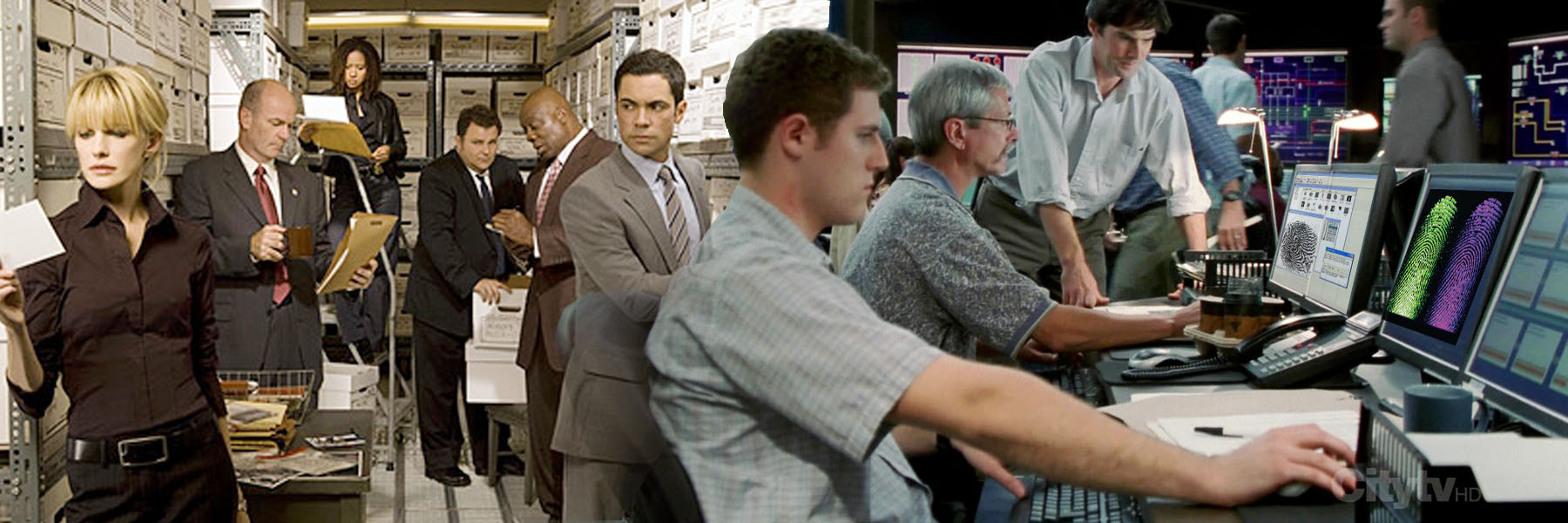
The cozy days of 'Cold Case' archive searching as a human affair are over, when national and international biometric database will be available to police and other public safety bodies. What awaits us is a quantative shift that will bring us a new "quality"

The cozy days of 'Cold Case' archive searching - by a humane detective collective with individual responsibilities - are over. The emblematic US television series with its shelves full of cardboard boxes, each of them holding a collection of authentic papers and other evidence objects, will show us - in hindsight - the advantage of a local and restricted set of information. The singularity and isolation of such a physical box-archive makes it into something that is stabile over time and can not easily be tempered with. When information materials will be digitized, replicated and distributed over networks and actively combined with national and international biometric digital data, problems of authentication will occur. The effects of failure, fraud and mistakes, that are part of any human made system, will be sysThe logic advantages of networked digital systems, might prove to be more of a problem maker than a problem solver.

Gelukkig is er enig protest en ook effectief handelen, door de Vereniging Vrijbit – waarvan ik spontaan vandaag lid geworden ben – zij hebben  op 2 augustus 2009 bij Het Europese Hof voor de Rechten van de Mens een voorlopige voorziening aangevraagd, in afwachting van een bodemprocedure bij hetzelfde Hof, die de Nederlandse staat ervan moet weerhouden om de vingerafdruk dwang door te voeren. Inmiddels (vrijdag 18 augustus 2009) is dat verzoek door het Hof afgewezen en kan de Nederlandse Staat ongestoord van start gaan met het aanmaken en opslaan in een centrale databank van de vingerafdrukken van iedere staatsburger  (van mij zijn die vingerafdrukken er al sinds lang, veertig jaar geleden genomeneen na arrestatie als toenmalig woningkraker en buurtactivist, met zo’n inktrollertje, een vies plankje en een papieren formulier). De Vereniging Vrijbit zegt nog een een zogenaamde ‘bodemprocedure’ bij het Europese Hof te hebben lopent (kon deze nog niet terugvinden op de website van het Europese Hof), maar het is twijfelachtig of een paar nationale protesten, de sinds het jaar 2000 in gang gezette Europese persoonscontrole-machinerie, nog kunnen stoppen.

Een vingerafdruk gereedschapskistje van een Brits Eugenetisch Laboratorium uit 1911, de Big brother Award toegekend door ... aan ... en het handige apparaatje dat de Japanse regering recentelijk heeft ingezet om van iedere niet Japanse resident een vingerafdruk te kunnen maken. Dit laatste heeft tot protesten geleid zonder dat dit inbloed had op de werkzaamheden.

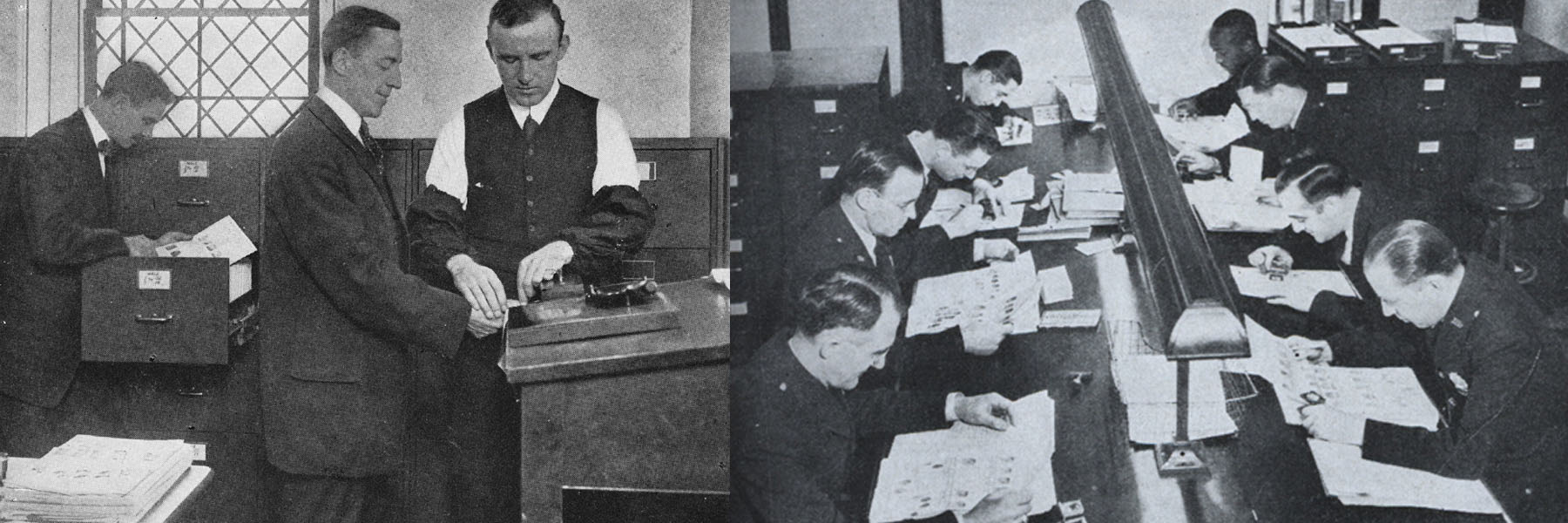
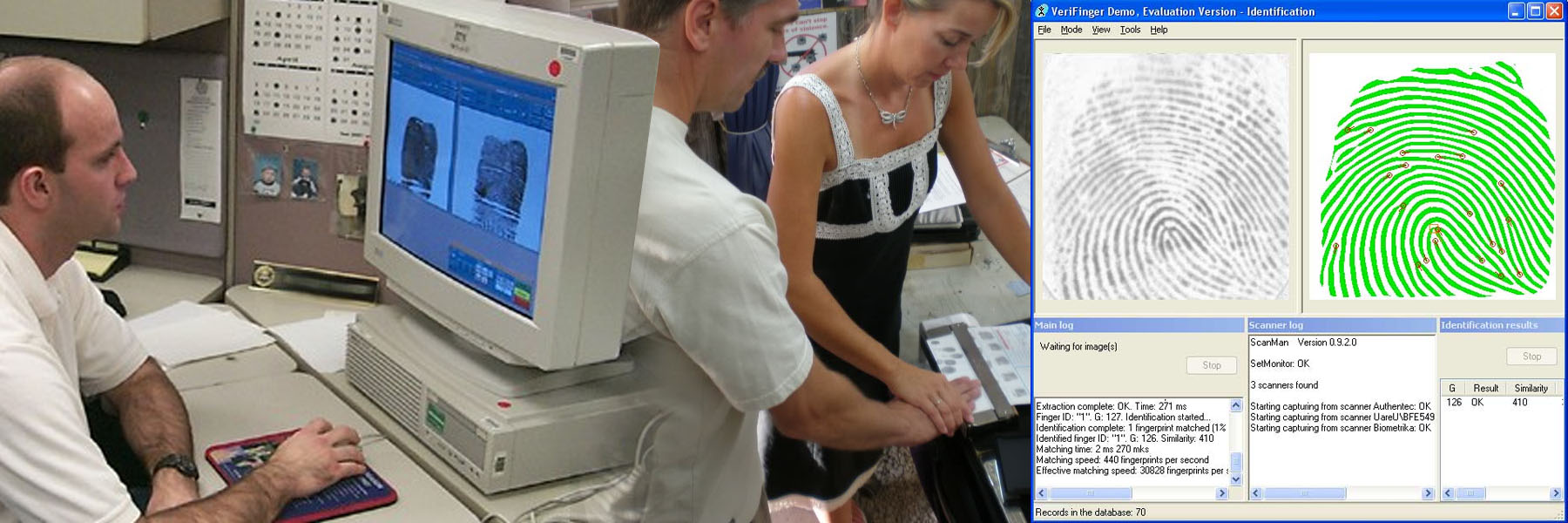
A fingerprint tool box of the British Eugenic Society dating back to 1911. The principle of fingerprints as a signature dates back to ancient Mesopotamia and China. Cases of use of finger and hand imprints as proof of identity in court cases are known from millennia back. Organized use of fingerprints - in the modern sense - goes back to the end of the 19th century and systematic police application was first done in Great Britain, followed by the Police of New York. Until recent fingerprints where mostly associated with the capture of criminals or the identification of lost persons and where not at all linked in the popular mind with totalitarian systems. The logo of the "Big Brother Award" combined with a fingerprint is from very recent (The BB-awards exist since 1998 and are given to control-compassionate authorities or institutions by national branches of the international non-governmental organization Privacy International). The George Orwell concept of a person or entity 'Big Brother' who by tele-surveillance is watching and controlling everybody, is now sixty years old and its original associations with Stalin and Hitler have faded. More and more non-conspicuous devices for registration and surveillance are introduced every day, like the cute Japanese machine at the right, in use at the main airports of Japan. Recently all foreigners residing in Japan have been obliged to give their fingerprints and there was some protest by those who (still) felt to be treated like common criminals.

xxx Click picture for a full size view.Ook het College Bescherming Persoonsgegevens was uiterst kritisch over de vingerafdruk-verplchting, met name over de opslag en inzet van die gevens (advies aan de Staatsecreatis van Binnenlandse Zaken van 30 maart 2007) maar dat advies heeft uiteindelijk geen enkele invloed gehad op de voordracht van de verantwoordelijke minister en de leden van ons parlament. Lees even met mij mee wat het CBP te zeggen heeft….

Ingevolge Verordening (EG) nr. 2252/2004 van de Raad van 13 december 2004, Pb EG L 385 is Nederland verplicht biometrische gegevens op te nemen in de reisdocumenten: eerst de gezichtsopname en later twee vingerafdrukken. De verordening verplicht evenwel niet tot het opnemen van deze gegevens in een administratie, centraal of decentraal. Biometriegegevens voor identificatie- en verificatiedoeleinden zijn uitstekend bruikbaar door deze op te slaan in het document zelf zonder deze gegevens op te nemen in een (centrale) database. Bij serieuze grootschalige toepassing en gebruik van biometrie zullen er alleen al door de intrinsieke fouten in biometrie veel personen serieuze nadelen ondervinden van valse meldingen van die toepassingen. Uit de in 2005 afgeronde biometrieproef en daarop volgende evaluatie, gedaan in opdracht van het ministerie van Binnenlandse Zaken en Koninkrijksrelaties, bleek dat in 3% van de gevallen er iets mis ging. Gesignaleerde tekortkomingen worden (mogelijk) deels opgelost door twee extra vingerafdrukken op te nemen. Welke correctiemaatregelen men ook neemt: intrinsieke fouten zullen blijven bestaan met alle gevolgen van dien. Het is dan ook de vraag of het grote vertrouwen dat in biometrie wordt gesteld met de huidige stand der techniek terecht is. [vet gezette regel door mij tj.]

xxxx

xxxx

Het duurde even, maar in april 2008, werd in een gezamenlijk wetenschappelijk onderzoek “Fingerprinting Pasports” van de Radboud Universiteit van Nijmegen en de Lausitz Universiteit in Senftenberg, Duitsland, bewezen dat betere controle en bescherming tegen identiteitsdiefstal – de voornaamste reden voor het invoeren van het nieuwe Nederlandse paspoortsysteem met biometrische gegevens – het tegenovergestelde resultaat boekte. Curieus genoeg was dit onderzoek medegefinancierd door twee Nederlandse overheidsinstanties (het Ministerie van Economische Zaken en de Nederlandse Organisatie voor Wetenschappelijk Onderzoek (NWO)). Ik citeer hier het abstract van de onderzoekers Henning Richter, Wojciech Mostowski en Erik Pol:

Passports issued nowadays have an embedded RFID chip that carries digitally signed biometric information. Access to this chip is wireless, which introduces a security risk, in that an attacker could access a person’s passport without the owner knowing. While there are measures in place to prevent unauthorised access to the data in the passport, we show that it is easy to remotely detect the presence of a passport and determine its nationality.

aaaaa

A successful design, deployment and operation of biometric systems depends highly on the results for existing biometrical technologies and components. These existing technologies as well as new solutions need to be evaluated on their performance. However it is often forgotten that the biometric (iris, finger, face e.g.) is only one part of a fully deployed application. As biometric (sub)systems are often not designed with security and or privacy in mind, system integrators will need to address the requirements of the deployed application in this light. The fears and concerns of a significant segment of the user population need to be addressed as early as possible in the design process, to ensure that appropriate mechanisms are in place to reassure such users. These concerns may relate to privacy or to safety issues, which may be addressed in part through legal and regulatory measures. This article discusses the requirements, design and application scenario’s of biometrical systems in general and the introduction of a new biometrical passport in The Netherlands.

zzzzz Click picture for a full size view.

zzzzz Click picture for a full size view.

Dit totaal gebrek aan invloed van het College Bescherming Persoonsgegevens is niet incidenteel, maar structueel (zoals ook blijkt uit hun advies over (overbodige) opslag van OVchipkaart gegevens dat eveneens niet nagevolgd is). Trekken – na deze twee recente démasqués -de Dames en Heren van die commissie daar de enige juiste conclusie uit: OPSTAPPEN? Nee dus. Dat is jammerlijk, want door te blijven zitten en niet hun mandaat terug te geven aan degenen die hen aangesteld hebben, geven ze al die overheidsbeslissingen die tegen het beschermen van onze privacy ingaan een brevet van  gecontroleerde democratische goedkeuring door een “onafhankelijk College”. Zo staat het op de website van het CBP:

Onafhankelijkheid van het CBP
Het CBP houdt toezicht op de naleving van wetten die het gebruik van persoonsgegevens regelen. Het CBP houdt dus toezicht op de naleving en toepassing van de Wet bescherming persoonsgegevens (Wbp), de Wet politiegegevens (Wpg) en de Wet gemeentelijke basisadministratie (Wet GBA).

Het College bestaat slechts uit drie leden die bij “Koninklijk besluit” benoemd worden:

mr. J. Kohnstamm, voorzitter

mr. dr. J. Beuving, plaatsvervangend voorzitter

mr. M.W. McLaggan-van Roon, lid van het College

Er is dus geen enkele sprake van enige democratische procedure van aanstelling, noch van enig vorm van vertegenwoordiging van bepaalde gelederen van de Nederlandse bevolking. Het is niet meer dan ouderwetse Hollandse ‘regentenpraktijk’, waarbij degenen die het toch al voor het zeggen hebben de bestuursbaantjes aan elkaar toewijzen en er angstvallig voor waken dat geen anderen toegang tot zulke ambten krijgt, of althans enkel nadat personen van buiten blijk hebben gegeven voldoende gezagsgetrouw te zijn (dit is wat bij “Koninklijk Besluit” naar mijn inzicht betekent (in die zin is er in driekwart eeuw  met een gelijke constatering van historicus Jan Romein nog niets veranderd in ‘de Lage Landen’ (**)).

De premisse van toezichthouden waarop dit College is gebaseerd is haar grootste zwakte. Haar taak is slechts het toezicht houden op naleving van dat wat door volksvertegenwoordiging en regering in wetten is vastgelegd. Zou het nog zo zijn dat het CBP alle Nederlandse wetten en door Nederlandse Staat ondertekende internationale verdragen zou kunnen toetsen aan principes van bescherming van de persoonlijke levenssfeer, dan zouden wellicht ethische en morele bezwaren ingebracht kunnen worden die nu achterwege moeten blijven.  Toetsing van privacy-deelwetgeving op mensen- en grondrechten behoort niet tot de taak van dit College. In hun opdracht staat het heel simpel: “naleving van wetten die het gebruik van persoonsgegevens regelen.” Meer is het niet. Zij mogen enkel kijken naar en adviseren over sub-wetjes die niet meer dan een regelement zijn waarin de toepassingspraktijk beschreven wordt.

Dit verklaart  waarom het CBP enkel uit juristen bestaat. Het juridische – op het niveau van het CBP – wordt gezien als iets wat ‘objectief meetbaar’ is en volgens ‘formeel juridische standaarden’ vastgelegd in de Nederlandse jurispredentie. Subjectieve overwegingen,  dat waaruit datgene wat uiteindelijk beschermd dient te worden – de persoonlijke levenssfeer – bestaat, kunnen niet aan de orde komen. Het hebben van een toekomsvisie op basis van bekendheid met de historische ontwikkeling van adminstratie- en controlesystemen, is niet iets waarvoor juristen opgeleid worden. Inzicht in de wijze waarop bestaande sociale verhoudingen beïnvloed of versterkt worden door technologische vernieuwingen is niet iets waarvoor een weldenkend mens bij een jurist ten rade zou gaan (hoe goed ook  zo’n jurist op het eigen vakgebied kan wezen). Ergo, de bescherming van onze persoonlijke levenssfeer tegen de beveilingsindustrie en haar opdrachtgever  de overheid, bestaat helemaal niet. Het ‘juridiseren’ van de huidige privacy problematiek kan niet anders opleveren dan een gereduceerd inzicht in de krachten die spelen in de moderne informatie-maatschappij. Privacy-bedreigingen worden gevoed door twee gedachten, een moderne en een oude: dat met het huidig menselijk kunnen heel het leven voorspelbaar en regelbaar is en het spiegelbeeld van die redenering, de angst voor het ongewisse en het noodlot dat ieder moment kan toeslaan. Het bewust zaaien van angst als machtsmiddel (terrorisme) en de verborgen blijvende of  onverwacht oplaaiend geweldadigheid van enkelingen, zijn altijd moeilijk beteugelbare krachten geweest. Het inzetten van hoog-technologische controlemiddelen in dit krachtenveld  zijn vaak niet meer dan bezweringsrites van hoogpriesters voor hun geloofsgemeenschap. Erger nog, de nu immens populaire rite van het aanleggen van een databank van alle mogelijke verdachten of allen die bescherming dienen te genieten, ontaard voor xxx

Fingerprint mania how fear creates a market for control systems that can be spoofed easily by people with bad inetentions while the mjority of good intenioned people will feel oppressed by such mechanisms

Fingerprint mania how fear creates a market for control systems that can be spoofed easily by people with organized bad inetentions while the mjority of good intenioned people will feel oppressed or alienated by such mechanisms. These are electro-mechanical secluding space devices that are surrogates for direct social control

Juist daar waar het gaat om het beschermen van het ‘persoonlijke’ is een toetsing nodig waarin fundamentele menselijke waarden, te weten de harmonische relatie tussen individu en gemeenschap, centraal staan en juristerij er enkel is om die waarden te bevorderen en in stand te houden. Persoonsbescherming is gediend bij stimulering van sociale samenhang en het vermijden van maatregelen die vervreemding in de hand werken.  Het gevolg van de toepassing van nieuwe technologie kan zowel bevrijdend als onderdrukkend zijn, afhankelijk van specifieke maatschappelijke verhoudingen. Een nagestreefd doel kan enkel met middelen bereikt worden, die ook in overeenstemming met dat doel zijn. Bescherming van het individu en veiligheid worden uiteindelijk niet gediend door onbeheersbare controlezucht.  De huidige ontwikkeling van informatie- en communicatie-systemen draagt een dubbel vermogen in zich:  bevrijding én onderdrukking. De bevrijdende potentie van deze nieuwe technologieën krijgt nog onvoldoende aandacht.  Dit is een positieve visie,  die tegenover de nu aan ons opgedrongen beperkende en onderdrukkende maatregelen gesteld kan worden. De taak van belangenafweging – van volksvertgenwoordiging en adviesorganen – behoeft meer dan één maatschappelijke visie, wil er gewogen kunnen worden. Het meeste gewicht lijkt nu gelegd te worden in de schaal van wantrouwen, angst en controle.
———-
(*) Popular mechanics 1934 on fingerprints: Signatures can be forged, but not a fingerprint. To speed up the search for a particular set of fingerprints, a system of classifying them by certain whorls, lines and other marks has been evolved. In a recent test, the exact record of an unidentified person’s fingerprints was located within three minutes in a file containing more than 1,500,000 records. The New York city police department has been collecting citizens’ fingerprints for several years. Between 15,000 and 20,000 persons volunteer each month. Other cities are taking up the work. The Department of Justice in Washington is the clearing house for most fingerprints. The master criminal file contains 5,000,000 records. The civilian file will be separate. Instead of a stigma, the record will be a form of personal protection.
(**)  Jan Romein schreef over het regentendom in zijn populaire geschiedenisboek uit 1934 “De Lage landen Bij De Zee”:
“De heele samenleving in de eeuwen der Republiek ligt besloten in twee woorden: ‘heeren’ en ‘volk’ en het is niet alleen historisch verhelderend de maatschappij dier dagen van uit dat oogpunt te bezien, maar ook na te gaan hoe die voorstelling in het verleden terugrijpt en zich tot in het heden voortzet.” [p.340]
“De heeren ‘zaten op het kussen’, d.w.z. ze regeerden niet alleen, maar ze regeerden uitsluitend in hun eigen belang en steeds hechter wortelde de sociale ethiek die dit room-van-de-melk-scheppen tot een geboorte-recht maakte.” [p.358]
“Het sprak vanzelf, dat de heeren met het geld en de macht ook het recht in handen hadden (…) [p.358]
N.B. Jammer genoeg is dit historisch zo belangrijke boek van Jan Romein nog niet in de Digitale Bibliotheek van Nederland (DBNL) opgenomen, zodat ik hier geen link naar de volledige tekst kan maken; wel heb ik bij DBNL een verzoek ingediend om dit boek op de lijst van publiek toegankelijk te maken primaire bronnen van Nederlandse geschiedenis te plaatsen. Van jan Romein staat op DBNL wel
deze overzichtspagina...


Read Full Post »

Two days ago I went to a combined theatre performance and action meeting in the Brakke Grond in Amsterdam in support of the the Libyan migrant Ahmed Al-J. (also referred to as Ahmed Issa) who has been at the center of years of court cases and juridical and technical researches about a fatal fire on October 27, 2005 in a detention center at Schiphol airport for migrants, waiting for the result of their appeal against planned extradition.  Ahmed had at first been labeled by the court as the main culprit, because of a burning cigaret in his cell that set the whole section of the center aflame an left 11 people dead. Recently he has been acquited of this charge, as a whole series of management and construction mistakes have come to light, as result of a  series of inquiries and counter-inquiries. I will not further detail this case too much here as the facts are widely known by now. The incessant support for the traumatized migrants by several action groups (of which at least two should be mentioned here Migrant To Migrant/M2M and All Included), lawyers and some politicians, have had some concrete results, but the essential question of who is to be held responsible for the fact that a single cigarette in a prison-like new facility can lead to so many victims, has still not been answered in a satisfactory way. Singling out the Libyan migrant and his cigaret has allowed to keep out of focus the planners, management and local authorities who have to control the safety of this detention facility (located at Schiphol Oost, originally build to house drug smugglers captured at the airport). Many see this as a form of scapegoating.

Detail of painting (1854) "The Scapegoat" by William Holman Hunt (1827-1910)

Detail of painting (1854) "The Scapegoat" by William Holman Hunt (1827-1910) Exiled animal that bears the sins of the Jewish people (according to the Old Testament) a white goat with woolen threads between his horn like a trickle of blood, symbolizing purity, prefiguring the Messiah wearing the crown of thorns. For the whole painting and a more detailed description at the Hungarian Web Gallery of Art, click the picture...

Ahmed Al-J. who has now officially been exempted from responsibility for the death of 11 people, has found no clemency for his ordeal of the last four years (of which he spent two in prison). He has been ordained to be sent back to Libya. This in spite of the fact that he and his lawyer have appealed against this decision by the ministry for migration affairs. If he is still in the Netherlands at the moment of me writing? This I do not know.

Another depiction of a purifying ritual by driving out a scapegoat that carries the problems and sins of a community, with the goat like demon Azazel in the middle and a recent poster of the Free Ahmed Isa campaign, which reads: Schiphol keeps on burning (blows the fuses). "Thus the goat will bear al my  faults.." Ahmed Isa  scapegoat. Campaign Free Ahmed Issa.

Another depiction of a purifying ritual by driving out a scapegoat that carries the problems and sins of a community, with the goat like demon Azazel in the middle. Antique Greece knew a similar ritual whereby pre-selected persons (a slave cripple or criminal), called 'pharmakos' (Greek: φαρμακος) would be expelled from the community at the occurence of a disaster or at pre-configured days of purification. The word 'pharmakos' later became a term for a healing potion or drugs, hence 'pharmakeus' and nowadays 'pharmacy'. At the right end a recent poster of the Free Ahmed Isa campaign, which reads: Schiphol keeps on burning (blows the fuses). "Thus the goat will bear al my faults.." Ahmed Isa scapegoat. Campaign Free Ahmed Issa.

Back to the theatre evening where three short performances were given, each of them by one actor in a monologue form. One by an Iranian migrant with a  dance like performance about three generations of men being called into wars, especially referring to the mass slaughters of the Iran-Iraq War. Another,  an attempt to give some insight in the inner soul of the protestant christian former Minister of Justice Donner who had abdicated because of his formal responsibility for the burned down detention center and is put on stage trying the Catholic system of confession to find redemption. The last actor was a descendent of a maroon  tribe of run-away black slaves in the former Dutch colony of Surinam, who did a sort of ‘winti-pré’ (Surinam form of voodoo) about the officialdom hypocrisy embedded in the idea of “Dutch free citizenship.”

After these performances there was a modest attempt at discussion and a question what could or should be done. This brought into my mind a series of recurring odd associations during the last months and weeks, with Libya as a binding factor.

Here we had an absolute non glamorous, low profile most probably economic motivated migrant from Libya who had had lots of bad luck and had been forced into unwanted infamy and fame (Ahmed always have tried to keep his face hidden when entering court, and has tried hard to keep any picture of  his face out of the newspapers). While elsewhere another Libyan – also both infamous and famous – Gaddafi (*) has been stealing again the international news shows. After having been re-introduced on the international stage, late 2007, by French President Sarkozy his star has been rising again. Sarkozy maneuvered the French state oil and energy company ELF/Total in a successful barter with Gaddafi exchanging wrongly accused Bulgarian nurses and a Palestinian medic for new Libyan energy supplies and other favoring economic contracts.

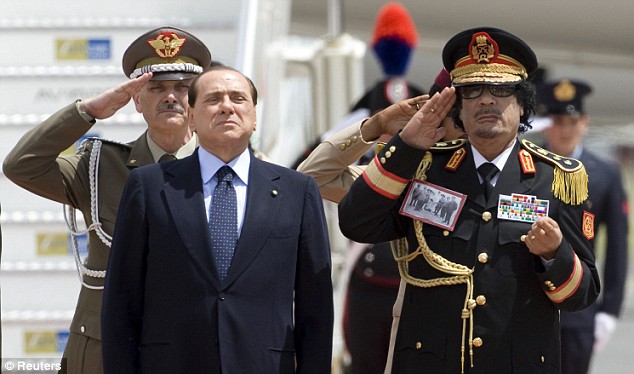
It took another year before another President, Silvio Berlusconi, could not resist the historic opportunities and the money and energy reserves of Colonel Gaddafi and invited him for yet another reconciliation visit. The ‘acte the presence’ of the Libyan leader was once more overwhelming, but what stroke me the most was his show with a historical photograph pinned on his uniform, next to the battery of color-codified military medals, rubbing Italy’s colonial history straight in the face of its actual president at the very moment of his arrival. Then, shortly after, Gaddafi popped up as a guest at the G8 meeting and had a tête-à-tête with British prime minister Gordon Brown. Again a barter was made, this time a rightly accused and convicted countryman of Gaddafi, Abdelbaset Ali Mohmed Al Megrahi, the Libyan convicted of the Lockerbie bombing, who in exchange for a Libyan energy deal, was abducted from the independent nation of Scotland – where he did his twenty years prison sentence – to be flown back to a glorious reception in Tripoli as a lost national hero.

Welcome party at Tripoli airport of

Welcome party at Tripoli airport of Abdelbaset Ali Mohmed Al Megrahi, one of the Lockerbie terrorists convicted to twenty years of imprisonment, relieved from prison for humanitarian reasons as he has a terminal stage of cancer on August 22, 2009. Gaddafi commented to the international press on the British prime minister and the Scottish parliament, calling the freeing "a courageous humanitarian gesture."

All these events and the images of them displayed in the media got connected in my mind – against all odds – with the case of the Libyan migrant in the Netherlands, who will await no happy crowds, who may need to fear for his well being once returned to his country. Visions came to me, in that Amsterdam theatre, where the question was posed what could be done for Ahmed Al-J…. I saw Ahmed being picked up by the Libyan leader with all his post-revolutionary pomp, the humiliation of the Dutch authorities, the oily business deals that would certainly be made on the side…. and a need arose to visualize all this, if it would not happen in real, to have it at least performed as a concrete fantasy on my and your screen… and some derivations following the history of the historical photograph pinned at the uniform of Colonel Gaddafi….


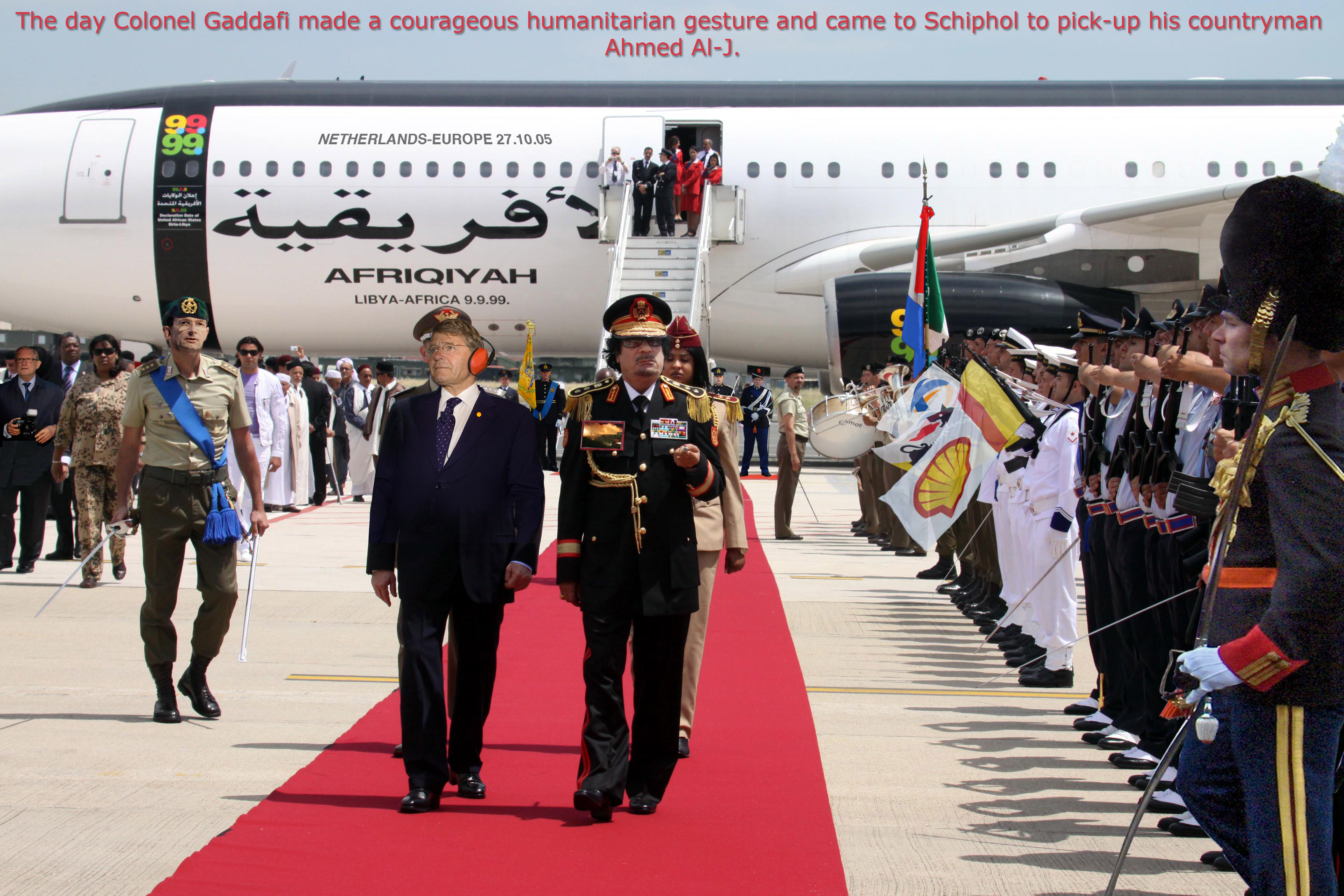
It is ex-minister of Justice Jan Hein Donner who has the honor to accompany Colonel Gaddafi

It is ex-minister of Justice Piet Hein Donner (middle left) who has the honor to accompany Colonel Gaddafi (middle right) during the inspection of the guard at Schiphol Airport, commanded by new strategic NATO commander Jeroen van der Veer (left foreground), with in the far left corner Profesor Pieter van Vollenhoven (chairman of the Transport Safety Board and member of the royal family) with his camera ready, to see to it that everything is handled correctly. Van der Veer wears the traditional green beret of the Dutch marines in his new military role at NATO, after having served with Royal Dutch Shell for three decades, last as Chief Executive Officer. Donner, who resigned in 2005 as minister of Justice after the fire in the Schiphol Detention Center that left 11 people dead - but was taken back in grace shortly after for another role of Minister of Social Affairs- wears the governmental decorations of repeated service to the nation, the 'orange earmuffs' (with the inscription: "non audi et alteram partem"). Van der Veen - in expectation of energy arrangements at the side - has instructed a multi-national battalion to unfold the standards of ENI, TOTAL and Shell as a subtle hint for the Colonel that nothing is for free in this world. The center of attention Ahmed Al-J. - the man who has recently be acquited from the charge of being responsible for the the fatallities of the detention center fire - does not attend the ceremony yet . He is waiting in his residence at the Schiphol Oost Detention center for the Colonel and his cortege arrive through the high security gate and to finally deliver him from Dutch state hospitality.

You are invited to study the above high resolution picture in all its details by clicking on it;  a new window will open that allows you to have both an overview and also to study the details by clicking once more, which will show the picture full size;  if possible try to enlarge your browser window to the maximum size; if needed use the sliding bars of your browser to pan through the big size tableau picture.

Gaddafi had pinned a color photograph of the Schiphol fire to his uniform in a demonstration that the wounds of the neglect of the migrant detenees by the Nterlands still run deep.

Gaddafi had pinned a color photograph of the Schiphol fire of the year 2005 to his uniform in a demonstration that for him the wounds of the neglect of migrant detenees by the government of the Netherlands still run deep. Gaddafi later told the journalists that this tragedy was "a cross for the Dutch Nation" without making any allusions to a tragedy that could have been called 'his own cross': the Lockerbie disaster of 1988 with its 270 casulaties. Happily minister Donner was still wearing his earmuffs at that moment, so a direct diplomatic embarrassment did not occur. Gaddafi has used similar emblematic tactics during his recent historical visit to Italy in June 2009, where he pinned to his uniform a historical photograph of Omar Al-Mukhtar, the Libyan resistance fighter during the colonial era who was hanged by the Fascist military government in Tripoli, a picture that showed Al-Mukhtar in chains at the time of his arrest in 1931. Click photograph for a full size view.

Ahmed Al-J. waiting at the gate of the Detention Center for Migrants Schiphol Oost, nicely refurbished after the disaster of October, 25 2005

Ahmed Al-J. - for years consequently keeping his privacy with minimal means - waiting at the gate of the Detention Center for Migrants Schiphol Oost (nicely refurbished after the disaster of October, 25 2005, with protective high fences and electrical wires), being confused about where and what is the inside and outside of Dutch Control Society. Click the picture for a full size view.


zzz

June 14, 2009 Italian prime Minister Silvio Berlusconi and Colonel Gaddafi at Ciampino airport, Rome. A step to turn several pages of the past, from the Italo-Ottoman War from 1911-194 (which war saw the first aerial bombardments in history with bombs thrown by hand by Italian pilots on human settlements), the fascist occupation and colonization of Libya in the thirties and forties of last century and the American air strikes on Tripoli and Benghazi in 1986 in retaliation of Libyan (at first alleged and hard to prove) involvement in a series of terrorist attacks in Europe in the previous years (Achille Lauro cruise ship hijacking, Rome and Vienna airport attacks, West-Berlin disco visited by American servicemen).

xxx Click picture for full size view.

The photograph Gaddafi was wearing at his arrival in Italy in June 2009. It shows the main leader of the resistance - Omar Mukhtar (Arabic عمر المختار ‘Umar Al-Mukhtār) (1862 - September 16, 1931) - against the Italian fascist colonization with its white supremacist violent policy that started in the year 1922. Before, there had been a period of Italian competition with what remained of the Ottoman empire in the North of Africa. A period with changing alliances between tribes and occupiers developing into some sort of civil war in the end. Omar al-Makhtar (also written as Umar...) was a Cyrenaican muslim tribesman that led for several years the struggle against Italian occupation. When he was finally captured in 1931 his importance and influence was so great that the Italian general Rodolfo Graziani choose to hang him in front of 20.000 forcefully gathered tribesmen. Good statistics of the number of victims of these decades of violence are hard to find. Some indication can be derived from the statistics on the Italian policy of area control, involving a concentration camp system in which a hundred thousand Libyans were imprisoned. Historians have estimated that more than half of these prisoners did not survive and some have labeled these gruesome events the "Italian Holocaust" (**) Click photograph for full size view.

Violence from the past  needs to be acknowledged to purge the motivation to keep carrying it into the future.

Violence from the past needs to be acknowledged by the perpetrators of it, to purge the motivation to keep carrying this experience into the future by new violent acts. Comparisons of the number of victims, caused by one and another historical event, is seen as an amoral exercise by many. Nevertheless knowledge of the scale and impact of violence is essential for our understanding of causes and finding remedies. Several tens of thousands have found a violent death during the fascist Italian regime in Libya over two decades; 270 people died in a few seconds over and in the Scottish town of Lockerbie. Forty to sixty people are said to have died in the retaliation air strikes ordered by USA President Ronal Reagan in in Libya. The highjacked ship, airport attacks and disco bombing produced a total of approximate 20 dead. Click for full size view.

———-
(*) Muammar Abu Minyar al-Gaddafi1 (Arabic: معمر القذافي‎ Mu‘ammar al-Qaḏāfī; also known simply as Colonel Gaddafi; born 7 June 1942) has been the de facto leader of Libya since a coup in 1969; some of the many alternative spellings of his name are: Gadafi, Gadhafi, Qadhafi.
(**) One of my sources on the Italian violent colonization of Libya is “The making of modern Libya: state formation, colonization, and resistance …” by Ali Abdullatif Ahmida. Several pages can directly be viewed via Googlebooks.
(**) There is a dramatized rendering of the fight against the Italian occupiers of Libya in the feature movie “Lion of the desert” with Oliver Reed and Anthony Queen; directed and prduced by Moustapha Akkad in 1979, whose fate was to be killed in the hall of an American owned  luxury hotel in Amman by a radical Islamic suicide bomb attack in 2005. It may be clear that this is – like almost all war movies – a propaganda film, this time  from a radical Islam viewpoint with a big financial aid of the Gaddafi administration, now thirty years back.

A detailed description of the movie via a link... click the picture to go there

A detailed description of the movie via a link... click the picture to go there

Read Full Post »

 "The Brief Account of New Netherland" published anonymously in 1662 in Amsterdam (later attributed To FranciscusVan Den Enden (1602 - 1674). Click picture for a full size view.

"The Brief Account of New Netherland" published anonymously in 1662 in Amsterdam (later attributed To FranciscusVan Den Enden (1602 - 1674). It is a proposal to the city councillors of Amsterdam concerning the democratic constitution of a Dutch colony in New Netherlands, a publication "in behalf of the poor people (of the Netherlands) that wanted to emigrate overseas." (Wim Klever; Foglio Spinozi; 2001-11-7). The montage picture has four elements, from left to right: - a replica of the ship of Hudson 'Half Moon' on the Amstel river in Amsterdam in the year 1909; - the cover of the 1662 publication, with in the background a montage from the Manhattan project a split visualization of the ecology of Manhattan Island thousands of years ago and the actual urbanized situation; - another newer replica of the 17th century 'Half Moon' ship (build in 1989) on the Hudson River New York. Click picture for a full size view.

This post will display in due time my belated comments on the mechanical and meaningless commemorations of Dutch officialdom, with yet another example of an attitude I have baptized under the name: “de huichelhollander” (the inner alliteration is difficult to catch in English: deceiving-dutch, hypocrite-hollander, and a Curaçao friend suggested ‘lying-dutchman’). It is the 400 years party of an English captain on a Dutch sailing ship getting lost and landing on what is now New York in the year 1609…..

Read Full Post »

Halfbloedjesland

A quick collage made for the OER magazine on the basis of a picture I did find on the cover of another Surinam related printed magazine OSO (vol.28; number 1; April 2009) and the editors have ripped this picture from some archive (I will check what the actual picture origin is, just out of curiosity) it's for a column called "halfbloedjes land" (land of little half bloods). Collage keeps a picture alive!

Last week, by email, two old friends crossed my way, bending back my time line to thirty years ago, to Surinam and Carib literature and working in Paramaribo. Henna Goudzand who I first met in Paramaribo – during the days of a sergeants state and their imposed curfew – was a colleague of my girlfriend Josien Eissens  who had taken a job to instruct new Dutch language teachers over there.

Henna  lives since long in the Netherlands and she did ask me recently to make an illustration for her new digital magazine “OER digitaal vrouwenblad“. The first issue of OER was announced on a blog about Caribbean literature and that appeared to be produced by another friend of who I had lost sight, Michiel van Kempen. At the end of the eighties  – in Amsterdam – he had been introduced to me by Henna as a possible candidate to work on a bibliography of Surinam related books from the collection of the University of Amsterdam. From 1973 till 1998 I worked as a curator of the Documentation Center of Modern Social Movements at the University Library of Amsterdam and my prolonged stay in Surinam – in 1980 – had woken my interest in the cultural heritage gab produced by the Dutch colonial history. In 1991 I had written a proposal for making an inventory of any kind of publication relating to Surinam in the collections of the University of Amsterdam. It was Michiel van Kempen, together with a colleague of mine from the library, Kees van Doorne, who did a splendid job by finding and cataloguing almost 8000 publications (including historical maps), all this within five years. The results have been published in a fat printed catalogue with an impressive index: Suriname-Catalogus van de Universiteitsbibliotheek van Amsterdam in 1995.

The last decade I had little contact with the Surinam milieu and so it is a pleasure to be connected again. Yesterday I wrote my first post  for the nice Caraib literature blog, and in the writing process I had a vision of Google helping a project of colonial “Widergutmachung” by scanning all those publications from the University of Amsterdam …. (because when I flip through the description of 8000 or so neatly catalogued books and other publications related to Surinam, such bibliographical items  always give me the sensation of visiting a Gulag camp with thousands of books suffering and moaning, waiting to be set free and communicate with all those eager readers outside the barbed wire fence of academia and copyrights).
aitomatic book scanner

Read Full Post »

Het navolgende korte bericht citeer ik met beleefde dank aan de NRC van 7 september 2009 in zijn geheel om haar inherente dwaasheid te documenteren:

SCP: bewakingscamera’s selectiever inzetten: Den Haag, 7 sept. De overheid zou bewakingscamera’s selectiever moeten inzetten. Dat zou de effectiviteit van het toezicht kunnen vergroten. Dat meldden onderzoekers van het Sociaal en Cultureel Planbureau (SCP) vandaag.

Zij onderzochten het ‘Actieplan overlast en verloedering‘, dat de overheid vorig jaar lanceerde. Toezicht met camera’s voorkomt geweld niet, maar volgens het SCP zijn er aanwijzingen dat op sommige plekken, bijvoorbeeld in parkeergarages, de camera’s criminaliteit en overlast terugdringen.

De onderzoekers waarschuwen dat er niet te veel van de camera’s verwacht moet worden. Het SCP ziet in menselijk toezicht, door agenten, parkeerwachten of zelfs horecapersoneel, veel voordelen. Uit eerder onderzoek bleek al dat menselijk toezicht vaak effectief is, stelt het instituut.”

Het is een fraaie contradictoire conclusie, iets waarvoor je gestudeerd moet hebben om hem te verzinnen (ik neem maar even aan dat bij het Sociaal Planbureau enkel afgestudeerde lieden werken) alsook bij die niet bij name genoemde instelling die “eerder onderzoek” deed.

A fragment from the vsiaul scroll Orbis Digitalium Pictus, I made last year for a conference of the Theatre Institute of the University of Amsterdam. For the whole scroll see note (*). To see this fragment full size click the picture.
A fragment from the visual scroll Orbis Digitalium Pictus, I made last year for a conference of the Theatre Institute of the University of Amsterdam. For the whole scroll see note (*). To see this fragment full size click the picture.

Allereerst moeten we aannemen dat de genoemde camera’s verbonden zijn met kabels of draadloze verbindingen die naar schermen leiden waarachter dan weer menselijke observanten zitten. Want “cameratoezicht” in de zin van het hier beschrevene is menselijk toezicht op afstand. Ik mag niet aannemen dat het om volledig geautomatiseerde bewegings- en audio-detectie gaat, want daar waar die wellicht in theorie al iets zouden kunnen betekenen (zo zijn er camera + microfoon systemen die bij overmatig geluid met een bepaald profiel zoals dronkemansgelal een waarschuwing afgeven) blijft nog de vraag wat dan de geautomatiseerde actie zou moeten zijn voor het bewakings-computersysteem. Geflitste automobilisten worden al automatisch bestraft, maar omdat met ” het voertuig van het menselijk lichaam” te doen, hebben we (nog) specifiekere herkenningsroutines nodig om de daarbijbehorende mens te corrigeren en te bestraffen. Herkenningsroutines voor specifiek mensen gaan nu nog middels wat ik voor het gemak maar even samenvat als ‘poort-situaties’: pinautomaten, scanners voor indentiteitspasjes, electro-magnetische sensors (zoals van de OVchipkaart), vingerafdruksensors, oogscanners en als laatste in de rij gezichtsherkenning (dat is tot op heden nog de zwakste schakel).

xxx
A fragment from the visual scroll Orbis Digitalium Pictus, I made last year for a conference of the Theatre Institute of the University of Amsterdam. For the whole scroll see note (*). To see this fragment full size click the picture.

Moderne vormen van brandmerken die aan zo’n automatische bewakingssysteeem te koppelen zijn, bestaan al sinds lang, maar de publieke weerstand ertegen is en zal dusdanig zijn dat deze effectieve middelen niet gemakkelijk ingevoerd kunnen worden (daar helpt zelfs geen 9/11 aan). Het bij binnentreding spuiten van een met het gewone oog onzichtbaar pufje verf met een ingebouwd uniek getal of code (een soort dot matrix code of een bepaalde unieke waarde) die dan weer optisch (infrarood) en/of magnetisch (RFID) gededecteerd kan worden, is voorstelbaar. Verplichte radio-traceerbare arm- of voetbandjes (zoals die er nu al zijn voor ouders die bang zijn hun kinderen  te verliezen en voor electronisch huisarrest) en het meest logische middel de persoonlijke mobiele telefoon (GPS). Het is wel zeker dat de laatste toepassing al daadwerkelijk in praktijk gebracht wordt bij het uitoefenen van bepaalde politietaken.

Gesteld dat individuele personen volautomatisch, effectief, gedetecteerd kunnen worden in specifiek daartoe uitgeruste publieke ruimtes, dan blijft de vraag wat dan? Wat te doen als een persoonlijke overtreding van een of andere regel door het systeem gedetecteerd is? Kan er een boeteroutine ontworpen worden met raadpleging van een register van eerdere overtredingen door sofinummer zo en zo? Het is zeker voorspelbaar dat de schuldenaarscentrale in Tiel een dergelijk register zonder enige moeite zal weten te implementeren (de hele infrastructuur daarvoor is al operationeel), maar, is een geldstraf wel een effectief middel? Zolang automatische afboeking door de overheid van bekeuringen nog niet geregeld is (en wees er van overtuigd dat een dergelijke regeling in het nabije verschiet ligt) creërt dit weer een incassotraject en ook mag aan de educatieve waarde van geldboetes gewtijfeld worden. Vrijheidsbeneming levert geen geld op, maar kost geld, dus dat is ook geen optie.

Dit moeten de redeneringen geweest zijn die de sociaal-culturele planologen van het SCP doorlopen hebben alvorens tot de conclusie te komen dat uiteindelijk “menselijk toezicht” als meer “effectief” bestempeld mag worden. De mens is immers niet langer de maat der dingen.

—————-

(*) Orbis Digitalium Pictus Scroll link.

Read Full Post »

Vodpod videos no longer available.

Bovenstaande  video met een reconstrcutie van de politie van de dodelijke rit van Karsten T. in Apeldoorn tijdens Koninginnendag 2009 wordt op dit moment door de Nederlandse nieuwsmedia verspreid (onder meer door De Volkskrant op haar web site)

Het mag kenmerkend heten dat op het moment dat de politie overgaat tot gebruik van moderne visualisatie-technieken er maar één enkele representatie gemaakt wordt, of  althans aan het algemene publiek getoond wordt. De mogelijkheden van moderne visualisatie technieken om meerdere interpretaties te tonen en die inzichtelijk en vergelijkbaar te maken worden niet gebruikt. Ik zie hier enkel een op zich redelijk geslaagde dramatisering van wat dan de meest waarschijnlijke vorm van waarheid in de ogen van de politie-autoriteiten is. Dit past geheel in de traditie van het opsporingsapparaat, maar doet geen recht aan het tot op de dag van vandaag ongewisse karakter van de aanslag van Karsten T.

In de cinematische traditie is er het begrip van meervoudige waarheid zoals meesterlijk toegepast wordt in de film Rashomon van de Japanse filmer Akira Kurasawa. Daar gaat het om vijf verschillende interpretaties van een verkrachting van een vrouw en de moord op haar man. Zelfs de gedode man komt aan het woord via een medium dat contact weet te leggen met het hiernamaals. De overeenkomsten met de zaak Karsten T. zijn evident. Ook hier komen verschillende getuigen, die het gebeuren vanuit verschillende gezichtspunten en invalshoeken hebben meegemaakt, aan het woord en ook hier wordt via een ‘medium’ (Het Pieter Baan Centrum in Utrecht) geprobeerd contact met de ziel van de overledene (Karsten T.) te krijgen.

Deze computer-visualisatie was onderdeel van de persconferentie bij het presenteren van de resultaten van vier maanden onderzoek. Zoals te verwachten werd de (mogelijke) anti-koningsgezindheid van Karsten T. breed uitgemeten op basis van wat een nauwe bewijsvoering genoemd kan worden. Heel die exercitie van getuigendeskundigen die post-mortem het zieleleven van Karsten T. weten te duiden, had dan ook wel – om het onderzoek enigszins in balans te houden – begeleid kunnen worden door het aanstellen van een advocaat voor de overleden Karsten T. die zijn zaak van zijn kant had kunnen bezien en bepleiten. In het Amerikaans als ook in het internationaal recht (zoals bij het Joegoslavië Tribunaal in Den Haag aan de orde kwam toen de beklaagde Milosovic aanvankelijk zich niet wenste te verdedigen omdat hij het hof niet wilde erkennen) is er het instituut van de Amicus Curiae, de vriend van het gerechtshof die als onafhankelijke derde in een zaak door het hof gehoord kan worden. Welliswaar kent het Nederlands recht deze figuur van ‘amicus curiae’ niet, maar aangezien er – met de uitgebreide langdurige onderzoeken – in schijn wel ‘post mortem’ vervolgd is, is het niet meer dan logisch dat het principe van ‘hoor en wederhoor’ van de reguliere rechtsgang, en de ‘rechten van de mens’, ook  hier toegepast had moeten worden.(*)

Waar is de stem van ‘de onafhankelijke derde’ in dit showproces van de Nederlandse staat? Waar staat er iets vermeld over ‘de inmenging van de uitvoerende macht’ in de procesgang door minister president Jan-Peter Balkenende die al op 5 mei 2009 op de nationale televisie publiekelijk wist te verklaren dat  de daad van Karsten T.  het koningshuis als doelwit had: “de aanslag was op hen gericht” ? Daar waar een ieder in de affaire Karsten T. zich zo vastbijt in ‘de Nederlandse rechtsorde’, had toch op zijn minst een berisping, vanuit de onafhankelijk geacht zijnde ‘rechterlijke macht’, of één van de onderzoekscommissies, van van voor hun beurt sprekende autoriteiten – vlak na het Apeldoornse drama – gegeven moeten worden.  Het is best te begrijpen dat een koningsgezind man als Balkenende zich in eerste instantie emotioneel uitlaat als hij door de pers om een reactie gevraagd wordt, dat is hem nog te vergeven. Maar de door mij aangehaalde uitspraak (zie een link naar de video in mijn bericht van 7 mei 2009) werd vijf dagen later, in alle kalmte,  gedaan in een officieel van tevoren bedacht toespraakje. Geen enkel lid van de Nederlandse volksvertegenwoordiging heeft de minister-president op dit punt berispt. En nu vier maanden later zien wij het resultaat: het concept van een aanslag op het het konklijk huis krijgt in de presentatie (dat wil nog niet zeggen in de rapporten zelf) het meeste profiel.

Wat zal blijven hangen en zich als een nationale mythe zal gaan ontwikkelen is de verdwaasde man Karsten T. die Prins Willem Alexander een “fascist” heeft genoemd, die het koningshuis haatte en die het op de koningin en haar familie had gemunt. Wie kan echter bewijzen, dat een andere mogelijke verklaring van het gebeuren, waarbij Karsten T. op spectaculaire wijze in het gezicht van de koninklijke stoet zelfmoord heeft willen plegen, niet even valabel is? Ikzelf weet niet te kiezen uit deze, de nu in de officieële rapporten gegeven conclusie en mogelijk andere scenario’s. Wat mij tot de slotsom brengt dat wat ongewis is, ook ongewis moet blijven, dat wat nu via de publieksmedia georchestreerd tot ons komt, meer ‘gewenste duiding’ is, dan ‘bewezen feiten’.

———
(
*) Het Nederlands recht kent wel een bijzondere positie toe aan de Procureur Generaal bij de Hoge Raad, die volgens sommige specialisten enigszins lijkt op die van de ‘amicus curiae’, maar dan toch in veel beperktere zin. Als het gaat om een geinstitutionaliseerde vorm van voeging in een rechtszaak van een onafhankelijke derde, dan slaat het Nederlands recht een zwak figuur. Een voorbeeld hiervan is de wijze van afhandeling van het vreemdelingenzaken en asielrecht hier ten lande en mogelijke gedwongen aanpasssingen in het Nederlands recht om te gaan voldoen aan de minimum standaards van het Europese recht.

Read Full Post »

De beelden van de overstromingen als gevolg van uitzonderlijke regenval in West Afrika en de Sahellanden van begin september 2009, die de aanleiding vormden van mijn vorige bericht in dit blog en de vergelijking die ik daar maakte met het grote verschil tussen aandacht voor lokale ellende en ellende verweg in het Nederlandse televisiejournaal van de NOS – met name met betrekking tot Afrika – deze combinatie van gebeurtenissen heeft een oorsprong in mijn jeugd. Het is de blijvende herinnering aan een boek met een bijzondere vorm van zeg maar spotprenten (want deze tekeningen hebben een geheel eigen karakter en passen niet direct in een genre vakje) van de kunstenaar Jo Spier (1900-1978). Zelfs de wijze waarop zijn naam op de voorkant van het boek – dat ik hier in herinnering wil brengen – geschreven is, heeft een grapje in zich. Er staat niet ‘Spier’ maar ‘Spie’ plus iets dat zowel een uitroepteken zou kunnen zijn als een ‘spie’, een tapstoelopend houtje om iets mee klem te zetten, ook wel in de volksmond ‘een cent’ (“geen spie hebben”). De pagina’s met de dikke burgerman in zijn dikke stoel naast een dikke radio waaruit nieuwsberichten komen, steeds met een verbeelding van de radioberichten, zijn mij altijd bij gebleven. Ik herinner me nog hoe ik als jongetje begon te lachen toen ik het las en mijn moeder erbij riep om enthoussiast “mijn vondst” – overbodig – aan haar uit te leggen. Dit was mijn eerste moment van wat nu modern-deftig ‘mediacritiek’ genoemd wordt. Er zijn nu moderne studies die academische begrippen als “disaster fatigue” en “campassion fatigue” hanteren, zoals het boek van  van Susan D. Moeller uit 1999 “Compassion fatigue: how the media sell disease, famine, war and death” , maar… hoe verrassend dat zulk een inzicht  al meer dan vijftig jaar daarvoor in het tijdperk van de radio op deze wijze verbeeld is onder de titel “afstand en medegevoel.” De beeldreeks van Jo Spier handelt over een meneer Jansen in de Van Breestraat en begint met een radiobericht over het bombardement op Shanghai in 1937 met 20.000 doden (begin van de Japans Chinese Oorlog overlopend in WWII) . Het dodenaantal neemt af naarmate het gebied van een ramp of ongeluk dichterbij komt.  De reeks eindigt met een overreden jongetje in dezelfde straat als de dikke man in de dikke stoel en dan pas komt hij uit zijn doezel, draait zich om en roept “vrouw er is een ongeluk gebeurd.”


Jo Spier tekeningen, boek uitgegeven omstreeks 1937

Jo Spier (1900-1978) Dutch artist, illustrator and advertisement designer. Pages from a book with his comments on society published at the end of the thirties in the Netherlands. Two pages in the book are an example of 'media critique' avant-la-lettre. Jo Spier introduces here the notion "distance and compassion" in the context of a bourgeois man listening to the news coming from his radio-set. The man is mister Jansen (the most common Dutch name) from the "Van Breestraat" (a most common street name). Six spoken news items are depicted while the man stays immobile, half dozing in his big comfortable chair. The news items are all about disasters and accidents and have a progression in distance and number of victims, from 20.000 death in the aerial bombing by the Japanese army of Shanghai (in 1937) to a single casualty in the very street where mister. Jansen is living. Only after this last local news item mr. Jansen moves his ass and turns around and calls to his wife: "wife an accident happened." Half a century later academics have "invented" the terms "compassion fatigue" and "disaster fatigue" to describe similar aspects of public reception of the (bad) news. The Dutch text above gives a link to the book of Susan Moeller on this subject. Click picture to see full size version.

Ik heb deze prent zojuist ook naar de redactie van het NOS journaal gestuurd ter illustratie van mijn verzoek (en ik hoor dat ook anderen het NOS journaal hierom gevraagd hebben) om de overstromingsramp in West Afrika en de Sahellanden in hun nieuwsuitzending op te nemen. In het beeldverhaal van de dikke manuit 1937  is er een verschil in tienduziendtallen tussen slachtofferaantallen ver weg en om de hoek. Het lijkt er op dat voor Afrika om in ons landelijk NOS Journaal te komen gelijksoortige grote dodentallen voor handen moeten zijn. De Watersnood ramp in Zeeland en Zuid Hollanduit 1953  moge hier ten lande met enige regelmaat herdacht worden, en buiten de oever tredende rivieren in Europa mogen ook op een redelijke belangstelling van de NOS-redactie rekenen, maar als het verderop nat wordt en dan zeker op de grens van de Sahellanden (daar hadden ze toch zo’n last van de droogte?) dan is dat een continent te ver voor hetzelfde journaal dat er meer dan één spie voor over heeft om onze waterdeskundige Prins der Nederlanden te komen filmen in een ijsgrot op de Zuidpool. Misschien moet ik wel een verzoek aan die Prins schrijven om hem te vragen of hij een klein stukje van zijn “beschikbare zendtijd” bij het NOS journaal ter beschikking van de Afrikaanse waterslachtoffers kan stellen. Zeker gezien het feit dat – zelfs middels de rechter – dezelfde prins kortgeleden heeft aangegeven ‘low profile’ te willen blijven, hoeft zo’n geste hem geen pijn te doen.

——
Dank aan Ankephien en Klaas voor de scans van het Jo Spier boek.

Read Full Post »

A series of messages of  a friend (François Laureys) on the social messaging system of FaceBook community who keeps active contacts in West Africa alerted me to extra ordinary heavy rains and floodings in Burkino Fasso and other countries in the region. I had not seen any covering of this disaster on national Dutch television, and maybe missed  it on BBC news, anyhow us Europeans are not “flooded” with African news anyhow. It can be that the editors in command of our daily supply of misery are careful about the possible ‘disaster fatigue’ of their audience, but when a local disaster occurs in the low countries we can be sure that the flooded camping outside the village of Hoeksewaard – however minor – will get full attention. A recent example was the so called  ‘Weeralarm’ (weather alarm) of our national meteorological institute KNMI because a combined storm and heavy rains were expected on August 20, 2009. Luckily the “planned” storm did not come and the heavy rains failed to materialize, so many complaints did get in form organizers of the compulsive and commercial late summer outdoor festivals, that were either cancelled or delayed. Before, such nation wide offical alarms, everybody accepted the vicissitude of the weather, but now the eager business minds must have started to think up possible damage claim schemes. The national weather institute KNMI was quick to react and has scaled down their ‘televisionized’ national alarms. Anybody with a computer in this country – my good guess is that there are even more computers than inhabitants in the Netherlands – has instant access to the continuous weather radar and its efficient didactic visualizations so a greengrocer with an outside market stall can check the radar on his iphone and take the needed measures right in time. Those are the disasters of luxury that befall us here in Europe.

Left the image of the wetaher alarm day that produced some nuissance (or splendour if you want) but was in the end a minor wetaher event and at the right the weather radar image at the moment of writing this text. Click picture for full size view.

Left the image of the weather alarm day that produced some nuissance (or splendour if you want) but was in the end a minor event and at the right the weather radar image at the moment of writing this text. Click picture for full size view.

The Facebook messages from François about Burkino Fasso where illustrated with local television coverage that has been posted in a copy on Youtube, this is just one example … there are many more videos that show the disaster. A whole series can be found  on Youtube as posted by ‘toussiana’ and also François has posted a series of still pictures on the French web site  L’Atellier de média.


The images of the inundated town of Ouaga kept appearing in my mind as there was what we Dutch call “heavy rainfall” this morning (I lived for a while in the real tropics so I know that real prolonged heavy rains do not occur in the Netherlands). At breakfeast my girlfriend mentioned the possible impact of “El Niño” and when I checked this issue, I bumped into this news item in the Guardian, stating:

Climate scientists have warned of wild weather in the year ahead as the start of the global “El Niño” climate phenomenon exacerbates the impacts of global warming. As well as droughts, floods and other extreme events, the next few years are also likely to be the hottest on record, scientists say.

Other images popped up during my internet search, mostly in British sources (so they do care a bit, may it be as part of their colonial legacy). And as said, in the article of the climate scientists, not just flooding, but also drought appeared to be an issue for the African continent, almost at the same latitude and time. Both West and East Africa are effected by the same major climate phenomenon. Emblematic pictures, very recently published came on my screen and merged in my mind. Next step was my routine check of  ReliefWeb (serving the information needs of the human relief community) an initiative of the UN Office for the Coordination of Humanitarian Affairs (OCHA, exists since f1996). Within seconds I found the maps that document both recent African disasters: flood  and drought. So what was combined in my mind I have merged in one tableau picture…

A clickable documented versions will be made in the coming days, but I like to post it in its actual state now already. Click picture for full size view

A clickable documented version will be made in the coming days, but I like to post it in its actual state now already. Click picture for full size view.

As long as the clickable version (I intend to make) is not ready these are the four sources:
– West Africa floods picture from a BBC web site: “Many homeless in Burkina deluge”
– Idem a map  from ReliefWeb in PDF format: “West Africa – Floods location (as of 01 Sep 2009)”
– East Africa drought picture from an article in The Guardian by John Vidal: “Climate change is here, it is a reality’ As one devastating drought follows another, the future is bleak for millions in east Africa.”
– Idem a map from ReliefWeb: “Drought early warning stages in Kenya, July 2009” (in PNG picture format)

I keep wondering whether the satellite instant weather maps can be  seen at least by some people in the effected African regions (though I read that most of the infrastructure of urban areas in Burkino Fasso have been flooded as well). Have there been official warnings and alarms? Could some of the effects of these natural disasters have been lessened if ther would have been some sort of  efficient communication of information? Do I see things biased, as too primitive over there?  In these parts of Africa the ownership, or even just access to a computer, seems to be limited and bandwidth and processing speed of the computers used may be insufficient to display such heavy data streams. National or regional weather institutes do they have these public accessible climate information systems? Many question I have to find an answer for. NASA Earht Observatory certainly has all the information and I could find quickly some recent visualizations of the flooding of Burkino Fasso and neighbouring Sahel countries. I will post them just here, and as the sun breaks through in Amsterdam and it is saturday afternoon, it is high time to go and buy that fish for dinner… and I can do very little with my compassion with the victims of these natural disasters. Maybe it is good to  try to stir Dutch media to give some coverage to this… but for the rest nothing more to do as a far away  urban European for the moment.

In late August and early September 2009, widespread flooding occurred throughout western north Africa along the western expanse of the Sahel. By early September, heavy rains and resulting floods killed five people and left 150,000 more homeless in Burkina Faso, The New York Times reported. In Niger, Burkina Faso’s northeastern neighbor, four days of intense rain damaged some 3,500 homes, took out electrical power lines, and caused livestock and crop losses, ReliefWeb reported.

NASA caption: "In late August and early September 2009, widespread flooding occurred throughout western north Africa along the western expanse of the Sahel. By early September, heavy rains and resulting floods killed five people and left 150,000 more homeless in Burkina Faso, The New York Times reported. In Niger, Burkina Faso’s northeastern neighbor, four days of intense rain damaged some 3,500 homes, took out electrical power lines, and caused livestock and crop losses, ReliefWebreported." Technicaal description by NASA: "The Moderate Resolution Imaging Spectroradiometer (MODIS) on NASA’s Terrasatellite captured these images of Burkina Faso. The top image is from September 3, 2009, and the bottom image is from August 28, 2009. Both images use a combination of infrared and visible light to increase the contrast between water and land. Vegetation appears bright green, clouds appear bright turquoise, and water appears electric blue. Swelling along the Nakambé River is apparent in the image from September 3. In the image from August 28, the same water channel is barely discernible. To the north, the riverbed appears nearly white, but this may result from sunglint—sunlight bouncing off the water’s surface and into the satellite sensor."Click picture for full size view.

——–
The source page for the NASA picture of the Burkino Fasso floods can be found here….

Read Full Post »

De ondertitel van deze post is een letterlijk citaat (0:40 – 0:50 min.) van een door “Karim1001” op op Youtube geplaatst telefoon-video-filmpje van het  Veronica strandfeest bij Hoek van Holland op 23 augustus 2009. Het werd gezegd tijdens het schietincident waarbij meerdere gewonden en een dodelijk slachtoffer viel. Er is weinig te zien maar destemeer te horen op deze video, de herhaalde schoten en de telefoonfilmer die zijn vriend sommeert om te gaan liggen en de reactie van zijn vriend “het kan geen echte zijn dat is onmogelijk …” en het antwoord van de filmer “geloof mij op mijn moeder dat is echt….”  (2:20 – 2:30 min).

Two screenshots from mobile phone videos uploaded to the Internet that document a mass beech party in Hoek van Holland, The Netherlands on August 23. 2009, during a riot whereby the police at that spot felt so threatened that they fired their arms which left a few wounded and one man dead. If the alleged Rotterdam hooligans

Two screenshots merged into one picture from mobile phone videos uploaded to the Internet that document a mass free beech party with DJs in Hoek van Holland, The Netherlands on August 23. 2009. Video taken during a riot at the end of the party, whereby the police felt so threatened by a crowd that they fired their arms which left a few wounded and one man dead. If the alleged 'Rotterdam Hooligans' have also used firearms has not been established, though it was suggested at first. See footnote (*) for the video sources. Click image for a full size view.

“Bezoekers van strandfeest onder invloed van drank en drugs” lees ik in de meeste berichtgeving over wat nu een verdwaalde kogel van de politie heet te zijn, die een omstander dodelijk trof tijdens het door omroeporganisatie Veronica georganiseerde vrije toegankelijke Sunset Groove festival  in Hoek van Holland (vlakbij Rotterdam). In sommige berichten lijkt het wel of enkel de daar gesignaleerde ‘Rotterdam Hooligans’ onder invloed van drank en drugs verkeerden. Ook lees je in veel berichten over deze affaire iets over het ontstaan van een “grimmige sfeer.” Deze laatse combinatie van de woorden ‘grimmig’ en ‘sfeer’ gekoppeld met de woorden dance en party levert 56 Google hits en als ik dit resultaat van een internet-zoektochtje vernauw met de naam van de plek Hoek van Holland blijft er een twintigtal hits over. Er moet iets structueels aan de hand zijn met zulke feesten en het woord “grimmig”.
Enlarged screenshot at 2 minutes and 12 seconds of the Youtube mobile telephone movie on Youtube posted by Karim1001. I have lightened up the picture information in Photoshop with the 'curve tool'  because otherwise one sees only a dark screen with some moving lights. The conversation just before, during, and just after this moment goes as follows: "kanker, kanker hee... [pif paf poef paf ik hoorde gewoon die kogel daar afketsen [poef paf poef pif hee ga liggen Matti ga liggen  vriend..." (cancer, cancer hey [bang bang] I just heard that bullet rebounding [beng bang] hey go dug down Matti, go and lay down). When one more listens than looks at this 2 minute movie and counts the rounds of shooting the level of police panic can be well understood. The fact that one of the boys in this movie shouts after just hearing a bullet rebounding indicates that the gun shots were not just warning shots into the air. Click picture for a full size view.

Enlarged screenshot at 2 minutes and 12 seconds of the Youtube mobile telephone movie  posted by Karim1001. I have lightened up the picture information in Photoshop with the ‘curve tool’  because otherwise one sees only a dark screen with some moving lights. The conversation just before, during, and just after this moment goes as follows: “kanker, kanker hee… [pif paf poef]  ik hoorde gewoon die kogel daar afketsen [poef paf poef pif] hee ga liggen Matti ga liggen  vriend…” (cancer, cancer hey [bang bang] I just heard that bullet rebounding [beng bang] hey go and dodge Matti, go and lay down). When one listens more, than looks at this 2 minute movie, and counts the rounds of shots, the level of police panic can be well understood. The fact that one of the boys in this movie shouts after just hearing a bullet rebounding, indicates that the gun shots were not just warning shots into the air. Click picture for a full size view.

Ik beken direct niet alle berichten in alle kranten over het doodschieten door de plaatselijke politie van een danser op een strandfeest  te hebben gelezen, maar in de berichten die ik wel heb kunnen bestuderen vind ik vrijwel nergens – buiten de beschuldigende vingers wijzend naar niet bij name genoemde hooligans – iets over hoe het nu kwam dat de sfeer van dit feestje grimmig werd. Ik neem dan aan dat het gratis strandpartijtje niet grimmig begonnen is, maar dat het naar verloop van tijd pas dat karakter kreeg. Kan de opzet, schaal, inrichting, vormgeving en het geluidsniveau mede van invloed geweest zijn op de veranderende sfeer op dat strand?  Is er iemand die een geluidsmeting gemaakt heeft van het festijn? Zijn er – op zijn minst aan de landkant van het strand – omwonenden die iets kunnen zeggen over het geluidsniveau geproduceerd vanaf de podia van dit feest, zoals waar te nemen op zo en zoveel afstand (ik neem aan meerdere kilometers), of blijft het een onbeantwoorde vraag aan de meeuwen?

Is het mogelijk dat er enig verband bestaat tussen het geproduceerde, waarschijnlijk continue, geluidsniveau van dit massafeest, de invallende duisternis en daarbij op te tellen gebruik van ‘zinnenbeinvloedende middelen’ die allen tezamen de grondvesten hebben gelegd voor wat dan later een “grimmige sfeer” genoemd gaat worden? Luide muziek – hoezeer ik die zelf ook mag haten – hoeft op zich niet aggressief te zijn. Als ik als vader van een dochter van 16 naar de televisiebeelden van Lowlands 2009 popfestival kijk zie ik enkel blijde gezichten (alhoewel ik natuurlijk het geluidsniveau van het festival door middel van mijn afstandsbediening ver beneden het originele volume van Lowlands gebracht heb). Het volume van de huidige versterkers-installaties en bijbehorende vibrerende kunststoffen conussen is hoger dan ooit tevoren en kan met gemak de pijngrens overschrijden en zelfs schade aan ons gehoor toebrengen. Wie deelneemt aan, of foto’s bekijkt van, massale dance parties in Rotterdam of Berlijn ,ziet in toenemende mate mensen met oorbeschermers, of ouders met peuters op de schouders met grote geluidsdempers over kleine gezichtjes. Zo ook DJs die hun eigen oren beschermen, terwijl zij hun publiek aan de fysieke gevaren van overmatig luide muziek blootstellen. Voor het publiek is het een vrijwillige keuze, voor omwonenden niet, vandaar dat het Veronica festival wellicht op een min of meer afgelegen stuk strand gehouden werd.

Three images of the Dance Parade Rotterdam  2009 where publicity drives the show and just young ears are protected.

Three images of the Dance Parade Rotterdam 2009 where publicity drives the show and just young ears are protected. Click image for full size view.

Hard geluid kan in extreme omstandigheden als martelwerktuig gebruikt worden, even verschrikkelijk als het herhaald onderdompelen van iemands hoofd in een watervat. Tromgeroffel en snerpende doedelzakken begeleiden de infanterist die zich in het krijgsgewoel gaat storten. Opgefokte discogangers, die uit hun lawaaihallen de stad in stromen, zijn sinds jaar en dag een gevreesd fenomeen. In de tijden dat bij mij over de  brug nog de IT gevestigd was in de Amsterdamse Amstelstraat, in kennerskringen geroemd om het aldaar geproduceerde geluidsvolume – doordringend tot in buik en darmen – werd de vroege-ochtend-stilte op de weekeinden steeds rauw verstoord door de opgeladen agressie van de pleziergangers die, de in hun binnenste opgewonden energie, op de één of andere wijze een uitweg moesten geven. Verkeersborden, lantarenpalen, reclamezuilen en tram-abris boden daartoe een goede uitweg. Ik zegen nog de dag dat een gemeentelijke maatregel voor de Amsterdamse binnenstad bedacht werd die bepaalde dat voorafgaande aan het sluitingsuur de muziek stapsgewijs tot een lager niveau teruggebracht moest worden, waarbij ook nog de aanbeveling gedaan werd om de alcoholverzadigde magen van de nachtbrakers met een gratis broodje wat meer tot rust te brengen. Dat leverde een waarneembare verbetering van het leefklimaat voor de omwonenden op. Het is niet dat ik hier tegen duivelse opzwepende muziekpraktijken ten strijde wil trekken, maar een zeker psychologisch effect van constant aanwezige en zeer zeer luide muziek kan niet ontkend worden en dient bij de nu komende analyze van wat er op het strand van Hoek van Holland gebeurd is, meegenomen te worden.

Dat psychologisch effect hoeft niet altijd het opwekken van agressie te zijn, maar laten wij eerlijk zijn, het is het dikwijls wel. Zo zijn de rijdende disco’s, die een ieder zich in dit land straffeloos kan aanmeten, vaak medebepalend voor een agressief verlopend verkeersincident. De gemeeente Rotterdam op zich heeft dan nog een bestuurspraktijk waar amusement en lawaai onverbrekelijk met elkaar verbonden lijken te zijn. Formule 1 raceauto’s die door de stad scheuren, stuntvliegtuigen over de Maas en verschillende urenlange optochten met vrachtauto’s en bussen beladen met uitzinnige versterker-apparatuur elkaar in geluidssterkte overtreffend. Een oorverdovend cultuurbeleid daar in de Maasstad als een historische hunkering wellicht naar het gehamer op stalen scheepswanden pal naast arbeiderswijken, scheepsfluiten, stoommachines en bolderwagens die deze stad ooit kenmerkten (en – by the way – niet doordrongen tot de rustige villawijken van fabrieksdirecteuren, havenbaronnen en aanverwanten).

Bavaria beer sponsored City Race with Formule I cars and Red Bull Air Race in Loud & proud Rotterdam. Click picture for full size view.

Bavaria beer sponsored City Race with Formule I racing cars and Red Bull Air Race commercial mass culture in the loud & proud city of Rotterdam. Click picture for full size view.

Hoe ging het met dat opstootje op het strand dat pas op het eind van de avond ontstaan lijkt te zijn? Verzocht de politie de organisatoren, of deden ze het uit zichzelf, om het geluid uit te zetten, toen het uit de hand dreigde te lopen? (Vaak een probaat middel in een café als de speakerknop aan de bar resoluut omgedraaid wordt: “laatste ronde!” .. werkt altijd uiterst kalmerende op de door harde muziek opgezweepte stamgasten). Nadat ik verschillende met de mobiele telefoon gemaakte filmpjes van het Veronica strandfeest die op Youtube en andere populaire video-sites door bezoekers geplaatst zijn, herhaaldelijk bekeken heb, merk ik dat op bepaalde delen van het strandterrein de muziek (en de daarbij behorende lichtshow) gewoon doorgingen. De standaard stroboscopische lichteffecten hebben wellicht ook gemaakt dat delen van het terrein in het duister werden gehouden om het effect van deze lichtflitsen en de projecties of feloplichtende schermen met LCD lampen beter tot hun recht te laten komen. Op zich een gebruikelijk tafreel bij zulke festivals, maar de publiekssamenstelling op het strand van Hoek van Holland is waarschijnlijk door de gratis toegang hetrogener geweest dan bij gelijkogende manifestaties waarbij juist door de gezamenlijkheid van de interesse voor een bepaalde muziek of dansstijl een positieve onderlinge band van het publiek kan ontstaan. Bij zo’n gratis feest en een bezoekersaantal van meerdere tienduizenden die waarschijnlijk niet allen gericht voor  het geboden programma gekomen zijn, komt zo’n saamhorigheidsgevoel minder makkelijk of misschien helemaal niet tot stand. Het lijkt mij belangrijk om ook het programma van die avond – dat als ik de aankonding lees en de fimpjes bekijk merendeels uit DJpresentaties bestaat, in het aangekondigde onderzoek te betrekken. Het persoonlijke karakter van afzonderlijke bands die vlak naar elkaar optreden lijkt mij een andere sfeer onder het publiek te geven dan de eenzame figuur van een door lichtflitsen omgeven DJ achter zijn regietafel. Een kort onderzoek naar on-line geplaatste telefoonvideo filmpjes van die avond leert al dat er vele tientallen registraties van om en nabij hetzelfde moment te vinden zijn die allemaal door de duisternis, lichtflitsen en het geringe aantal pixels dat die cameras kunnen vangen behoorlijk vaag zijn. Wel valt op dat er  niet echt sprake is van een focus op een enkel optreden op een podium, maar meer van losse rondlopende groepjes mensen waarvan velen niet geboeid lijken te zijn door het geboden programma. Hoe te omschrijven wat er  op die video’s te zien is? Het lijkt mij een mengsel van lol en weggeduwde verveling. In elk geval  heb ik moeite dat wat in een van de vele enthousiaste vooraankondigingen op het internet te lezen staat over het “Sunset Groove Veronica Strandfeest” in die videobeelden te herkennen.

Aan het einde van een zinderde zomerdag maakt het geruis van de branding plaats voor groovy sounds en de lekkerste beats. Vanaf een indrukwekkend podium torenen vele nummer 1 club DJ’s hoog boven het strand uit. Zij laten iedereen, met hun beste sets, ook dit jaar weer compleet uit hun dak gaan! En vanzelfsprekend zijn alle sets weer gegoten in een zeer spectaculaire show!

Toch is het domweg verbieden van massale dance parties  teveel een schrikreactie, gespeend van enige behoefte om het karakter van zulk soort feesten  te leren begrijpen. Zoiets kan enkel door alle aspecten te onderzoeken. Symptoombestrijding door eenzijdig zondebokken aanwijzen is al te gemakkelijk. Oorlogsverklaringen en banvloeken vanaf de gemeentekansel, zoals door de Rotterdamse burgermeeester, zijn niet meer dan bezweringen van een volgende mogelijke verkiezingsnederlaag van zijn partij.

The new mayor of Rotterdam Ahmed Aboutaleb and his challenge to go beyond scapegoating as he declared war on a group labeled as 'hooligans' which makes one think back half a century when the Ducth 'nozems' (teddy boys) were branded as enemies of city authorities.

The new mayor of Rotterdam Ahmed Aboutaleb and his challenge to go beyond scapegoating as he - declared war on a group he labeled 'hooligans', after the shooting incident of Hoek van Holland. An official inquiry is under way but as usual public authorities know already where to put the blame. This makes one think back half a century when the Ducth 'nozems' (teddy boys) were group branded as well and were declared enemies of the state by all city authorities. Blaming individuals as a group tends to strengthen their collective identity. Abusive words against group identities are often taken as honoures titles, from the Dutch 'provo' movement of the sixties to the international 'punk' movement of the late seventies and beyond; or back in Dutch history with the abusive French name used for the Dutch insurrectionists at the court of the ruler of the low countries "gueuses" (beggars) that was taken as a name of honnor and survives till today in the Dutch language as Geuzen. This does not imply that the alleged today Rotterdam Hooligans can be equalled in any way with the Dutch revolt against Spanish rule, my intention is only to point to the dangers of hasty and over-simplified scapegoating. For an impression of what the Rotterdam Hooligan football supporters group stands for see footnote (**). Click the picture to see a full size view.

Een latere cultuurhistorische terugblik zal verbanden weten te leggen tussen het de schuldgeven aan de nozem van de 20e en de hooligan van de 21e eeuw en zal ook de positie en gezichtpunten van stadsbetuurder, politieman, feestuitbater en feestganger  in het geding en in onderling verband weten te brengen. In het prille begin van de popfestivals in Nederland liep het op kleinere schaal ook wel eens uit de hand van de boerenveilinghal in Blokker, de veehallen in den Bosch tot de Jaarbeurshallen in Utrecht. In die laatse stad verordoneerde nu veertig jaar geleden de burgermeester dat bossen politiemannen verdekt achter de podia opgesteld moesten worden om op elk moment te kunnen ingrijpen (iets wat naderhand volstrek onnodig bleek te zijn). Elders in het land was het gebruikelijk dat een zaalbeheerder op het nog vroege avonduur die ene stekker van die ene geluidsinstallatie uit het stopcontact trok waarna enkel de drummer nog in staat was om zijn spel voort te zetten en het publiek binnen de kortst mogelijke keren mokkend afdroop. De stelselmatige schaalvergroting van pop-evenementen in de afgelopen decennia en de commercieële belangen die daarmee gemoeid zijn en de invloed die dat heeft op wat er aan programma geboden wordt, dienen ter sprake gebracht te worden als het gaat om hoe het anders zou kunnen. Verbieden is een slecht idee. Bezinning op doel en middelen van zulke feesten is onoverkomenlijk. Niet de beheersing van oncontroleerbare massa’s als een politievraagstuk moet op de agenda van bestuurders, organisatoren, publiek en wie er maar meer zich mee wil bemoeien, geplaatst worden, maar een nieuw vormgeven van een ander mengsel van cultuur en vermaak, dat de nu alles overheersende geluidsbarrière van de vermaaksindustrie met haar consumptiedwang en massificatie zal weten te doorbreken.

Hooligans zijn een product van de vermaaksindustrie en in het veranderen van de culturele waarden van die industrietak zal de oplossing van het hooligan probleem gezocht moeten worden, om het even of  het nu om een voetbalstadion of een strandfeest bij Hoek van Holland gaat.

Hooligans are a product of the the entertainment industry and to solve the hooligan problem the cultural value system of this branch of our economy needs to be changed, irrespective whether it is about a football stadium or a beach party at Hoek van Holland.
————
(*)
Video posted by Karim1001 op Youtube met het volgende bijschrift: “Politie schiet tijdens een strandfeest op hoek van holland in het wilde weg op omstanders je hoord de kogels om je oren vliegen.” (police shoots at random at bystanders during beach party at Hoek van Holland, je heard the bullets flying by).

(*) Video posted by Dinnemeester op DINN/Dit is Nou Nederland.nl onder de titel: Op Sunset Groove Veronica. Filmpje begin schietpartij met 4 agenten.”

(**) Video posted on Dailymotion.com “Welcome to Rotterdam Hooligans” which give some insight in their activities; one sees mainly confrontations between rival football supporters groups and intervening riot police and the last ones becoming a target as well. The candid camera (videophone) shots are montaged on a continuous music track which may be compared to the DJ type music performed at the Veronica beach party. A fast pulsing beat with a transformed voice-over with the text “the dynamo of the universe is war”. This seems to be an early hard core cult song (other sources name it hard style gabber music) by a group/artist under the name Knightvision… That sentence in relation to the Rotterdam Hooligans puzzles me a bit, so I did yet another search on some discreet parts of that sentence and what may be a connection is an American evangelist Wilbert L. McLeod (1918-) of a Baptist church in Saskatoon, Saskatchewan who is said to have had a vision in 1971 whereby he was connected to the “dynamo of the universe” (see Encyclopedia of Evangelicalism page 439); the term “dynamo of the universe” is apparently also used in astronomy as a metaphor for the sun. I see this motto also appear in some forums of game players. I will not further dwell here on the aesthetics and possible inter-textuality of the Rotterdam Hooligans (but one may not exclude such groups of having their own set of historical references), it could simply be just the favorite song of the maker of this video. Someone with a claim to know it better, is invited to denounce or correct my academic bullshit, right here, on the spot.

Epilogue  ————————–

Almost half a million people have watched this video posted by Karim1001 on Youtube and almost 2000 reactions have been written by the people who have seen it.

Almost half a million people have watched this video posted by Karim1001 on Youtube and almost 2000 reactions have been written by the people who have seen it. We are entering a new area of public scrutiny, police inquiry and instant sociology, with this available for all document and several other comparable recordings from different points of view, both in the sense of space and mentality and life comments of their makers. What will be the effect of this transparency whereby mass-media potential lays in the hands of any one with an up-to-date mobile phone and access to the internet. Almost two decades ago there was the Rodney King incident in Los Angeles, where police brutality had been captured by a personal video camcorder and became evidence in the court case. As this footage had been distributed publicly on local television networks, many people had been able to see with their own eyes what bad things had happened to Rodney King. When later an implicated police officer was acquited by the court a mass revolt broke out. This event became an inspirational source for an international media activist conference held in 1993 in Amsterdam with the name Next 5 Minutes International Festival of Tactical Media. I did get involved in the archiving of the mass of conference materials of this first and later conferences on tactical media (in total 5 conferences have been held over the years). A few hundred video-tapes of the Next 5 Minutes conferences have been catalogued and can now be found in the archives of the International Institute of Social History. The Youtube footage of the beach riot in Hoek van Holland made me associate - at a certain level - these crude videophone images with the crude camcorder materials of the 90s in the Los Angeles incident. I can not yet say who are the goodies and baddies of the Hoek van Holland incident, but media-distribution-wise interesting comparisons can be made. In some way the intermediate function of established television channel media in distributing camcorder footage, has become obsolete. The statistics of the Karim1001 video on Youtube proves that. Almost half a million viewers and mostly in the Netherlands is some kind of audience comparable to a print run of a national newspaper or a non prime-time television coverage. The Youtube video-footage as such - on the other hand - has not been contextualized at all. It has been thrown just as raw footage on-line and did generate the forementioned 2000 reactions ,which are most of them as wild as the imagery taken at those confusing moments on the beach. Whoever reads Dutch and can handle strong language in a cool way, may like to access the links to the video and read through some of the many comments. In between scolding, hefty speech, macho talk and sporadic racist remarks, one finds what may be useful witness accounts, sane observations and frequent rebuttals of of nonsense entries and sloppy ways of arguing. The video itself does proves little, but still conveys strongly the atmosphere of the moment and - more importantly - the apparent loss of control of the police officers (or whoever else used firearms at that moment) who seem to fire in an uncontrolled way above and also into, the dark beach environment lighted up by random flashes of the party projection system, with the lcd-screens of mobile phones swirling like fire flies through all this. The fact that there were several casualties, one dead and six or seven wounded, attests to this. To conclude... all the tools are there for anyone to make their own inquiry and publish it... to challenge whatever the official reports will tell. Will that happen at all? Time will learn. tj.

Read Full Post »

Dit verhaaltje begint met zoiets simpels en normaals voor een stadsbewoner als een tram- of buskaartje. Ooit kocht je dat bij een klein tempeltje dat op strategische plekken in de stad neergezet was, een kiosk (in oorsprong een Turks woord voor paleis) of je sprong gewoon zonder kaartje op de tram waar altijd een tramconducteur aanwezig was met een tas vol kaartjes op de buik en een grapje in de mond. Een korte verkennende blik naar buiten van de conducteur, een ruk aan het touw en tringggg daar gaat ie weer.

Kiosque selling tramway and other tickets at Dam square Amsterdam and open balcony tram with conductor selling tickets as well.

Kiosque selling tramway and other tickets at Dam square Amsterdam and open balcony tram with a mobile conductor selling tickets (and jokes) as well. The conductor also checked if all passengers were in safely and if the way was free before signaling the driver to start. At the right end of the collage a mechanical tram card stamp device as introduced in the eighties of last century. At first all conductors were thrown out both in trams and busses, later a conductor behind a desk came back on the trams as too many people started to introduce a free-ride system of their own. So the passenger ticket system started off with a man-made system and ended up with a hybrid man-machine system, partly switching back to a men-men control system on the trams with their tram conductor desk. Click image for a full size view

De strippenkaart, ooit een omstreden noviteit werd in 1969 (*) als plaatselijke Amsterdamse openbaar vervoerskaart ingevoerd gelijk met het verwijderen van conducteurs op trams en bussen, kaartverkoop-automaten, dubbelfunctie voor buschauffeur als bestuurder en stempelaar en “onbemande” stempelautomaten in de trams kwamen ervoor in de plaats. In 1980 werd dit systeem – gebaseerd op een aantal strippen per ruimtelijke zone – landelijk ingevoerd: De Nationale Strippenkaart. Het systeem van strippenkaart en vervoerszones is door de jaren heen voor veel mensen iets obscuurs en onbegrijpbaars gebleven, althans voor de wijze waarop ze hun kartonnen kaart met twee of meer strippen tegelijk moesten omvouwen om in de stempelautomaat te steken of wat te antwoorden op de vraag van een buschauffeur “hoeveel zones”.

The odd Dutch system of paper cards, time stamps han dled by humans and humans handling ticket stamp automats. City areas are carved up in zones and each strip on suich a card pays for one zone. Base tarif is two zones, a longer trip can involve three zones and more.

The odd Dutch system of folding paper cards (strippenkaart) and time stamps handled by human conductors with in addition human passengers handling ticket stamp automats. City areas are carved up in zones and each strip on such a card pays for one zone. Base tarif is two zones, a longer trip can involve three zones and more. There was no actual control possible if a passenger would stamp just two zones and kept sitting till the end station, for which he needed actually to stamp four zones. Only when a squad of controllers would enter a tram or bus such a free zone consumer would be caught. The stamp had three basic elements: 1) zone of entering; 2) time; 3) date. The mechanical stamping device in some trams or metro carriages had just a mechanism to reset zones, time and date at the appropriate intervals. This system was based on checking in without a checking out. The 'strippenkaart' was a blank recording system with no intended memory function. The passengers were trusted to a certain extend not to misuse the system when asking their cards to be stamped or inserting their card in a machine. In short it was a hybrid men-machine control system based on a certain level of social trust. Click image for a full size view.

He oude zone systeem van het Gemeentelijk Vervoetbedrijf Amsterdam (GVB) lag vast in een diagram gekoppeld aan een daadwerkelijke kaart en een matrix met de cijfesr van het diagram waaruit je kon aflezen hoeveel zones een ritje van de ene naar de andere zone besloeg. Deze twee visuele hulpmiddelen staan volgens mij wel op de overvolle informatiekaarten van het GVB (althans die in de metro) maar niet in  trams of bussen zelf. Waarom dit zo is kan ik niet verklaren. Is het zo dat wij reizigers als te dom beschouwd worden om het  toch erg eenvoudige zone-systeem te begrijpen? Bewegwijzeringsprofesor Paul Mijksenaar bemoeit zich al decennia – dacht ik – met de vormgeving van de informatieverstrekking van het GVB, maar dat heeft niet geleid tot de inzichtelijkheid van de metrokaarten van Londen en Parijs, voor Amsterdam.  Dit laaatste lijkt een trend, daar in meerdere Nederlandse spoorweg stationshallen niet langer de overzichtskaart van het landelijk lijnennet te vinden is, zelfs niet bij de informatiebalie , zo is ook op de website van de Nederlandse spoorwegen de kaart van alle spoorlijnen in Nederland  in geen velde of wege  te bekennen. Van gelijke orde is het gestaag verdwijnen van stationsklokken. Dit alles is wellicht te verklaren door het feit dat wij allen geacht worden immer en altijd een mobiele telefoon annex computer op zak of in de tas te hebben, die al die tijd- en ruimte-informatie met een vingertoetsje op het scherm laat verschijnen. Wij dienen eigenlijk alleen ons begin- en eindpunt te weten en wat daar tussen ligt  is voor verantwoording van de vervoeraanbieder. Samenvattend was het oude systeem met zijn zone-diagram, matrix gekoppeld aan kartonnen strippenkaart ontwaard met hand- en machinestempels, een statisch systeem, waarbij reiziger en vervoerspersoneel – hoe klunsig dat om te vouwen kartonnen kaartje ook was – fysiek en visueel controle hadden over  reisafstand en betaling. Een statisch systeem ook in de zin dat het niet makkelijk was om zones en tariefstelling te veranderen. Reizigers op een vaste route kennen het aantal zones van hun reistraject en weten daarmee ook precies wat de kosten daarvoor zijn. Aangezien sinds 1980 het stelsel van strippenkaarten landelijk werd, konden gemeentelijke en regionale vervoersbedrijven niet zomaar even wijzigingen in de tariefstelling – afstand en verschuldigde betaling per zone – aanbrengen. De technische en organisatorische beperkingen van het stempelsysteem hebben – terugkijkend – een zekere mate van rust en zekerheid in het openbaar vervoer gegeven, een zekerheid  die nu met de dynamsiche mogelijkheden van digitale  automatisering verloren dreigt te gaan.

A diagram of the old Amsterdam public transport zone system and a matrix to rwad out how many zones there are form one point in the matrix to another. The reintroduction of control by a conductor on the tramway

A diagram of the old Amsterdam public transport zone system and a matrix to check how many zones there are from one point in space to another. The reintroduction of control by a human conductor on the tramway who had a fixed place at the back or in the middle of the tram has lead to the oddity that most of the tram doors were marked as no entry points and a small bustling crowd had to fight to get in in time at the proper entry doors next to this conductor's desk. An example of the structural clumsy policy of the Amsterdam public transport system who think through badly a new concept and end up with compensating this with half-hearted measures as described here. Click image for a full size view.

Nu is er dan voor Nederland de nationale OV-chipkaart gebaseerd op een systeem dat nu zo’n vier decennia terug ontwikkeld werd voor het automatiseren van  veehouderij in de Verenigde Staten, door Texas Instruments. Wat ooit in het hoorn van een koeienpoot ingebracht  glazenbuisje was, met een spoeltje en een chip met een unieke code, wordt nu ingezet voor  het reisvee in het openbaar vervoer.  Met die chip in dat buisje,  kon middels afgegeven radiosignalen en een radiosignalen ontvangend poortje, vastgesteld worden welke koe, wanneer ,een bepaald stal-traject doorlopen had. Een transponder is een mini-radiootje dat als het in de buurt van een energie uitstralend zender/ontvanger poortje gebracht wordt gedurende een kort moment genoeg energie heeft om zijn ingebakken unieke code uit te zenden. Die code wordt dan door het poortje ontvangen, opgeslagen en doorgestuurd. Met zulke gegevens kunnen toegesneden processen aangestuurd worden. Bij het openbaar vervoer gaat het dan niet om vee, voederen, melken en afslachten, maar om het adminstreren van reizigersbewegingen en het bij- en afboeken van betalingen. De kaarten die nu te koop aangeboden worden zijn er in verschillende vormen van persoonsgebonden kaarten tot anonieme kaarten. Bij de eerste worden al de reisbewegingen en betalingsactiviteiten gekoppeld aan een gevensbestand van een specifiek persoon, bij het anonieme kaartmodel vindt die koppeling tussen persoon en reisgedrag niet plaats. Dat de strippenkaart onhandig was valt niet te ontkennen, maar pas bij de introductie van een nieuw medium of systeem worden mogelijke positieve kanten van het voorgaande zichtbaar.

Het lezen van een gedrukte grootformaat krant in bijna elke gewenste positie en zonder iets anders als ons godgegeven lichaam met soms nog een bril moge een voorbeeld van dit fenomeen zijn. We hadden er de ervaringen met het lezen vanaf een computerscherm voor nodig om ons dat bewust te worden.

Voor het systeem van enkel aanmelden bij het instappen, komt nu een syteem in de plaats van zowel aan- als afmelden bij in- én uitstappen. Vergissingen en vergeetachtigheid die in het oude systeem meestal niet ten nadele van de reiziger uitvielen dreigen nu met moeilijk terug te vorderen verkeerde afboekingen op de reiziger verhaald te worden. Dat wat met de strippenkaart als een zichtbaar proces van ontwaarden van een bewijs van vooruitbetaalde vervoerskosten verliep, is met de chipkaart volledig onzichtbaar geworden, althans voor de afnemer, terwijl de leverancier wel de mogelijkheid heeft om vrijelijk gegevens van ieder handeling in het systeem op te roepen. Die onzichtbaarheid, die onmogelijkheid van direct kunnen aflezen, van directe controle is een grote tekortkoming van wat nu als meest moderne vernieuwing en verbetering aan ons opgedrongen wordt.

Still have to try and find some of those Tokyo subway credit cards with the punch holes indicating the level of devaluation of the initial amount

Still have to try and find some of those Tokyo subway credit cards with the punch holes indicating the level of devaluation of the initial amount paid. This system was in use some 9 years ago and I do not know if they kept it. These cards were not personal and did not record all the passengers movements.

Ik herinner mij de verschillende metro-creditcards uit de tijd dat ik  – nu bijna tien jaar terug – in Tokyo woonde, waar meerdere verschillende openbaar vervoerbedrijven actief zijn. Basis systeem was dat je een reiscrediet van een paar duizend yen kocht op een magnetische kaart (geheel niet persoonsgebonden) en dat bij iedere reis de ontwaarding van dat crediet zichtbaar werd gemaakt door kleine ponsgaatjes in de rechter bovenhoek van de kaart geslagen door de poortjesautomaat waarin je je kaartje bij het binnenkomen invoert en na het passeren van het poortje weer oppakt (iets dergelijks gebeurd ook in het Londense systeem). Zo bestaan er ook batterijen die aan de buitenkant als een soort thermometer laten zien wat er nog aan energie over is. De OVchipkaart ontbeert zulk een directe afleesbaarheid.

De meest vergaande verandering met het nieuwe chipkaart systeem waarvoor in Nederland gekozen is, is de registratie en het bewaren van de reisgegevens van alle reizigers gekoppeld aan de de electronisch gemerkte kaarten die zij gebruiken. Dit is het toppunt van registratiezucht die inherent aan het gekozen betalingssysteem en daarmee vooraf gekend was bij al diegenen die eraan hebben meegwerkt om dit stelsel aan de gehele Nederlandse bevolking op te dringen. In vervolg op de rekeningrijden-plannen voor automobilisten en het flitsen van nummerplaten van auto’s niet enkel voor sneldeidsovertreding maar als algehele (preventieve) controle op autobewegingen binnen een bepaalde regio ten nutte van mogelijk politieonderzoek. Met het nu in te voeren OV-chipkaart systeem  is het een fluitje van een cent geworden om van iedere chipkaart en daaraan verbonden reiziger , instant een cartografie van alle reisbewegingen op een computerscherm te toveren, met bijbehorende tijdspaden en tijdsstempels van iedere in- of uitstap-registratie. Het is deze registratie- en controlezucht van de Nederlandse overheid die mij en met mij velen tegen de borst stuit. Iets simpels als een tram of buskaartje is hiermee geworden tot een ethisch probleem met een historische dimensie. Meldingsplicht, gebiedsverbod, verbanning, grensposten, tol- en stadspoorten, schaduwen, aanwezig- of afwezigheidscontroles, prikklokken, oormerken, brandmerken, legitimatieplicht, appèl, reisverbod, razzia en deportatie… Sommige van deze woorden mogen veel te zwaar zijn voor wat de permanente registratie van alle reizigerrbewegingen in het openbaar vervoer van Nederland als gevolg kan hebben, maar mijn gezonde achterdocht denkt deze woorden echter toch of brengt ze voort als onuitgesproken gedachtenassociaties in mijn geest: “die Gedanken sind frei wer kann sie erraten?” is de beginstrofe uit een 19e eeuws Duits vrijheidslied dat mij in situaties als deze altijd tot troost is. Achterdog, ja zeker, want er is ook een reeks van meer recente historische associaties in het schemergebied waar digitale dienstverlening eveneens gebruikt wordt als een instrument voor commercieële marketing en politionele opsporing: telefoontaps, creditcardgebruik, nationale archiefgebruikerskaart, bibliotheekpas, Ah-bonuskaart, digitaal paspoort, patientenpas, studentenkaart… Het beeld is al zo vaak geschetst: als al die datastromen (“in het belang van het onderzoek”) met elkaar gecombineerd zouden kunen worden – en dat is waar sommige overheden, met name politie-organisaties op lijken aan te sturen – dan is daarmee een web geweven  dat het individu past als een  dwangbuis.

I have been searching for cartography in which tracking in time and space of passenger movements in an urban area have been visualized. I could not yet find an example of such mapping (though it must have been done already somewhere) but did find this interesting example whereby space is plotted on the x-y axis and time on the z-axis. Such a map is of course not a static rendering, but can be made highly interactive whereby the user of the system can zoom in on specific spot or a specific point in time and enlarge it or look at it from another time/space perspective. For reference of the source see note (**). Click image to see bigger version.

I have been searching for cartography in which tracking in time and space of passenger movements in an urban area have been visualized. Through a Canadian governmental military report with an overview of 'data visualization' relevant for the military, I ended up at the website of the firm with the quasi mythical name "Oculus Info", which is a firm offering a human version of the all seeing eye of God. All kinds of data can be fed into this software system and maps that represent movement in time and space can be generated instantly and be viewed dynamically. The maps have three axises: the regular x and y positioning for space on a plane and a vertical t axis for time. Sliders are provided to events or persons through time and space; zooming into a particular detail is possible as well. (**) Click the picture to see a full size version of a summary collage I have made of some of the info sheets of the Oculus company.

Vanmorgen dan merkte ik dat ook de anoniem-optie voor een OV-chipkaart beperkingen kent. Ik kan als 65+er niet van mijn korting gebruikmaken als ik een anonieme pas wil. Praktisch zou een met korting gekochte anonieme kaart heel gemakkelijk te regelen zijn, doordat een oudere met legitimatie op enkele punten een anonieme kaart kan kopen met ouderenkorting. Het is tekenend dat ook in zulk een klein detail de dwang, om het optimale controle systeem van de OV-chipkaart te introduceren, doorwerkt (***). Dit detail zette mij weer tot nadenken over het algemene vraagstuk van privacy en controledwang.

Dutch public transport system will be based on a personal chip card (OV-Chip Card)

Dutch public transport system will be based on a personal chip card (OV-Chip Card) that will keep track of all passengers movements and will store this information in databases for future use. One may buy an anonymous OV-Chipcard, but certain reductions available will not be available for this card. This small fact underlines the pressure to everyone in the Netherlands to have themselves checked and open for later control. There is a government body that has a a task to protect the privacy of citizens and to monitor any policy or measure that could be an infringement on civil liberties, in particular privacy. This institution has only lawyers in its board, who are all embedded in governmental and government related institutions. Over the last decade this control institution has utterly failed to fulfill its task and protect citizens against the combined force of electronic control system industry and its customers backed by policing managers. Privacy is in my view not in the first place a juridical question but an ethical question build on historical insight. The focus of the privacy debate should be changed from the regular top down view of the state and its subjects to a bottom up view of individuals and their adherence to society on a voluntary base. The de-humanizing effects of modern control systems are a danger for the social cohesion we all need for a sane society. It is not just an incident that the technologies used in the chip-based travelers cards in public transport originate in the early automation of American cattle industry. The transponder system (unique control numbers embedded in a small glass tubes with a tiny radio emitter implanted in cows) has been invented by Texas Instruments. Click image for a full size view.

Het door de overheid zelf ingestelde College Bescherming Persoonsgegevens is per regeringsdecreet “onafhankelijk” verklaard en heeft ook een keurige klachtenprocedure, formeel is alles in orde. Als men de CVs van de leden van dit college doorkijkt dan zijn het allen juridisch geschoolde en in de traditie van bestuur ingebedde types, die ten enemale praktijk, mentaliteit en achtergrond missen om de door moderne electronica-industrie en sociale-controle-ambtenarij gedreven machinerie van regelzucht in te perken. Privacypolitiek zou niet in de eerste plaats als een jurisch vraagstuk, maar als een op historisch inzicht gebaseerde toetsing van ethische normen gezien moeten worden. Zoiets vereist een heel ander college, beter nog een heel andere procedure waarbij debat en onafhankelijke meningsvorming de basis dienen te zijn voor adviezen aan overheden, beoordeling van wetten en het behandelen van klachten. Wie de website van het College Bescherming Persoonsgegevens bezoekt merkt direct al dat er van debat op deze site geen sprake is. Het is top-down vooorlichting wat hier geboden wordt. De mogelijkheden van moderne media voor een (gemodereerd) publiek debat geëntameerd door dit college worden niet gebruikt. Automatisering met gebruikmaking van digitale hulpmiddelen hoeft niet per defintie onderdrukkend en slecht te zijn, dezelfde middelen kunnen met een beetje fantasie als bevrijdend gebruikt worden.

It is astonishing to find out that noconcise  visualization of the Dutch state and democratic system can be found on the Ineternet. After one hour of trying I have given up to find such a thing. The only funny but not-so-funny example is this website for Dutch schoolchildren but it does not have - as far as I can find out - any diagram or scheme that gives an idea of how things are organized in one single view.

It is astonishing to find out that no concise visualization of the Dutch state and democratic system can be found on the Internet, not even as a part of the school curriculum. After one hour of trying I have given up to find such a thing. The only fun intended but not-so-funny-really example is this website for Dutch schoolchildren but it does not have - as far as I can find out - any diagram or scheme that gives an overview in one didactic overview scheme.

Het privacybetoog van parlament en overheid is nu gegrondvest op de staat en haar burgers, een combinatie die het begrip ‘staatsburger’ oplevert, die impliciet ondergeschikt geacht wordt te zijn aan de georganiseerde sociale orde van de “rechtsstaat.” De rechtsstaat is een geidealiseerd abstract model dat als functie heeft het zicht weg te nemen op de realiteiten van het dagelijks leven. Als daarentegen het individu tot uitgangspunt gemaakt wordt bij het al dan niet, of op welke wijze, invoeren van privacy beperkende maatregelen dan wordt er niet langer van boven naar de onderdaan beneden gekeken, maar omgekeerd. Het gezichtpunt in het privacy-debat moet omgedraaid worden, de burger, de onderdaan moet weer mens worden. De mens in zijn streven naar relatieve onafhankelijkheid binnen een door hem of haar aanvaarde gemeenschap, een idee waarvoor wij in het Nederlands het woord ‘samenleving’ gebruiken. Ethische opvattingen gevoed door historische inzichten dienen in de eerste plaats te komen en het juridische is dan niet meer dan een instrument van inpassing in het uiteindelijk te kiezen beleid. Het is onvoldoende om te denken dat het ethische en het historische voldoende ingebed zijn in het bestaande juridische betoog.

Met iedere nieuwe registratie- en controlemaatregel en de de macht en het geweld die daarmee potentieel uitgeoefend kan worden, wordt de staat sterker en de deelname aan de vrijwillig aanvaarde samenleving zwakker. Dit laatste is iets dat door een ethisch en historisch gegronde toetsingsmethode onderkend kan worden. Juristerij is te gebonden aan bestaande regelgeving om als beheersingsinstrument in zo’n debat gebruikt te kunnen worden. Inzicht in welke nadelen aan voorgestelde nieuwe controlesystemen kunnen kleven, zijn minder in wetboeken te vinden dan in geschiedschrijving en verhandeligen over ethiek.

=============
(*) Ik herinner mij nog de invoering van de gemeentelijke strippenkaart voor tram en bus in Amsterdam in 1969. Op meerdere plaatsen in de stad werden kaartautomaten op straat gezet en de nieuwe kaart was niet langer een fluttig stukje papier waarin een gaatje geknipt werd, maar een reeks strookjes op een dik soort kartonachtig papier die dan na de vraag van de chauffeur “hoeveel zones” afgestempeld werd. Arm en radikaal als wij waren in die tijd – waarin de eis voor gratis openbaar vervoer als tegenwicht tegen de opkomende autocultuur geeist werd – vond één van ons het systeem van de afwasbare strippenkaart uit (ik dacht dat het ex-provo Tom Bouwman was). Eerst ging het met parafine, door een kaars meerdere malen over het stempelgedeelte van de kaart te wrijven, later ontdekten wij een nieuw soort afwasbaar plakfolie – één van die wonder producten van de US firma 3M – die mat was en niet glimde. Dat was werkelijk een geniale vondst. Ik herinner mij lacherige bijeenkomsten waarbij wij advertenties die nooit geplaatst zijn verzonnen met frisse Hollandse huisvrouwen die hun strippenkaart in een sopje dompelden. Ik zou niet weten of deze praktijk van de eeuwig durende strippenkaart ook buiten onze eigen kringen toegepast is. Wij althans hadden besloten het als persoonlijke kennis te bewaren, omdat publiciteit altijd een vijand van zulke inventiviteit is.

(**) De tijd ruimte visualisatie van bewegingen in een stadsgebied vond ik in een rapport van de Canadese Defence Research: “Information Visualization, the state of the art for maritime domain awareness; an analysis of the current state of the art for Information Visualization, as it applies to Maritime Intelligence, Surveillance, and Reconnaissance (MISR)”.  Het volledige rapport is hier te vinden als PDF (let op de dwonload is groot & langzaam). Een brochure van het Oculus GeoTime systeeem is on-line in pdf formaat.

(***) In het rapport van het College Bescherming Persoonsgegevens over de OV-chipkaart uit het jaar 2005, waarin dit college aan de regering haar visie geeft staat  de volgende zinsnede die ook zou moeten slaan op de door mij geconstaeerde missende regeling voor 65+ers om een anonieme chipkaart met korting te kunnen aanschaffen:
“De niet op naam gestelde kaarten die vervoerders gaan introduceren moeten gebruikt kunnen worden onder faire voorwaarden: er mag geen situatie ontstaan waarin reizigers zich, bijvoorbeeld door prijsdruk, gedwongen zien om met gepersonaliseerde kaarten te reizen waar zij dit niet willen.”

Op de website van de OVchipkaart staat bij soorten kaarten dit over de anonieme kaart:De anonieme OV-chipkaart Kan ook door iemand anders worden gebruikt. Geheel anoniem. Zonder de mogelijkheden van de persoonlijke OV-chipkaart, zoals: persoonsgebonden kortingen of reisproducten, automatisch opladen, Mijn OV-chipkaart. Bij verlies of diefstal kan de kaart niet worden geblokkeerd.”

Read Full Post »