Feeds:
Posts
Comments

WAR WITHOUT BODY COUNT IN LIBYA:

The number of civilian death as result of the Allied bombings has according to the propaganda machine of Gaddafi reached 718 or so. The NATO bombing machine does give us nice numbers of strikes and the objects that have been struck but NO number of victims. Other sources say that there may be a total number of 10.000 violent death since the rising in Libya in February 2011. All numbers remain vague and contested from this or the other side in the conflict.

But let us be clear about something when it comes to mapping human violence. The total number of people that found their lives ending suddenly counts in the thousands. The factor may be 5 or 10 of thousands, but thousands for sure. The number of victims – collateral or not – as result of the NATO interventionist enforced change of regime, counts in the hundreds at least and the factor may be 7 or more. The number of soldiers and insurgents falling in this Civil War mixed with Western intervention is not given by any of the warring parties. And each human life should be considered as sacred – at least that is what my system of ethics says to me.

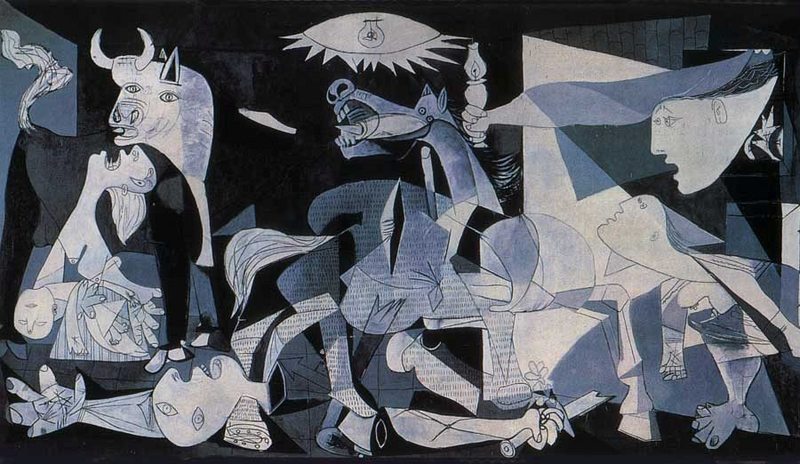
The Guernica of Picasso was painted after the Nazi bombing of this little town in Basque country  in 1937 during the Spanish Civil War and the involvement of German and Italian military airplanes was a clear interventionist action on behalf of the Nationalist Spanish government of General Franco, who was fighting the Republican Spanish Government. The number of victims that fell has never been firmly established, according to different sources in different times, between 400 and 1600 people are said to have been killed by this Luftwaffe bombardment, which was at that time described as a barbaric act unto a defenseless population.

So what about people dying unwanted by high tech destructive devices thrown from the air in the year 2011? Is their inflicted death a barbaric act or is it not? Where is the public outcry against it. Or are we lead to believe that there are either no victims at all of NATO bombing, or that each victim is a soldier supporting dictator Gaddafi, so it is a victory for democracy when such a ‘stand in the way of democracy in Libya’ will be blasted away from the air?

Comparative interventionist historical policy studies should be undertaken to answer this question.

Painting by Pablo Picasso. It was created in response to the bombing of Guernica, Basque Country, by German and Italian warplanes at the behest of the Spanish Nationalist forces, on 26 April 1937, during the Spanish Civil War.


Sarkozy explaining the recipe for the dessert from the desert at the upcoming dinner at the G8 top meeting in France May 2011: a Libyan ‘oil cocktail’ named ‘”Tour de Force de la Tour Eiffel” to be served by Apache waiters with NATO bonfires providing a festive backdrop. He makes it clear why the chosen interventionist taste is ‘Libyan’ and – say – not ‘Algerian’ or ‘Sudanese’, as there are 20 G-force countries wanting their sweet-oil-tooth to be served at a regular basis and one must make sure that there is enough constant supply of the needed ingredient.

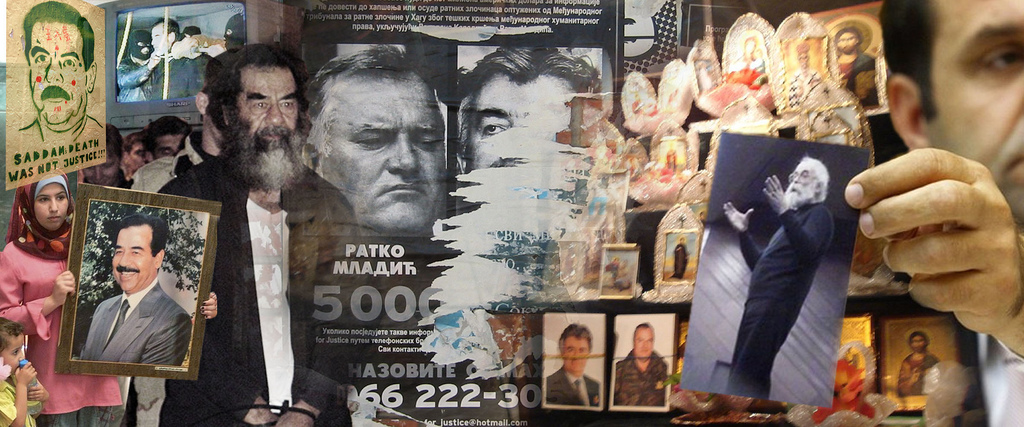
Will the arrest of General Ratko Mladic be a sign for the warring Allied Forces to stop trying to kill Colonel Gaddafi and exercise restraint and  patience instead of trying to kill this dictator? Negotiations and compromise will help Libya more than dropping even more munitions from the air. We need ‘the long arm of justice’ instead of ‘the eager hand grabbing for power’ in Libya.

Tableau made in 2008 to commemorate the arrest of Radovan Karadzic on July 21st. of that year with this caption: "last resort for a haunted man is to hide behind his beard covering a face that became a public icon ~ once his zeal is betryaed and his cover is torn, it still will take generations before his defaced idol has vanished from all shrines. To ridicule and make laughing stock out of a former ennemy is missing the opportunity to come to an understanding WHY it was that such a man could hold such power ~ it is failing to learn a lesson how to prevent it happeming again and again." (*)

(*) A documented version for each element of this tableau can be foudn at my web site: “http://imaginarymuseum.org/karadzic/karadzic_hussein.html”

The indictment of Mladic can be found at the web site of the International Criminal Tribunal for the Former Yugoslavia.

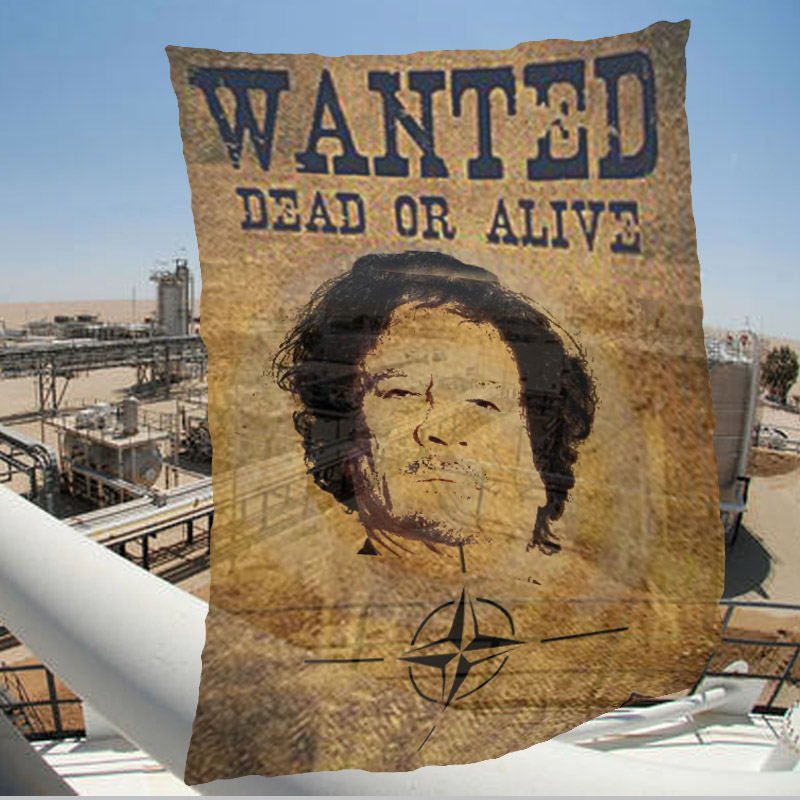
Flying NATO warrant for Gaddafi over Libyan desert.

When a court orders an alleged killer to be arrested and it notices that someone else tries repeatedly to kill ‘their killer’…. it would issue also an arrest warrant for the murderer ‘in spe’ of the indicted. Sounds logical but we see today that the Prosecutor of the International Criminal Court fails to do so. He did not issue any public statement ordering the chiefs of NATO to stop their attempts at the life of someone who needs to face his judges here on earth.

Below is the concluding statement by the ICC Prosecutor at the press conference on Libya in The Hague on 16 May 2011:

My Office has not requested the intervention of international forces to implement the arrest warrants. Should the Court issue them and the three individuals remain in Libya, Libyan authorities have the primary responsibility to arrest them. Libya is a member of the United Nations and it has the duty to abide by Security Council Resolution 1970.

When the time comes, implementing the arrest warrants will be the most effective way to protect civilians under attack in Libya and elsewhere. As in any other criminal case, the execution of the warrants will have a deterrent impact for other leaders who are thinking of using violence to gain or retain power.


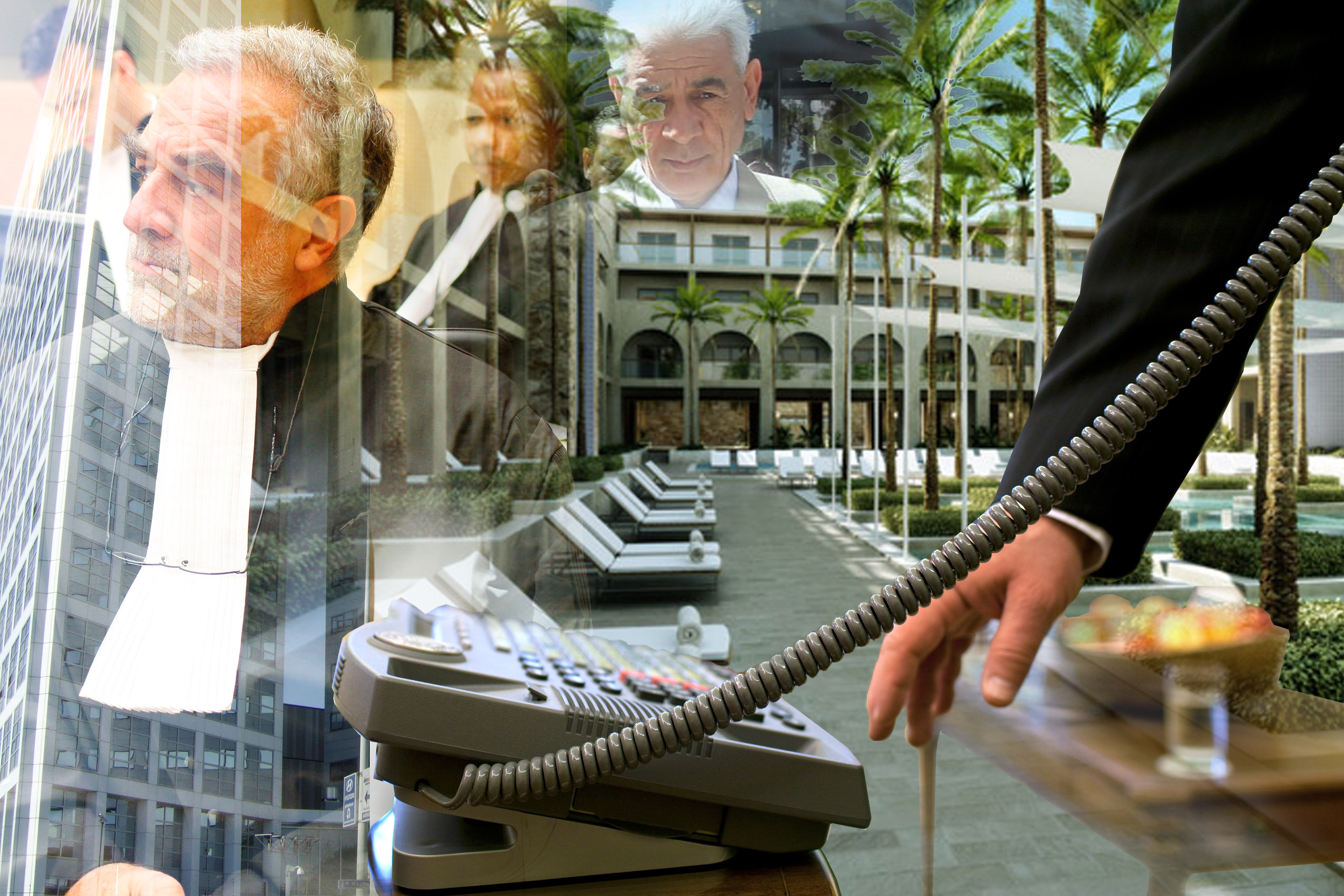
…while the list of Libyan war criminals by  the prosecutor of the International Criminal Court Luis Moreno-Ocampo keeps dwindling and until now only three suspects are mentioned by name: Muammar Gaddafi, his son Saif al-Islam and Gaddafi’s brother in law Abdullah Senussi. The deserted former head of the Libyan Secret Service and last Minister of Foreign Affairs Moussa Koussa (also spelled in the Western press as Musa Kusa), part of the regime till a few weeks ago, when he crossed the border of Tunis and was welcomed as a valuable informer for NATO in Great Britain, seems not to be on the list of the International Criminal Court. We now have a whole score of pro-active regime members who are defecting by telephone. This tactics seem to be much more effective than throwing big bombs from speedy airplanes onto buildings that are either empty or inhabited by people who were are the wrong place at the wrong moment. What to think about the British Chief of the Defence Staff General David Richards who called last Sunday for “widening targets in Libya”  as NATO tries all it can to keep Gaddafi from being caught alive and being brought for the International Criminal Court in The Hague. All of this is also a show of force to help topple the tank based Assad family from power in Syria, in the near future. Political leaders must by now have received the message of the international legal community, that only in China it is allowed to use tanks against demonstrators. Both politics and justice in Africa and the Middle East seem to be in the hands of  NATO generals, they take the initiative while parliaments have lost all control over this theatre of war. Happily the International Criminal Court in The Hague – that has no own police force to arrest indicted war criminals – still has a telephone line, to prove things can be done differently. Or, one musty believe that the members of Gaddafi’s claque and clique needed some bombs to rain next to their front doors before they would call The Hague, as if the downfall of the Gaddafi reign had not been imminent for many months already, without NATO airplanes. Why diplomatic forms of subversion have failed to be used to oust the regime of Gaddafi? Who does the body count in Libya irrespective on which side death occurs? Who are those Libyan army soldiers that are legitimate targets now?  I read the army consists of 25.000 volunteers and 25.000 conscripts and that their equipment is rather outdated. So what chance they have against the ultra up to date NATO forces? NATO does not have smart bombs that can decide who to kill and who not, bombs that can distinguish between a conscript, a volunteer, a Gaddafi guard or an insurgent. Too many unanswered questions. I have always had a suspicion when ‘civilians’ are protected and soldiers are open for lawful slaughter. We need to widen our vision on such conflicts and develop new tactics for more peaceful methods of transition of power.

Wednesday May 11th 2011 Gaddafi comes to one of the most safe places for him now-a-days the Rixos Hotel in Tripoli where most of the international journalists accredited by the Libyan Government are staying, though they are having dinner elsewhere in the hotel and know nothing about this meeting of Gaddafi and a whole parade of Libyan tribal leaders that come to him one by one and shake his hand, all the while being photographed as loyal chiefs. On a screen in the room a program of Libyan state television is projected in the background so the date and time of the meeting is documented. The video of this broadcast by Libyan State Television can be seen at YouTube under the title: “Gaddafi Live on Libya State TV May 11 – NATO Assassination Attempt Fails Again !” The video is not subtitled and not translated. It leaves the non Arabic speaking with only the body language of those acting out this scene.

It looks to me very much like a farewell meeting with someone who is going to die soon, knowing his day are counted.

I look in some old archives with different spellings of his name: Khadaffi, Qadhafi and see a young man right after having taken power in 1969: with sparkling open eyes and a smile, looking ahead. Gaddafi has been born – it says – in a Berber tent in 1942, where will he die and how, nobody can look into his eyes anymore to find the answer…

The Guardian of Friday May 13th. uses a subheading about  the Gaddafi unexpected meeting: “Gaddafi sneaks into hotel.”  I reacted with the following short lines:

In spite of a most common felt disgust for Gaddafi which I share, I do not like the suggestive language of your reporting “sneaks.” The Rixus Hotel is one of the safest places for Gaddafi in his country as long as a part of the foreign accredited press resides there. As he has been constantly been targeted, in spite of whatever blunt denials by NATO spokesmen, it makes good sense that he uses the relative safety of this place. We do not need to paint a black sheep black.

When images could be searched with images. The idea has been there for a long time, some early big databases could do it a bit, like one designed by IBM of which QBIC (Query By Image Content) is an offspring. This used to be only for customers paying a high price and using dedicated big machines…

The official logo of TinEye company

Often people are not well aware of what they do while searching for images, but almost all image search engines on the net are ‘text based’. Now there is TinEye “reverse image search” and the idea of searching images with images, will  start to become common practice soon. I did a few tests and given the historic moment, a most obvious one is for Bin Laden. Google image search said it has 290.000.000 pictures for me.

Search results from Google on the basis of the text search string "Bin Laden"

I choose one of them – just the  top left one of the first page that came up – and ask TinEye to check its database for me, comparing my chosen image with whatever other images having the same elements.

‘The same elements’, therein lays the magic… as my example shows many variations just based on one picture, readily available on the internet for years. All kind of alterations are now available on-line, as so many people wanted to be rummy, funny, mean or otherwise about Bin Laden. In all 1340 variations turned up by using the TinEye web site. Many variations were only slight, others greatly deviating from the original.  This result comes from an algorithm that searches for a whole set of parameters on a dataset of 1.9532 billion images.

Search results on TinEye are stored only temporary and this was  the URL from which I took the examples in my further deliberations below:

http://www.tineye.com/search/9488fe41bea7711086575c12eb6b5b71320f3120/?page=2&sort=score&order=asc

We have here such a large data set that we can observe the effectivity of the comparing algorithm. I was impressed very much at first. Even to such an extend, that I wondered whether or not also a text element had been used, as some kind of ‘identifier’ or ‘delimiter’ in the automated search operation. To find out if that is so, some double checks are necessary. Feeding back to the system its own results, applying different names to images and other information around images on web pages used, could be part of such a method of control. I have not been able to do this yet, and when I think it up, other people must already have thought to do the same or have done it already. It will need an hour or so of searching. Until then, marvel and suspicion at the same time, which made me go on, a bit more in detail of my first test.

I found that the smartness of the visual robot system was – sad enough – contradicted by the interface it offered. It is a cumbersome table like text based result, ten at a time, whereby our possible visual associations are constantly hindered by the non-functional design of the TinEye Robot page. Even Google Images (not  a master of good visual design) has understood that there is the ‘agile eye’, and offers since a year or so, a tableau of images. Our eyes can swiftly purvey big sets of images, within milliseconds. Not in the straightjacket of the alphabetic sentence structures from top left to down right bottom, making a little jump from right end to left start at each line, but in a much more jumpy and associative way. To make my point I have selected 47 examples from the search result of Robot TinEye (10 web pages of the 134 on the TinEye site, with 10 images per page) and threw them together in one pane, one tableau.

Click this picture to see it at full size and test the theory of the jumpy agile eye...

While looking at  the first hundred results a second time, some doubt crept in whether what is offered here is solely the result of a visual search. I decided to venture a bit deeper in the 1340 examples TinEye had come up with and in the end I looked at all of them, which left me – because of the ‘ten at a time’ interface with a lame wrist of doing all the clicks. What a machine can not do without the help of a human, a human can do without a machine at ease and so I selected a few visual categories that seemed to me not congruent with what I expect automated visual comparison can do. Five main categories and let’s try to forget the level of stupidity of the metamorphoses of the portrait of Osama Bin Laden. The argument is about what an algorithm to compare images is able to do.

1) montaged faces of more or less known political figures on Bin Laden's portrait, starting with Obama variations; 2) some variations with a change of make-up and color; 3) camouflaged Obama's with the last one on the row a complete exception of image patterns see most of the other examples shown here; 4) Obama impersonations for fun among friends; 5) hair dress and head gear changes.

The most unlikely ones to be derived from image comparison solely are 3.3, 3.5 and something which is literally on the edge is picture 3.6, which looks like Obama and only at the right hand side the contour of Bin Laden remains visible vaguely.

When looking at the examples on row 4, one wonders why when all these clumsy impersonations do come up in a search action, why not thousands of bearded men in a white clad and a white turban are found also in such a search, that is run on 19532 billion image database?

Row 5 seems to be an easy job, as the beard and the face elements remain constant, though image 5.5 hides one of the eyes almost completely with the blue hat.

It all points in my observation of this moment in the direction of more than just visual search elements. This is of course absolutely fine and a very logic thing to do, it only differs from the explanation given by TinEye on its web site:

TinEye is the first image search engine on the web to use image identification technology rather than keywords, metadata or watermarks. [About page of  TinEye]

Many more questions remain, like if the face tracking software development of the last two decades is one of the elements used in the comparison techniques of TinEye, and if so, then we step from an academic technical discussion into a social one. The potential of automated face tracking of photographs posted on the internet with all kinds of other intentions than enabling whatever security and surveillance initiatives, can become problematic. The TinEye seems to be most popular now with persons and organizations selling pictures and wanting to trace misuse of what they claim to be ‘their copyright’ or ‘intellectual property’. Of course a certain amount of control can be useful, but we know that when it comes to copyright claims only the most powerful will be able to profit and ownership of images also can lead to undesirable forms of censorship and blockages of what is called ‘fair use’. Other application of the TinEye Robot  could even have far stretching consequences.

Now  we all know that any serious secret service is using such face-tracking tools already for many years, on any photographic material available to them. The question is when everybody will start using such tools and combine them with messaging in social networks this might create havoc, doing the opposite of what these networks claim to be for. Many more effects can be expected like the claim to authorship and fame and image searches that show that the same visual thing existed somewhere else before or after. Endless fights over who has been copying who in the digital land of copy cats. The big music industry already runs automated sound sequence comparisons on the tracks and songs that keep raining down from millions of creators and duplicators, trying to construct court cases to catch what they think are gees that will lay them golden eggs in the form of fines. We may praise ourselves lucky that such copyright claims can not be projected back through the centuries, because how many great composers would have had to appear in the courts called by the lawyers of the music industry and who will ever acknowledge the collective creativity of uncountable anonymous masses?

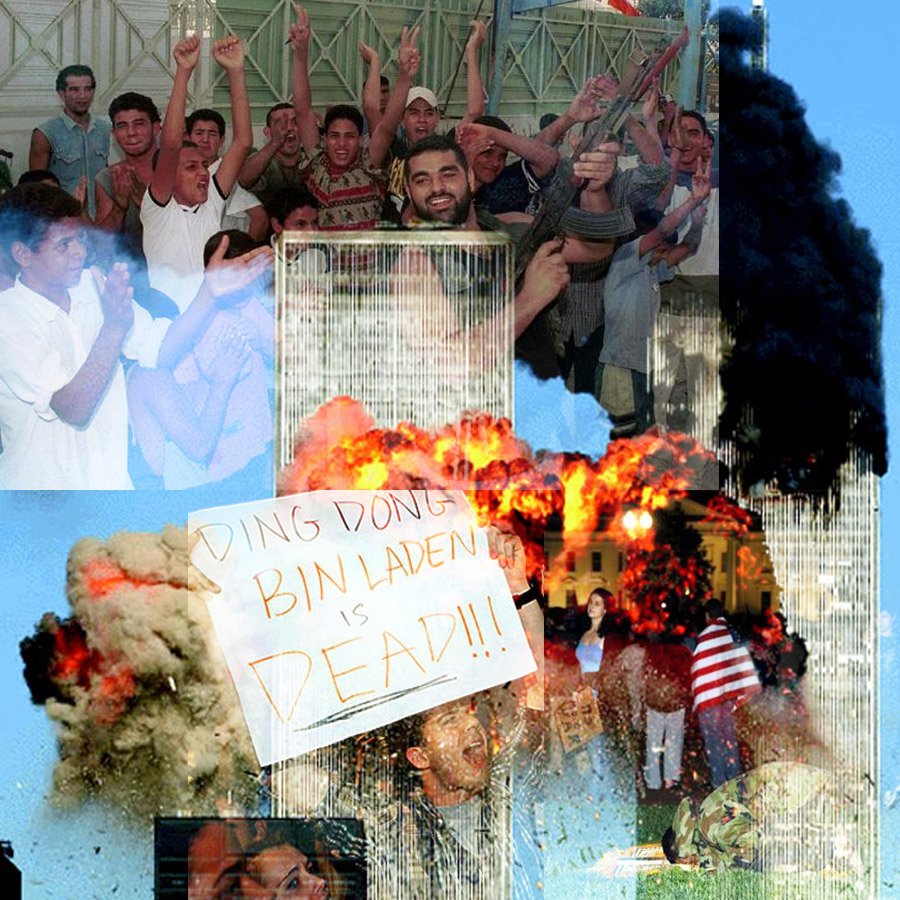
Back to our sweet looking TinEye image robot… I fed it this picture below, that I composed within 5 minutes from three sources, as I wanted to comment on Facebook about people dancing in front of the White House in Washington after the news of the killing of Bin Laden had been announced. Result zero said TinEye. Though anybody following the news would recognize a 1991 Palestine street dancing after 9/11 attack + the 9/11 attack itself + a picture from last week of people in front of the White House celebrating.

Diffused half transparencies are not yet within the competence of our lovely robot and for me that gave a feeling of relieve. As I am by now more fearing than admiring the capabilities of TinEye. Digital panopticism is not yet there, the human eye and human memory still reigns….

Tableau for my Facebook friends "I do not dance in the streets when I am horrified"

[this article will be extended in the coming weeks with my own and possibly your TinEye double check results]

Wednesday March 11 2011

Playing hide and seek with Tineye Robot

Could not refrain form playing a bit with the Tineye Robot and so we played ‘hide and seek’ with its own logo… it took three versions to have the robot effectively hiding behind the manipulated lettering of it’s own logo. Colour change and diffusing with a lense and grain filter did not alter the recognition of the word Tineye. Changing the wheel of the logo did not hide him from his own algorithm, but altering the angle  of his sensor ears and his arms + his facial expression by somewhat subtracting his chin, gave the desired effect. The robot is clearly visible to us, but not anymore gto its own software.

The result with the only the lettering recognised and the robot not seen by itself anymore. Click the image for full size view of this screen shot.

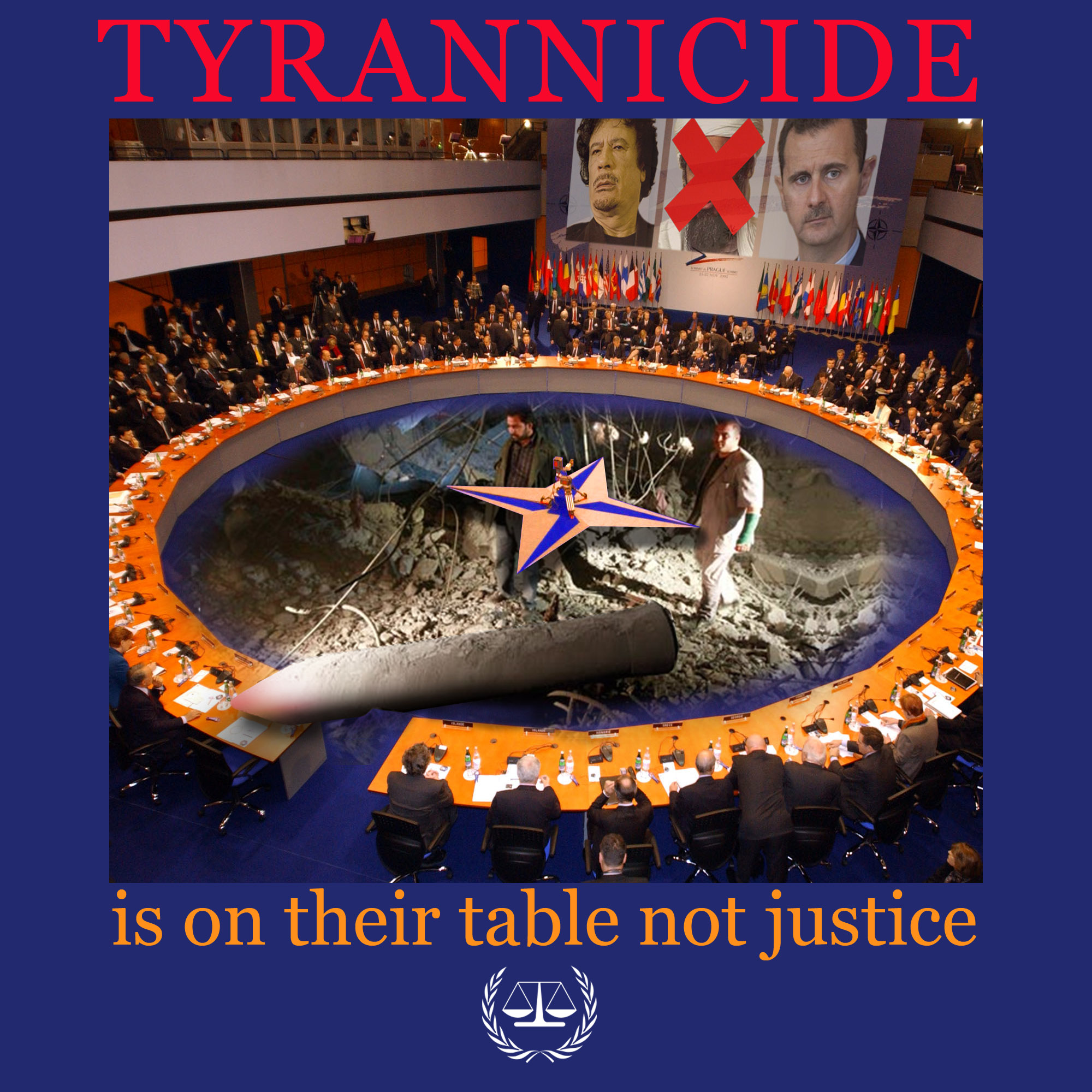
The dust of the impact of a NATO bomb on the compound of Colonel Gaddafi in Libya – leaving some of his family members dead – has hardly dwindled, or the triumphant news of the assassination of  Osama Bin Laden in Pakistan is proudly announced by the American president. Whereas the NATO spokesman denied a purposely targeting of the Libyan head of state using the commonly used argument in such cases that the targeted object had a military strategic function, the undercover operation of targeting and killing of Bin Laden – who is not a head of state and is considered an international outlaw – was proudly admitted by President Obama. Would Gaddafi have been killed in the NATO attack, it would have been classified as “a case of collateral tyrannicide.”

SECURITY COUNCIL APPROVES ‘NO-FLY ZONE’ OVER LIBYA, AUTHORIZING ‘ALL NECESSARY MEASURES’ TO PROTECT CIVILIANS, BY VOTE OF 10 IN FAVOUR WITH 5 ABSTENTIONS

That is what “Resolution 1973″ of  the Security Council in it’s 6498th meeting on March the 17th 2011 says. Who reads through the details sees: protection of civilians; No-fly zone’ ; enforcement of arms embargo;  ban on flights; asset freeze; but nowhere is the option of disposal of the head of state, let alone targeting his life mentioned. On the contrary – in the same document – the Prosecutor of the International Court of Justice in The Hague is alerted about the possible targeting of the Libyan civilian population by its authorities, this  in order to call them to justice. Our modern courts do not practice anymore justice on accused that are dead.

In antiquity the slaying of a tyrant was seen as an honourable act, a self sacrifice for the public cause, but the institutional execution of murder by international associations of states seems to be of another order. One can not pretend to uphold a state of international justice on the one hand and order summary execution without trial of misbehaving heads of state at the other, because who will be the judge of such decisions? The same reasoning does apply to the execution of those who are labeled as terrorists. What Gaddafi, Bin Laden and Assad have in common is that they have been declared in public opinion as public enemies and as such in the political practice of today they stand almost no change to be brought to court alive and face their judges. They are on the informal 'hit list' of legal representatives of state coalitions, designated to die violently. Will that serve the cause of justice and peace?


‘Mission creep’ has become a household word in todays international politics: half a war is started on a quarter of evidence whipped up in ‘the news’ and those who may have a good historical insight in any of these turmoil areas are the last to be consulted, as diplomatic options are cast aside in haste and overridden by military solutions. Politicians – with their own national and international agenda – are even competing in proposing the military approach as faster and more efficient. What started of as a temporary interventions to prevent mass killings, pre-emptive strikes against the employment of mass murder weapons, and other direct threats against humanity, prove  – on a longer term – to be operations that are more ‘problem makers’ than ‘problem solvers’. The military are saddled with practical questions diplomats were not able or not allowed to solve: is there a rational basis to decide who is going to be supported, who needs to be attacked, who to be protected and what about bloody revenge in the aftermath of a state collapse?

On the one hand there is notion of sovereign states and the principle of non-intervention under international law and, on the other,  the aim to protect human rights and prevent mass violence. “Protection of civilians by all necessary means” is the mission in the case of Libya. One should read the “all necessary” as acts that still need to be within the legal bounds of laws, agreements and regulations that form the foundation of the United Nations. The United Nations does not endorse the killing of a head of state, even when she or he is labelled as someone acting against their own population, is known as a tyrant. Head of states do not have (anymore) full impunity, they can be called to justice, an International Criminal Court has been set up in The Hague which is supposed to pursue such persons. The killing of a tyrant – tyrannicide – is not supported by international law, however beneficent  it may seem to be in short range. But, in law, one needs always to reverse the logic and ask the question: “but, is it explicitly forbidden and if so where and in how is that prohibition formulated?”

Two years ago this question has also been raised in a thorough article by the scholar Shannon Brincat in the ‘Australian Journal of Legal Philosophy’ under the title “Legal Philosophy of Internationally Assisted Tyrannicide.” Brincat is not a lawyer but a political scientist and rightly focusses on the underlying historical principles of the practice of international law and tyrannicide as he looks back a few centuries and cites Gentili (1522-1608), Grotius (1583-1645) and Vattel (1714-1767) on the issue of  acceptability of the killing of a tyrant, a person belonging to the classical legal category of ‘hostis humani generis’ (common enemies of mankind). Brincat shows the historical acceptance of ‘tyrannicide’ as a way to get rid of a despotic and cruel ruler abusing the public power. The legitimacy of a ruler was thought to be based on a common bond with his subjects. When a ruler failed to work for the welfare of all, the bond would be nilled and murder could be envisaged to put an end to tyranny. Murder of a tyrant has been often an act of a private citizen for the common good of his fellow citizens. In some cases it has been classified as ‘an act of self-defence’.
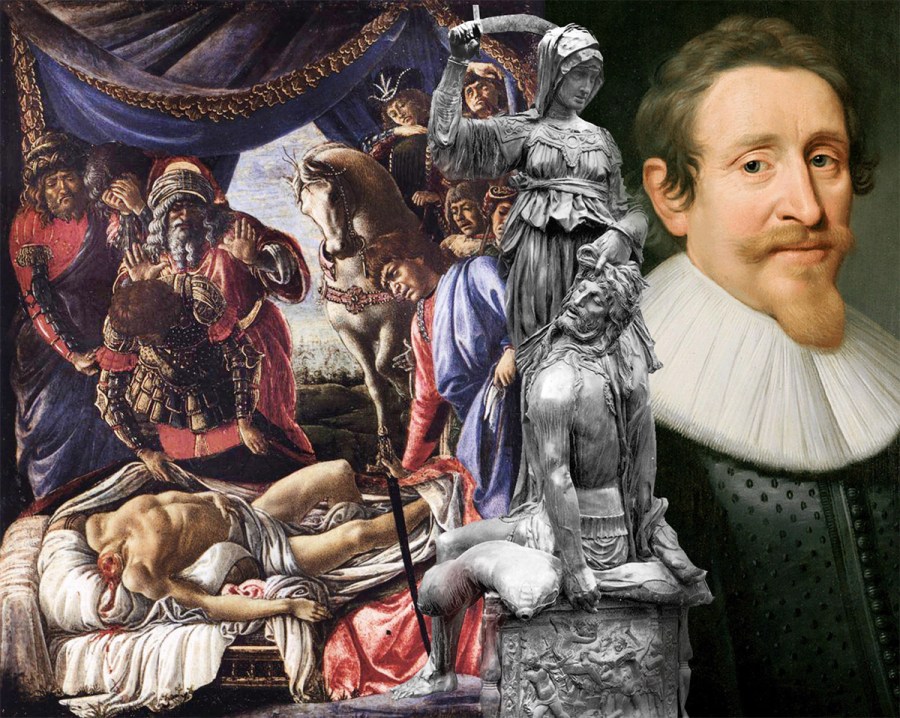
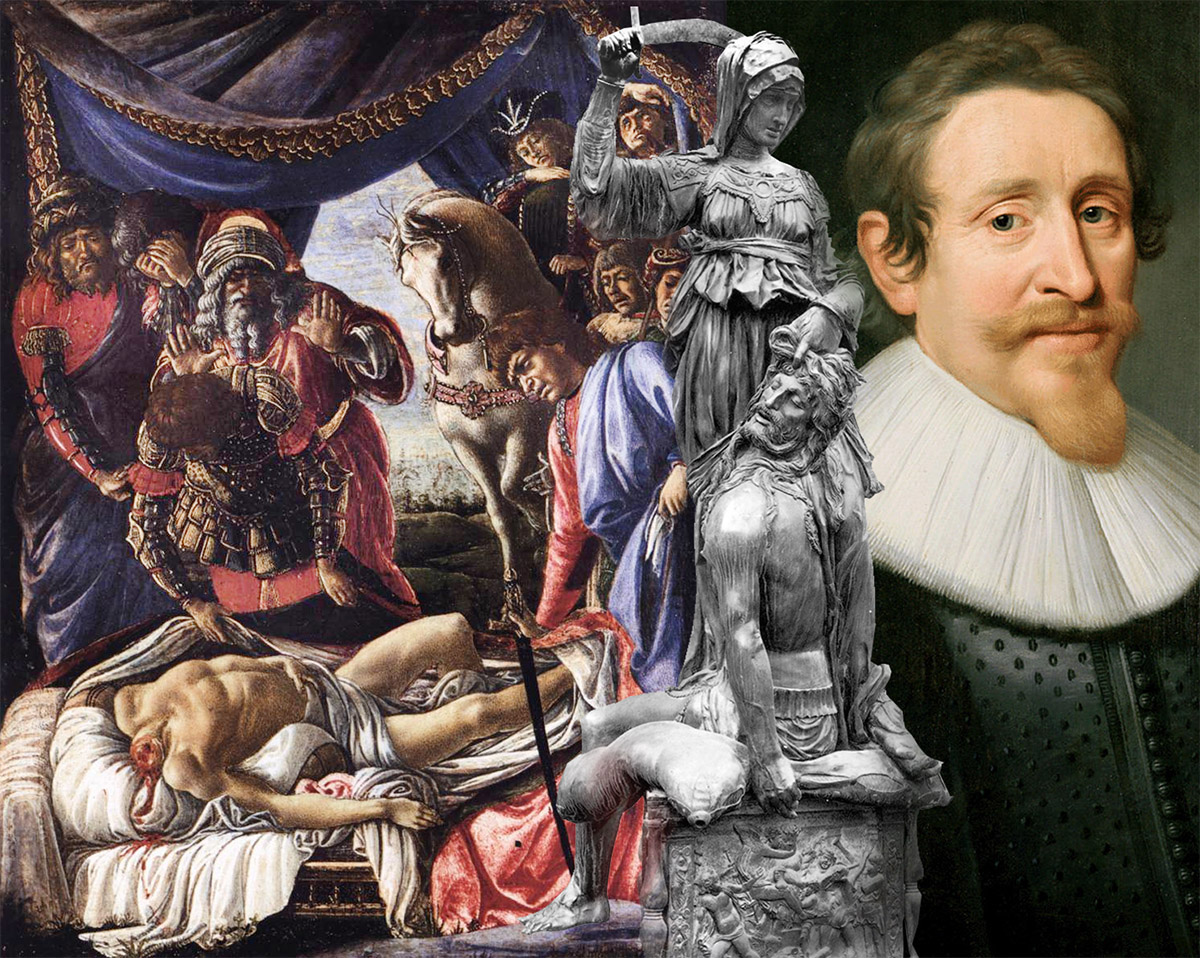
“It be lawful to kill him who is preparing to kill.” Hugo Grotius seen as the father of 'international law' in "On the Law of war and peace" (De Jure Belli ac Pacis; 1625. Book II, 10.), self defence not only after an attack but also to prevent it. Grotius uses all kind of classical references to support this point. The killing of tyrants is deeply embedded in human history and has also a strong presence in European Renaissance art, whereby the biblical story in the Christian Old testament of Judith beheading Holofernes, an Assyrian general who is about to slaughter her besieged home town Betylua in Judea, is the most famous example. A gruesome deed, acted out by Judith as 'the hand of God'. Our forebears were not afraid of gruesome pictures as can be seen here in two of artistic renderings of this 'parable': 'The discovery of the murder of Holofernes' by Botticelli painted in 1472, and the sculpture by Donatello dramatising the same subject in 1460. The meaning of Donatello's sculpture in Firenze was an explicit political one, pointing to the liberty of the citizens to dispose of a tyrant if needed. The portrait to the right is of Grotius known by the Dutch as Hugo de Groot.

There is also the planned assassination of a tyrant of one state by those governing another state, in support of oppressed people trying to revolt. This needs to be clearly set apart from all kind of inter-state conspiracies to bring down another power by treacherous acts. Brincat tries to distinguish all kind of murders arranged for political gain -assassinations – from the act of tyrannicide. He points to the context in which a murder is committed and how that can change its status, from being ‘a war crime’ , a ‘terrorist act’, ‘aggression against a state’, or ‘intervention in internal affairs’. International regulations of war are documented in some detail in the article, like the many conventions of  The Hague and Geneva over a period of one and a half century, whereby the ‘treacherous killing of citizens’ has been formally forbidden, and lately also the use ‘military covert action’ has been restricted. In spite of all this, military practice always has it in it’s own way, as it can not work without using treacherous tactics, hence the constant trespassing of all what is laid down in whatever convention. In the theatre of war the old adagio rules: “everything is lawful against enemies.”

The United Nations  ‘New York Convention’ – as it is known – in full Prevention and Punishment of Crime Against Internationally Protected Persons, dating from 1973, does give protection to heads of states, ministers, diplomats and their family outside of their country, this to support international diplomacy, but does not speak about the attempts on the lives of these same persons within their own country.

The States Parties to this Convention, Having in mind the purposes and principles of the Charter of the United Nations concerning the maintenance of international peace and the promotion of friendly relations and cooperation among States, Considering that crimes against diplomatic agents and other internationally protected persons jeopardizing the safety of these persons create a serious threat to the maintenance of normal international relations which are necessary for cooperation among States, Believing that the commission of such crimes is a matter of grave concern to the international community, Convinced that there is an urgent need to adopt appropriate and effective measures for the prevention and punishment of such crimes (…) [Convention on the Prevention and Punishment of Crimes against Internationally Protected Persons..; 14 December 1973]

This omission creates a a window of opportunity for legal advisers to military commanders as to the repercussions to be feared when targeting heads of state and their governmental echelon at home.  In the recent case of the alleged targeting of Gaddafi and his family by NATO, this can still be seen as a ‘hostile act of intervention in the internal affairs of a state’, but there are loopholes in the UN ‘Resolution 1973’. When an attack will be  classified as an operation necessary  to keep the forces of Gaddafi from attacking civilians, it suddenly is not illegal anymore. That the great leader or his family are hurt on the side is just “their” bad luck. Even when seated peacefully in his berber tent  in an oasis next to a swimming pool, not Gaddafi himself but his nearby entourage with all kind of communication equipment busy in commanding operations, can still be marked as a legitimate military target and Gaddafi being just a collateral victim.

“All NATO’s targets are military in nature … We do not target individuals” [NATO spokesman the Canadian Lieutenant-General Charles Bouchard, Brussels May 1, as reported by Reuters]
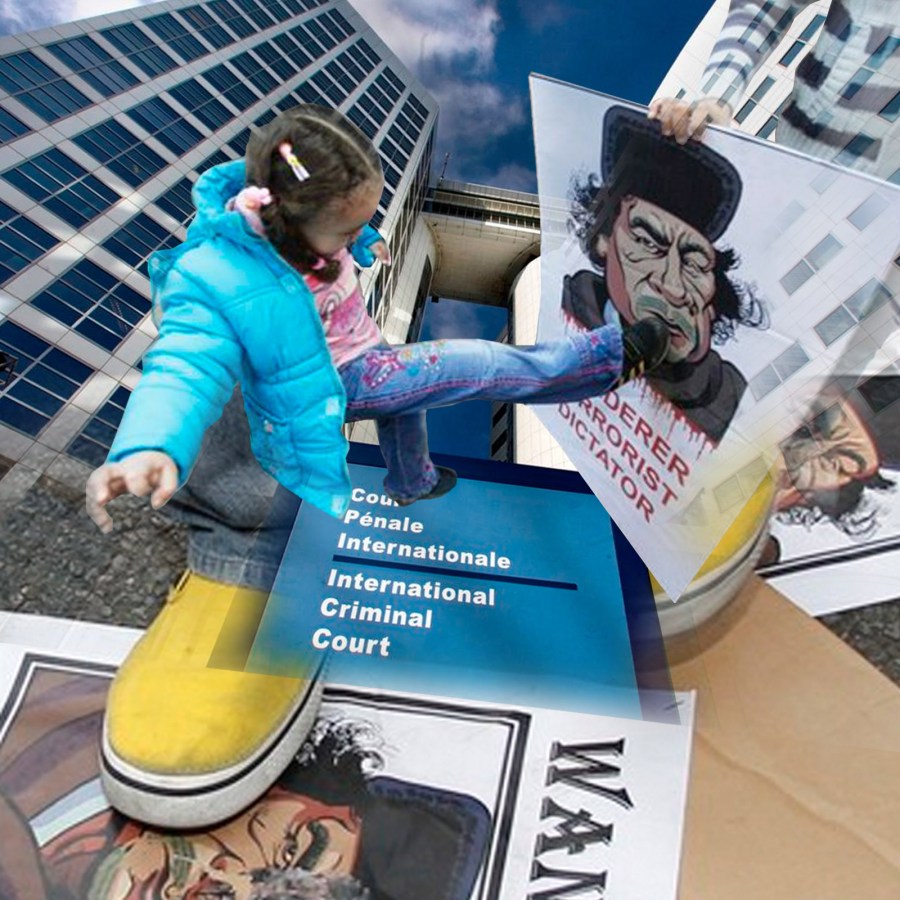
When demonstrators change the labelling of a head of state this does not mean that the legal position of the person according to international law has been changed accordingly, there is still the process of law that needs "to investigate the alleged commission of war crimes" Press Release: 04.05.2011 of the Office of the Prosecutor of the International criminal Court in The Hague. When it comes to killing a strong barrier between the 'symbolic' and the 'real' needs to be put in place, if we want to avoid lynching and other forms of 'mob justice'.

Heads of states – metamorphosed into tyrants or not – do not have international legal protection against attacks by other nations on their lives in their own country, as it has been thought obvious that local laws do protect them sufficiently, any constitution secures the safety of its head of state. A situation that brought President Ronald Reagan and his advisers to the cowboy tactics of  “Operation El Dorado Canyon” in 1986, bombing the headquarters of Colonel Gaddafi in retaliation of  the alleged Libyan support for several urban guerrilla actions in the period 1985-86, the latest one being a bomb attack on a dancing in West-Berlin in April 1986 (frequented by American soldiers; 3 death and 230 people injured). The number of people that died in the USA revenge bomb attack vary in different sources, from 15 to 60, among which an adopted daughter of Gaddafi (some say it was a post-mortum adoption for propaganda reasons). The American cowboy action was condemned by many countries and lead to a resolution in the General Assembly of the United Nations (79 in favour, 28 against, 33 abstentions). There was also a condemning  ‘Declaration of the Assembly of Heads of State and Government of the Organization of African Unity’.

Declaration of the Assembly of Heads of State and Government of the Organization of African Unity on the aerial and naval military attack against the Socialist People’s Libyan Arab Jamahiriya by the present United States Administration in April 1986: 1. Condemns the military attack perpetrated against the Socialist People’s Libyan Arab Jamahiriya on 15 April 1986, which constitutes a violation of the Charter of the United Nations and of international law; 2. Calls upon the Government of the United States in this regard to refrain from the threat or use of force in the settlement of disputes and differences with the Libyan Arab Jamahiriya and to resort to peaceful means in accordance with the Charter of the United Nations (…) [A/RES/41/38 20 November 1986 78th plenary meeting]
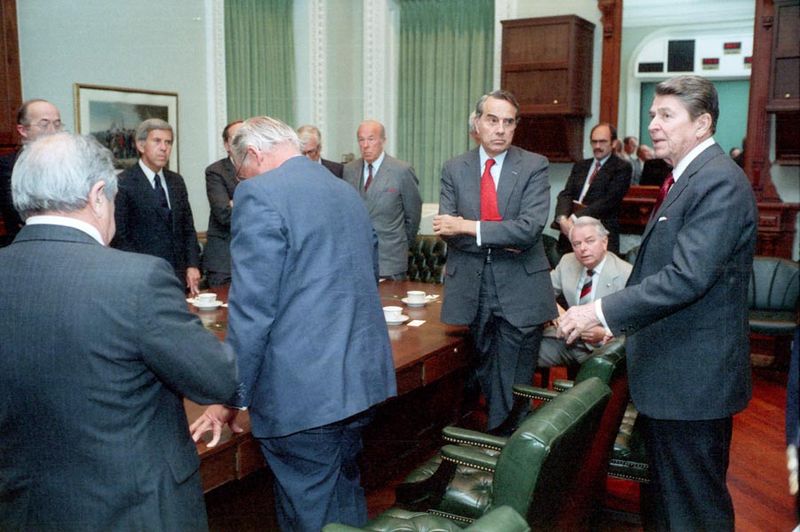
The U.S. President Ronald Reagan meeting with bipartisan members of the U.S. Congress to discuss the air strike on Libya ("Operation El Dorado Canyon") in Room 208 of the Old Executive office building, 14 April 1986.

The Iraq war of 2003 saw a repetition of such cowboy tactics, whereby at first a plan to murder Saddam Hussein had been devised and when that did not work, tons of bombs and missiles have been dropped on palaces and bunkers of the ‘head of state’, while the mission was officially not aimed at a change of regime, or the killing of the ‘tyrant’. Mission creep on grand scale…

At the other end of the international juridical spectrum are ‘the people’, the whole population, and how they are protected by international law against their own government when it turns against them. They are not protected, we all know it, as the principle of our international community in its actual form, the United Nations, is based on its Charter that defines the association of sovereign states as the most basic principle. Any intrusion of this sovereignty of an existing government by an outer force can be labelled as ‘intervention in internal affairs’.

All members shall refrain in their international relations from the threat or use of force against the territorial integrity or political independence of any state, or in any other manner inconsistent with the purposes of the United Nations. [UN Charter article 2 (4)]

There are of course, since the 1948 ‘Convention on the Prevention and Punishment of the Crime of Genocide…’, all kind of mechanism to protect human rights and human lives, but the enforcement of these rights remain problematic. The Genocide Convention itself is limited by its origin to prevent repetition of the racial based extermination policy of the Nazis and has proven useless when it came to mass killings with political or ‘social class’ motives be it in China , Cambodia, or elsewhere.

The principle of  the right to ‘self defence’ of individuals against an attacker is seen as customary and has found its way in all national laws, though many persons or groups that have been attacked by adversaries – be they local or national – and defended themselves, have found themselves categorised and treated as insurgents and outlaws by their local government.
The right of self-defence has been purported to states as sovereign entities also and laid down in international law, be it in a limited form, as the arbiter of inter state conflicts, the Security Council of the United Nations, needs to be alarmed and once they have undertaken measures this self-defence right should not anymore be practiced.

Nothing in the present Charter shall impair the inherent right of individual or collective self-defence if an armed attack occurs against a Member of the United Nations, until the Security Council has taken measures necessary to maintain international peace and security. [Article 51 of the UN Charter]

Not everyone reads this UN Charter article in the same way. Niaz A.Shah has written a thirty page long article in 2007 in the ‘Journal of Conflict and Security Law’ on the raging debate between international law professors and the different state and government bodies that pick from these academic deliberations, what serves them best. “Self-defence, Anticipatory Self-defence and Pre-emption: International Law’s Response to Terrorism” is the title of his overview of this battlefield of law and it becomes clear that two main schools of interpretation can be distinguished: the ‘restricted’ and ‘expanded’. It starts with the question when self-defence begins and even more important when it ends, whereby the development of ever more deadly and extreme rapid delivery of weaponry effects, has shifted some of the initial argument, that a state could not react before it had been actually attacked, to a situation whereby suspicion of imminent attack is sufficient . The interpretation of what must be understood by the two words “armed attack” has also changed since the UN Charter has been drafted and signed in 1945, its intention being “to save succeeding generations from the scourge of war.”

Some states do see ‘anticipatory self-defence’ as a statutory right and greatly widen its interpretation, like the ‘pre-emptive strike against terrorism strategy of US President George Bush. The impotence  of the UN Security Council, its constant failure to act swiftly, its awkward system of five big states that can pronounce a veto over any proposal, is mentioned as the main reason why the idea of “peaceful settlement” of conflicts and the internationally controlled used of force by the United Nations constantly fails. The right to self-defence may thus – by some states – be put above international law.

At the time of the writing of the UN Charter international conflicts were solely seen as between states, but the non-state based phenomenon of international terrorism have altered that view. Does article 51 of the UN Charter also apply to non-state actors like al-Qaeda and when can one state be hold responsible for such non-state terrorist actors and can the principle of self-defence of a state be stretched to such an extend that a supposed host of terrorists can be attacked, either in reactive self-defence, or as a pre-emptive strike to prevent suspected future attacks? “We can not let our enemy strike first” or “We can not just wait and accept our fate like a sitting duck”, the arguments are known and do sound convincing at first.

Niaz A.Shah cites a counter argument by Professor J. Lobel who refers to the bombing of Sudan and Afghanistan in response to terrorist attacks in an article in Yale Journal of International Law published in 1999:

It is untenable for international law to permit one nation to attack another merely because it alone claims that a group operating in the other country is launching terrorist attacks against it. Such a rule would obliterate the prohibition against the use of force, as unsubstantiated claims by a single state would become the new legal predicate for the use of force. Those who urge a looser interpretation of Article 51 have yet to prescribe a viable method of ensuring that self-serving characterisations of facts are subject to some clear legal standard and international oversight.

The Security Council issued in 2001 Resolution number 1368 as a reaction on the 9/11 terrorist attack: “to bring to justice the perpetrators.” Has justice been done now, since Osama Bin Laden has been shot dead in an undercover operation in Pakistan? A great nation like the United States of America at war with a non-nation like al-Qaeda, does that mean that on the one hand legality of ‘self defence’ based on article 51 of the UN Charter is used, while on the other no ‘rule or law of war’ seem to apply in the way this new kind of anti-terrorist battle is fought.

It dawned on me that the supposed killing in battle of Osama Bin Laden, applauded worldwide as a victory of justice, has all the aspects of a classical act of ‘tyrannicide’. David George of Cambridge University published in 1988-  in the year that al-Qaeda has been founded and was not yet widely known  – an article entitled “Distinguishing Classical Tyrannicide from Modern Terrorism” in ‘The review of Politics’. In his summary is this concluding statement: “Terrorism, in short, is a form of tyranny of which tyrannicide is a negation.” George sees ‘terrorism’ and ‘tyrannicide’ as different antagonistic categories even when some of the assassinations perpetrated by modern terrorists are be seen – by some – as ‘self-denying acts for the public good’ (“one man’s terrorist is another man’s hero”). Bin Laden thus has become the emperor reigning a non-state imperium, whose death has liberated us from a cruel reign.
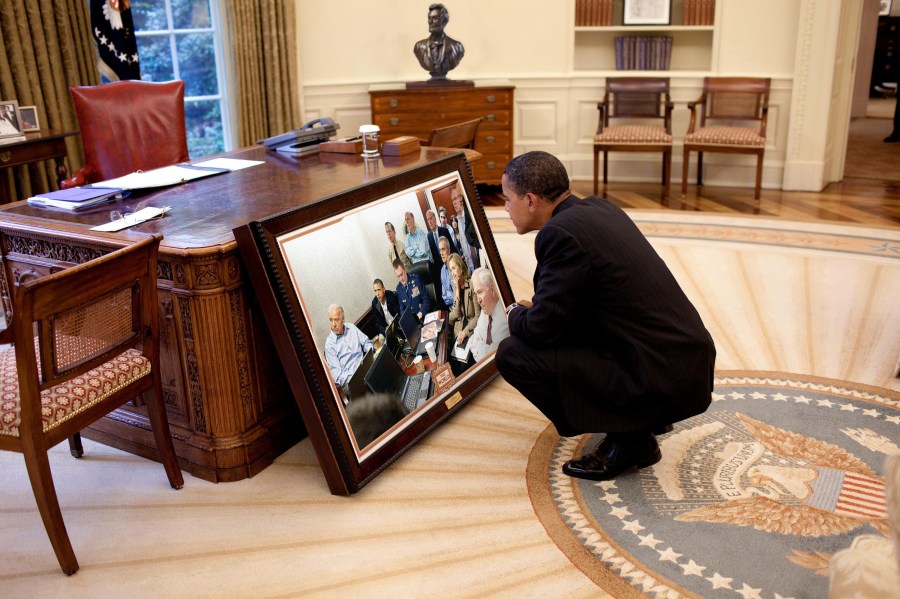
A painting one could imagine awaiting a central place in the Oval Office of the White House with the title "Geronimo-EKIA", meaning "Bin Laden - Enemy Killed in Action", Geronimo referring to the Indian Apache fighter against Mexican and American settlers colonising his land; a peculiar historical reference chosen as an operation name by the CIA. Though White House sources have stated that the actually killing has not been broadcasted live to the command centre of the President and the CIA, we see Obama and Clinton with their staff watching something 'we' are not allowed to see. Those who were present, they do the looking for us, like the official representatives during an execution in a state prison. The intentions and effects of this purposely made and widely distributed photograph by the official White House photographer are multiple. One of the possible interpretations is that this photograph makes us 'witnesses' the 'historical witnessing' by others, implicitly acknowledging the legality of the operation. On the drawer of the Oval Office we see a bust of President Abraham Lincoln who proposed once the following inscription for the Great Seal of the United States: "Rebellion to Tyrants is Obedience to God." (click picture for a detailed view)

US Attorney General Eric Holder speaking to the Senate Judiciary Committee on May 4th. said it was “an act of national self-defense”  and “lawful.” Tyrannicide as an act of state self-defence? The tyrant killed in battle ending his unjust cause. In the case of Bin Laden one can hardly speak about a pre-emptive strike or ‘bringing someone to justice’, though the distinction between “Enemy Killed In Battle” and ‘summary execution‘ has – in practice – always been hard to make. The internationally approved rules do in no way allow a killing on the spot without  judgement. The Geneva Convention of 1977 has a special paragraph forbidding it.

“Every human being has the inherent right to life. This right shall be protected by law. No man shall be deprived of his life arbitrarily.” “[The Death] penalty can only be carried out pursuant to a final judgment rendered by a competent court” – ICCPR Articles 6.1 and 6.2.[1]

One of the most classical cases of tyrannicide is by a group of senators, jointly stabbing emperor Julius Caesar to death in the hall of the Senate.  It is more an example of  a ‘preemptive strike’ than an execution or revenge. The royal ambitions and proposed absolute rule of the ‘dictator perpetuo’ of the Republic of Rome, had to be halted. The conspirators abandon the corpse of Caesar on the spot where he has been killed and ran through the streets of Rome shouting “People of Rome, we are once again free!.” Not many responded and curious enough the fact that they left the body of Caesar was also to their disadvantage as it became a symbol for his followers later. The dropping of the body of Bin Laden right after his violent death may point to some classicists on the team preparing the operation in Pakistan.

The assassination of Julius Caesar in 44 BCA here in an eighteenth century depiction of the the Italian painter Vincenzo Camuccini was a joint undertaking of a group of noblemen having the position of senators, who were fearing loss of their influence, something they saw a congruent with the safeguard of the liberties and influence of the people in the politics of the Republic of Rome. It set a series of events in motion that ended in civil war and the destruction of the same 'republic' they intended to safe. The centralising of power in the hands of one man as initiated by Caesar became after all practice in the later Roman Empire. Strangely - till this day - the assassination of Caesar is proposed as a successful prominent example of tyrannicide.

Humanitarian intervention by other states or international associations of states may be the only way to alter an unbearable state of suffering of main parts of a population, but however noble the incentive, practice may prove to be different in many cases. Imposed change of regime from the outside, invasion to establish democracy, we have seen how such undertakings can develop in yet another human disaster in Somalia, Iraq and Afghanistan. The question remains if  imposed change of regime, is aimed just at a dictator or a set of rulers, or if it is ‘the system of government’ which is targeted. Who is to judge  and on what premises?

Brincat mentions recent proposals for possible legal endorsement – in special cases – of the act of tyrannicide, in order to halt extreme suffering of a population, and he also notes its drawbacks.

“As many have warned the danger is that a unilateral assessment of tyranny could become a Trojan horse and may corrupt tyrannicide to an asymmetrical right only of powerful states.” [page 182 of his article]

Is that not, what we observe these days? Who makes the so called ‘tyrant hit list’, who will be on it? Who will have enough power to execute it? What about all those who do not agree with such irrevocable acts?  High technology aerial attacks on a head of state – or premises that are felt to be symbolic for the nation’s proud – by an outside force can also have a counter effect of rallying a nation around a national leader in demise, like it was the case after the NATO bombardments on Serbia in 1999 and the increase of support it created for President Slobodan Milošević, who could play out his new role as a victim of NATO aggression. It is not surprising that till this day this NATO bombardment, that was meant to protect the Albanians in Kosovo, is not forgotten in Serbia and remains a political rallying point for ultra nationalists like the Serbian ‘Radical Party’ of Vojislav Seselj (who is on trial at the Yugoslav Court in the Hague) a party who staged a pro-Gaddafi deomonstration in Belgrade on March 27th this year.

Left: March 20 demonstration outside the compound of Gaddafi in Tripoli say to form a human shield to protect their leader against attacks of Coalition forces. Right: Pro-Gaddafi demonstration in front of the Belgrade House of Parliament by Serbian ultra nationalists on March 27th. Some may call these demonstrators blinded zealots following the wrong cause, but one should consider that aerial attacks by foreign military forces will create antagonistic feeling for the powers throwing their bombs in broad layers of the population of a country suffering from it.

There are other aspects against the act of ‘tyrannicide’ especially when arranged or perpetrated from the outside, by other nations and other interest groups (like multinationals), not part of the nation that suffers tyranny. It distorts the social relations of a society – already in turmoil – with a foreign element which tends to be outside the scope of control of the population in question. It hinders the social revolution, apparently on its way. In the process of shifting of power it puts its weight only on one scale and thus disfavours genuine equalitarian forms of change.
It also puts too much emphasis on ‘the one supreme leader’ whereas each tyrant is a complex social system of alliances, with many collaborators that will be all too happy that the head of the tyrant is cut while the social body of the tyrant may life on for quiet a while or never vanish.
We should be aware that there is no great difference between ‘tyrannicide’ and ‘revenge judgement’. The hurried execution of the Rumanian dictator Ceausescu and his wife and the speedy trial and hanging of Saddam Hussein and only a selected group of his associates, are examples to bear in mind. When we think about long lived regimes like the one of Saddam Hussein, the Assad family and Gaddafi, there must be all kind of entangled social layers related in many ways to the ruling system. For such societies to reassess themselves is a cumbersome and long process and the concept of ‘Voluntary Servitude’ as formulated by Etienne de la Boétie (1530-1563) already centuries ago, must be born in mind. The text is also known in French as “Le Contr’un” which translates in English as the AntiDictator. Any usurper of power needs enough willing people to make him the ruler he is. A society must come to recognize how this process of mental and physical enslavement took place in order to find the right remedies to heal its historical wounds.

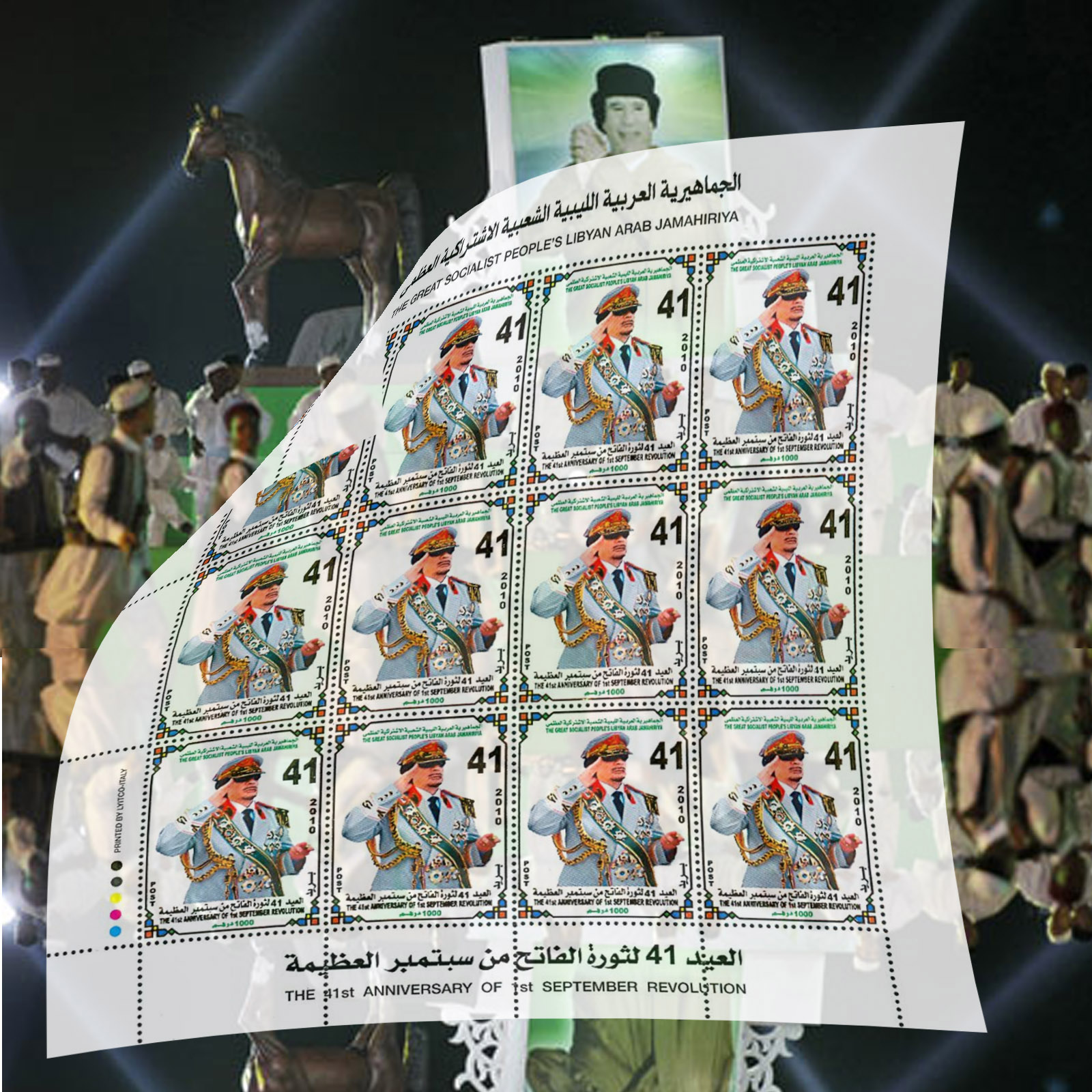
In September 2006 Gaddafi was celebrated as the 'knight of 40 years of Green Revolution'. A year later the habitual commemorative series of stamps was published "The 41st Anniversary of the September Revolution" by the Great Socialist People's Libyan Arab Jamahiriya"; Jamahiriya meaning "the state of the masses." .

As with the tyrants of the family Assad, Saddam Hussein (*) and Colonel Gaddafi, world leaders have been supportive of their regimes for decades for all kind of reasons: the stability of the Middle East and the position of Israel, a state opposing the Iran and its ambitions after the fall of the Western oriented Shah leading to indirect support of one of the most bloody post World War II wars, the one between Iraq and Iran. Other reasons are oil, gas and nuclear power contracts some of them signed only recently by the same political leaders of the Coalition Forces now involved in the military containment and overthrow of Gaddafi’s state. What about the economic interests colouring their vision? One can observe that shifts of power also imply shifts of political relationships, like a most recent visit of a trade mission of the People’s Republic of China to Cairo, after the fall of Mubarak.

Pictures from the family albums of heads of state to remember meeting Colonel Gaddafi: Putin, Chavez, Zapatero, Zine El Abidine Ben Ali, Ali Abdullah Saleh, Hosni Mubarak, Mandela, Blair, Brown, Berlusconi, Chirac, Sarkozy, Obama.

The choice for military force, the attempts at collateral killing of Gaddafi, leaves no space for the later appearance in any court – be it Libyan or International – of Gaddafi. Imagine this: Gaddafi taking the stage to defend himself, what would he say, what would he tell about his former  powerful friends? Just the idea… better have him dead! Images of the process of Saddam Hussein come to mind of a judge hammering off his public statements.

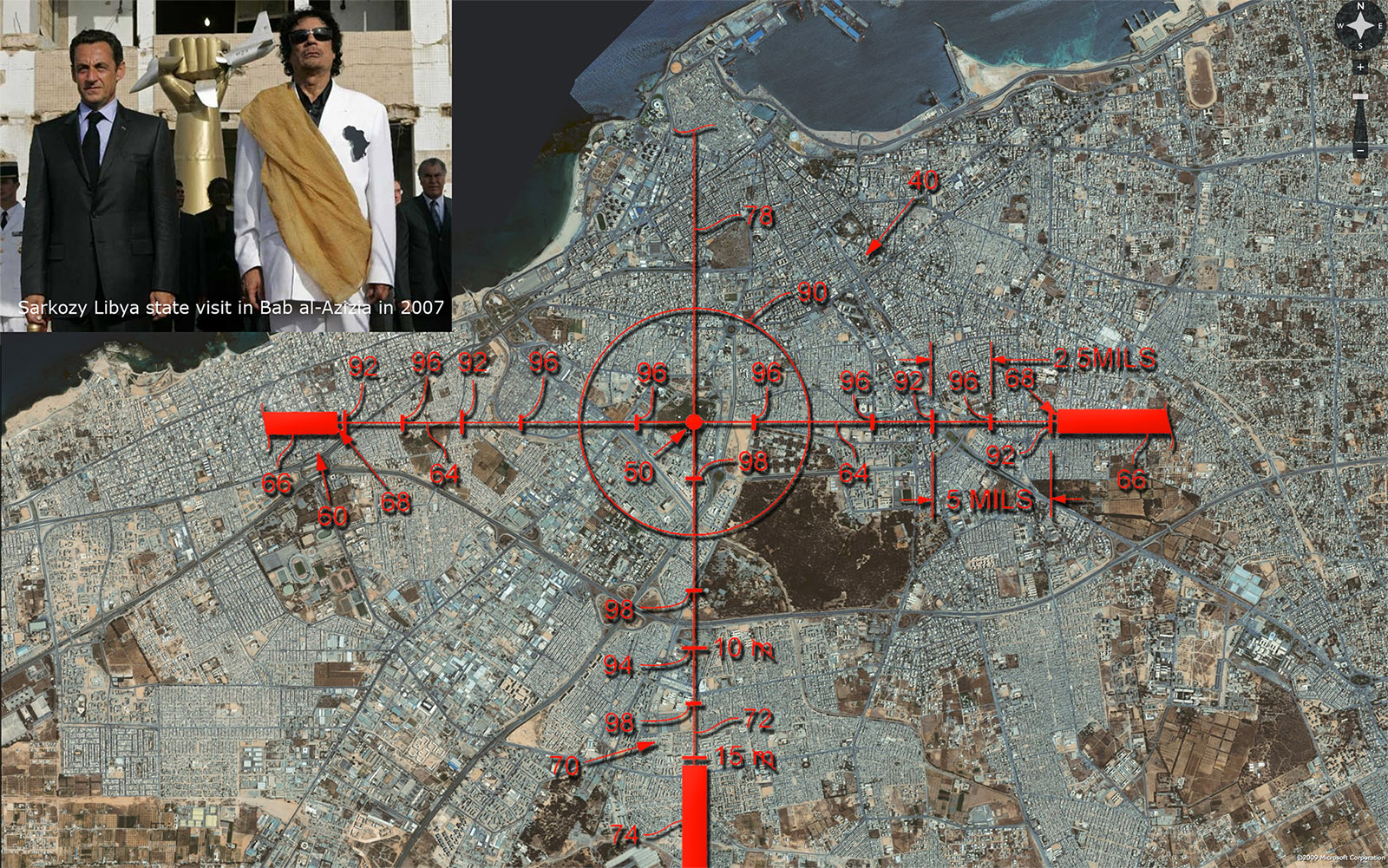
A simulated targeting view of the compound of Gaddafi in Tripoli. The inset shows Nicolas Sarkozy during his state visit to Libya in 2007 standing next to Gaddafi in front of the monument commemorating the bombardment ordered by USA President Ronal Reagan in 1986 of the same compound he is standing in. This year March Sarkozy has been involved in the bombardment of the same spot.

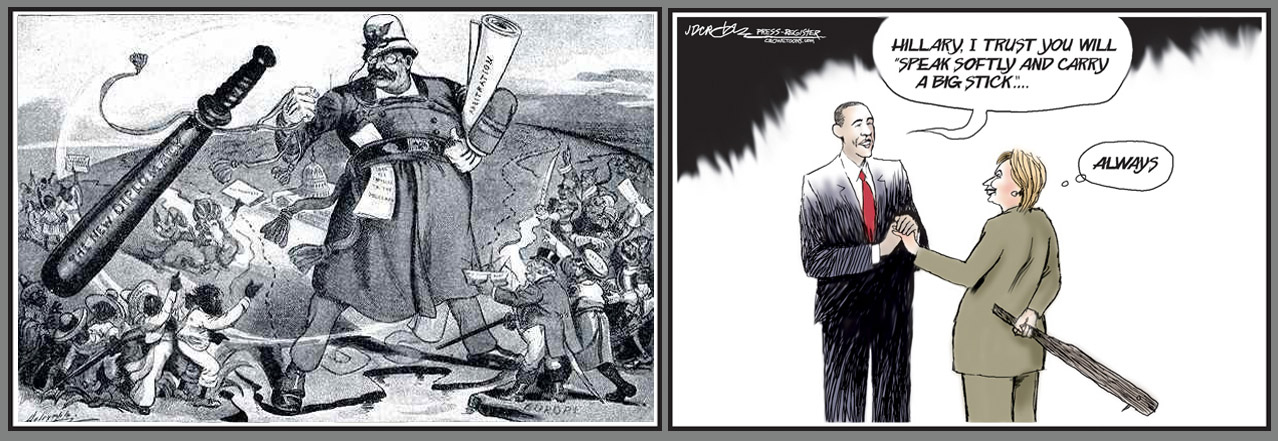
Are we ready yet for a real functioning of an International Criminal Court that prosecutes individuals and their crimes in an impartial fashion? A process of judgement that will create the space necessary for rebuilding in a nation that what has been destroyed, giving time to recreate a minimal common bond between the people and its government. On the international stage of politics many speak of human rights protection and the necessity of some form of democracy. In practice this is deliver through the use of high-tech military power. Are these the right means to such an end? Will it serve Libya now, Syria later? It is doubtful that long distance military force through the air, ‘Big Stick Policy’ of the 21st century, will help to establish peace. Many of the perpetrators that should be judged will be dead before they can face their judges, here on earth.
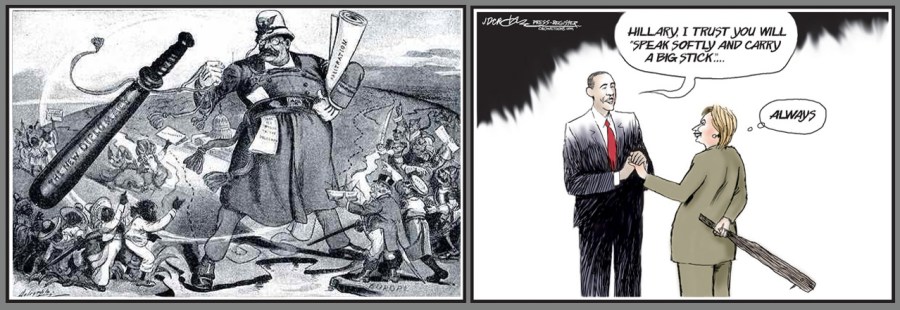
'Big Stick Policy' in American cartoons from 1902 Roosevelt to 2011 Obama. Roosevelt attributed the term 'big stick' he started to use in 1900 to an African proverb: "Speak softly and carry a big stick; you will go far."

Will  peace be served by state lead tyrannicide and assassination? I do not think so. The way a regime is changed determines the next one to come. There is now more than half a century of experience of how to apply international justice. The limitations of the victor courts of justice of Nuremberg and Tokyo after World War II have long been surpassed. The examples of national and international courts for Yugoslavia, Uganda, Cambodia, Sudan, Congo, and so on – whatever their shortcomings – point the way to go. The emphasis should be on the suppression of tyranny by the rule of law. (**)
——

*) See my interactive Meta-Map of Saddam Hussein  1927-2007 (published in the Dutch Daily de Volkskrant in the year 2006)

**) Jackie Ashley wrote a comment in the Guardian of Sunday May 1. “Few would weep for Colonel Gaddafi, but targeting him is wrong In war, international law is all we have. If we cast it aside, there’ll be nothing left but might-is-right, arms, oil and profits.”
Nasser speaking in Alexandria in 1956... click picture to see movie

A post by my Hungarian friend Attila Ara-Kovacs on Facebook pointing to an article in The Guardian about the youth of Alexandria protecting the new Alexandria Library against looters (“lawless bands of thugs” according to the librarian), did trigger a whole range of associations:

Alexandria, Egypt, Friday, Feb. 4, 2011.

Alexandria the city of popular upheavals for millennia against Roman pagan rule, against Roman christian rule, against French and British imperialists from the landing of Napoleons troops at the beginning of the 19th century to the French and British naval bombardment in 1882 and the Suez War of 1956… at the same time of the rising in Hungary and the Russian invasion. The Egyptians under Nasser where supposedly allies of The Soviet Union in those Cold War days… though Nasser kept local party communist activists neatly in prison.

An ancient obelisks from Alexandria, dating back three millennia, symbol of the all powerful rule of Egyptian pharaohs and – in disrespect of any idea of cultural heritage was given away in 1819 by Muhammad Ali Pasha to thank the Brits – enemies of his enemies for their interference against French Napoleonic occupation. Ali Pasha was a Turk general of Albanian origin of the Ottoman empire who had just declared himself ‘Khedive’ (vice-king) of Egypt and Sudan. The obelisk was taken and shipped  much later from Alexandria and almost lost on its way and can till this day be seen in London at the embankment of the river Thames. Later the Americans also did get their Egyptian obelisk as a gift by the next Egyptian ruler, Isma’il Pasha, in 1877 – the year of the opening of the Suez Canal – who wanted to play the Americans against the now en encroaching powers of France and Britain. This obelisk also came from Alexandria and now stands  in Central Park New York. The French did also get their obelisk from Muhammad Ali Pasha in 1826, this one  was taken from a temple in Luxor, it now stands at Place de la Concorde in Paris.  In a long range view of history, such symbolic gestures of royal gifts to stem imperial strive make sense. Was the founder of the Bibliotheca Alexandrina not one of the generals of another much earlier imperialist, Alexander The Great?

Ptolemaeus (367-283 BC), a Macedonian general, who used the icon of Alexander as a ‘trade mark’ on the coins of his new found Greek kingdom on the soil of Egypt… exploited the split up spoils of Alexanders wars of aggression against other empires, founding yet another one. He named himself pharaoh  and  was also the founder of the most idealised icon  of all libraries the ‘Museon’ with in it a collection of  mainly book-scrolls, later known as  ‘The Bibliotheca Alexandrina’. The new dynasty was expanding over neighbouring countries and held out three centuries to end up as a Roman dependency.

Alexandria has been a most important hub in Mediterranean trade, not only of goods but also a centre where different believe systems both came together and were fighting each other.  Pagans versus Christians and different schools of Christians between each other , while over time Islam took over almost completely and Jewish influence was constant, but marginal.  The history of rulers and upheavals in the town of Alexandria is sheer endless. These associations made me find today a fascinating book on the history of this town by  Christopher Haas “Alexandria in late antiquity: topography and social conflict”,  with several opening chapters freely available on the internet by GoogleBooks.

“The true criminals are the blood suckers… that sucked us dry”, Colonel Nasser is shouting from a balcony in Alexandria just over half a century ago… and I remember the war and the inflamed news of the Cold War  on the radio, from when I was just a boy of 12 years old. The bloodsuckers where the French entrepreneurs that started the construction of the Suez canal and the Brits that were first opposing  this new shipping route – because they had insufficient control of it – but later took over control and endorsed it. Main part of the work was based on Egyptian slave labour (“Egyptian blood ran in the canal before the water of the seas”). Nasser and his rebellious group of young army officers confiscated the Suez Canal in 1956 and send a wave of popular enthusiasm not only through the whole of Egypt, but throughout all of the Arab world. That attempts at canal building and the inclusive slave labour to realize it goes back till the time of the Egyptian pharaohs was left out of the revolutionary rhetorics of that time.

Click picture to see the news reel as a part of a documentary on YouTube

Has Egypt now been colonised by its own ruling class? Or is it only a neo-colonialist conspiracy with Mubarak as a puppet? The last option seems to be the most unreal one… So who are the true criminals now?

It seems that in the end each nation that has freed itself from the shackles of colonialism and even neo-colonialism, has enough exploitive creativity within its own ranks to keep on or recreate whatever forms of group exploitation. What we see is the demise of romantic ‘Third Worldism’, packaged in marxist, leninist, maoist or any other anti-imperialist discourse. The ‘haves’ and ‘have-nots’ may on the level of Gross National products economically by separate areas of the world, but within each territory this two-fold separation is reproduced once again. Each name of a leader we may know or learn during upheavals like the one in Egypt, is like a bastions behind which whole social layers of society who are profiteers and practitioners, hide themselves. The personal power of the Egyptian presidency from Nasser To Sadat en Mubarak may be comparatively speaking huge, a ruler and his or her rule is always carried by several layers of society, kept in a bond of reciprocal dependency.

Is being wealthy always a crime and poorness a virtue? Or can there be some form of creative connection between the classes to level out their differences, because too much wealth can not be consumed alone and needs to be shared. Is that maybe what democracy in Egypt and elsewhere should be about?

Nu het ‘historisch opportunisme’ van het Nationaal Historisch Museum hen van de hun schuilkerk in Amsterdam naar de Grote Markt in Groningen heeft gedreven, is geen wind te zwak of het NHM draait wel mee… Inmiddels ligt er in het uiterste en meest moeilijk bereikbare Noord-Oostelijke puntje van Nederland de eerste steen voor het Nationaal Historisch Museum al weer geruime tijd klaar… of het nu om het dorrup Rottum of om de Rottumerplaat in de Wadden gaat weten mijn bronnen niet vertellen, maar dat het een rottig plekje voor een museum is dat staat wel vast. Enkel voor doordouwerige standvastige echte liefhebbers van het Nationaal erfgoed waaiert hier de wind, het zand en het strand, met aan het grijsblauwe zerk in het verschiet het nationalistische symbool bij uitstek: de zeemeeuw. Hier, op de rand van de grote ijstijd, waar een wal van stenen als het ware de Grote Hollandse Muur als een natuurlijke barrière omhoog gestuwd heeft en onze volksziel haar natuurlijke grenzen vond met al het barbaarse buiten steen en wad liggende…. is toch de meest ideale plek voor hen die naar een volksgevoel snakken: in besloten gemeenschap gedeeld.

“Zwerfsteen in Rottum”

“Zwerfmuseum mogelijk naar Zuiderkerk in Amsterdam:

==
zie voor eerdere virtuele vestigingsplaatsen van dit zwerfmuseum de eerdere posts:

2010 December 24: Musea zonder H van Historisch: toeristische trekpleisters op het zere verleden

2010 November 5: Afgang der Batavieren in Nederland: geen Nationaal Historisch Museum in Arnhem

2010 October 31: Good news: plan for new National Historical Museum of the Netherlands cancelled


Kop van Het Parool vandaag: “Amsterdam Museum, zonder Historisch.”
Dat beweer ik nu al weer geruime tijd: “die ‘H’ in de naam van het ‘Amsterdams Historisch Museum’ is een letter en een woord teveel. Een museum dat niet langer in staat is het verleden steeds weer kritisch te hereiken (*), mag zich geen ‘Historisch’ Museum noemen, maar verwordt tot een uitstalkast van oude voorwerpen die als enig doel hebben om genoeg pannenkoeken en prentbriefkaarten te verkopen middels de museumkantine en -winkel, om de ‘oudheidkamers’ tussen Kalverstraat en Nieuwe Zijds draaiende te houden.

Vanaf januari wordt het ‘AHM’ dus kortweg ‘AM’ en dat past perfect in de looproute van ‘de toeristische trekpleisters op het zere verleden’, van Anne Frankhuis en Madame Tussaud, tot Rembrandthuis en een ander museum – dat gezien haar tentoonstellingsbeleid van de afgelopen decennia – wellicht ook het recht op die letter ‘H’ dreigt te verliezen, Het Joods Historisch Museum aan het Jonas Daniel Meijerplein (**).  Als we de trekpleisterroute vervolgen en de brug bij de Weesperstraat oversteken en langs het voormalig ouden van dagen huis het Amstelhof lopen is er nog een museum dat de letter ‘H’ al bij haar openingstentoonstelling heeft moeten inleveren: de ‘Ermitage aan de Amstel’, met haar kritiekloos etaleren van de pronkstukken van het door lijfeigenen rijk geworden geslacht van de  Romanovs met vermijding van het historisch verband tussen het autocratisch tsarisme en het daaruit voortgekomen Sovjetbewind. Niet voor niets was zowel Koningin Beatrix als President Dmitry Medvedev bij de opening (met in het gevolg ook nog de toenmalige CEO van de Koninklijke Shell Jeroen van der Veer die de gelegenheid aangreep om een nieuwe deal over olievelden in Siberië aan te kaarten).

Ook het  bijna doodgeboren ‘Nationaal Historisch Museum’ dat zich  vanaf  januari 2011 – eveneens in Amsterdam – schuil gaat houden in een kerk aan de Sint Anthoniesbreestraat dreigt het zonder ‘H’ te moeten stellen, omdat het bij decreet vastgestelde aantal vensters op de nationale geschiedeniscanon, nauwelijks binnen de eerdere genoemde definitie  van het bijvoeglijke naamwoord ‘historisch’  te vatten is: ‘het verleden steeds weer kritisch hereiken’. ‘Nationaal Museum; is korter en dekt ook beter de door voormalig SP kamerlid Jan Marijnissen geformuleerde taakstelling van het bevorderen van een ‘neo-nationaalbewustzijn’ (***).

Duidt dit jongste gebeuren  op een ware trend van onthistorisering van musea, zeker nu er van regeringswege verklaard is dat musea met onvoldoende bezoekersaantallen niet langer op rijkssteun mogen rekenen? Hebben ‘de succesvolle managers’ het niet al lang overgenomen van ‘de studieuze wetenschappers’ in de directiekamers van onze lokale en nationale erfgoedinstellingen? Een tentoonstellingsbeleid gericht op ‘kassakrakers’ ligt in het verschiet, waarbij de ‘de historie’ zeker overleven zal, zij het uit het zicht, in goed verborgen ‘schuilmusea’.


(*) …zoals met de éénzijdig royalistische Oranjetentoonstelling van scheidend directrice Pauline Kruseman (nu nog Vicevoorzitter Raad van Toezicht Nationaal Historisch Museum);  ‘Theater na Tomaat’ een buitenshuis samengestelde, slordige tentoonstelling, waarbij zelfs het jongste verleden onvoldoende bestudeerd was en onbestaande verbanden als historische feiten gepresenteerd werden (zie een meer feitelijke beschrijving op mijn web site); de viering van “Vier eeuwen vriendschap” tussen Amsterdam en New York met totale verwaarlozing van zowel het weinig succesvolle en ook gewelddadige kortstondige Hollandse bewind aldaar en met een algeheel negeren van de revolutionaire ideeën van de 17e eeuwse Amsterdammer Franciscus van den Enden en zijn utopische visie voor een nieuwe volksplanting op de plek die later New York is gaan heten: “Kort Verhael van Nieuw-Nederlant” (1662). Dit laatste is wel de allergrootste gemiste kans van een museum in jaren, om zo’n hinderlijk ‘zoveel eeuwen’  jubileum niet aan te grijpen om een onderbelicht deel van de geschiedenis onder de aandacht te brengen. [n.b. Wim Klever heeft verschillende teksten van Francsicus van den Enden opnieuw bezorgd en van commentaar voorzien]

(**) …het Joods Historisch Museum ziet het niet als haar taak om de lokaal pijnlijke geschiedenis van de efficiënt georganiseerde deportatie van Joden vanuit Amsterdam pregnant in beeld te brengen (de beruchte Gemeentelijke planningskaart voor het Joodse Ghetto van Amsterdam hangt wonderlijk genoeg verderop in Het Verzetsmuseum). Museumprojecten die jonge generaties Amsterdammers kunnen helpen om een ander inzicht te geven in de geschiedenis van het Jodendom en hun vervolging worden node gemist. Wat steeds ontbreekt bij het vormen van een eigen inzicht is de onaangename geschiedenis van de medewerking – van zowel Nederlandse autoriteiten als vertegenwoordigers van de Amsterdamse Joodse gemeenschap – aan de deportaties. Zo’n  zelfkritische historische benadering is een voorwaarde om een beter debat over het huidige door oppervlakkige argumenten gestuurde anti-semitisme mogelijk te maken.

(***) Jan Marijnissen: “Een volk zonder geschiedenis bestaat niet. Elk volk, ook het Nederlandse volk, heeft dus een geschiedenis. De hedendaagse verwarring over onze morele, culturele en politieke identiteit vindt voor een deel haar verklaring in het ontbreken van historisch besef in brede lagen van de bevolking.” Voor eerder commentaar op het 19e eeuwse idee van een ‘Nationaal Historisch Museum’ aan het begin van de 21e eeuw zie mijn post “Good news: plan for new National Historical Museum of the Netherlands cancelled” op dit blog.

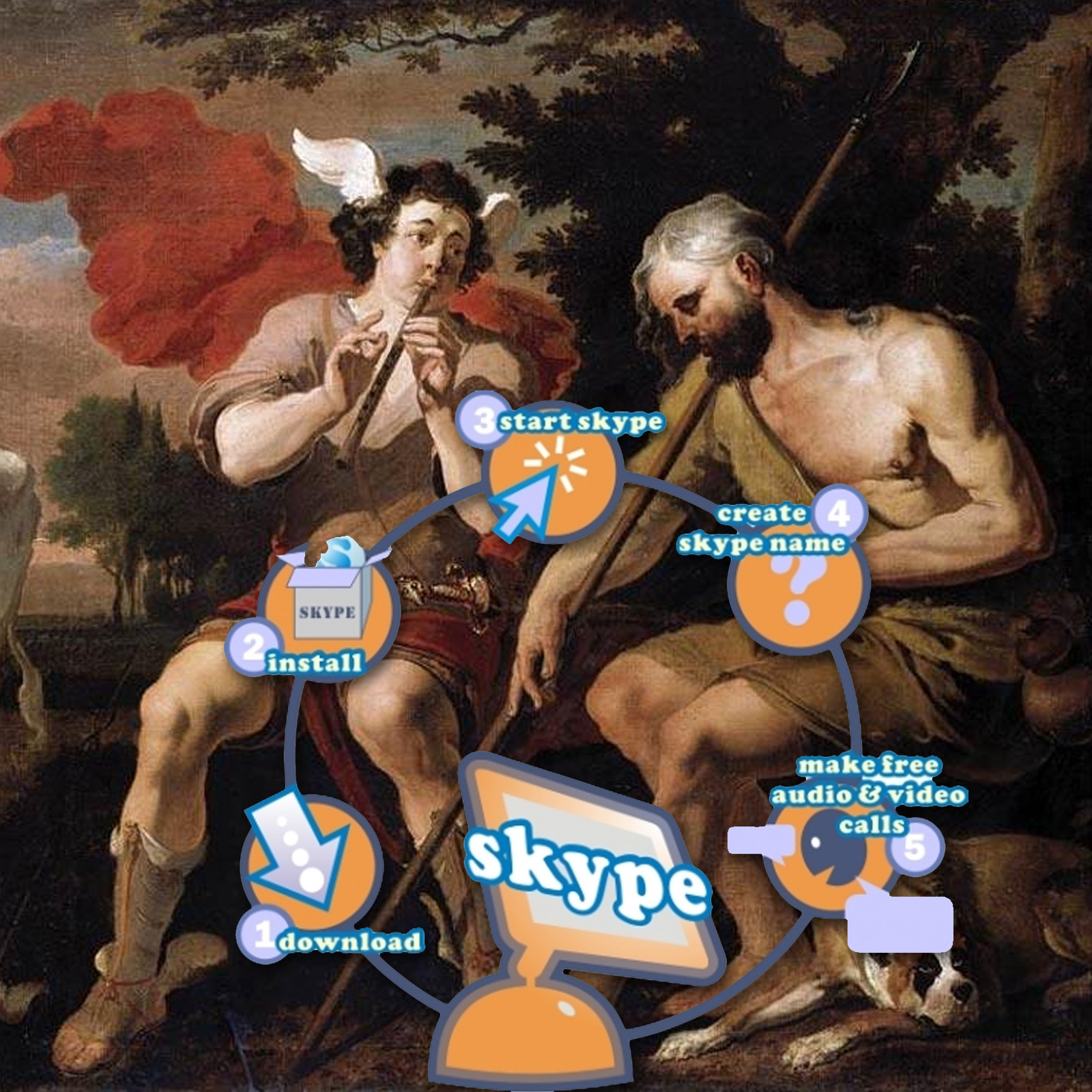
SKYPE is OUT TODAY… wednesday 22 december 2010 around 18:00 hours Amsterdam time. A storm of notifying Twitters whirls over the Internet while millions of users are left to wonder.

Mercury plays his flute and makes the watchman Argus doze... detail from painting by Abraham Danielszoon Hondius 1627

Quick & Swift Messengers are no godlike beings like the god Mercuy or the all powerful Hanuman. Cable networks, data distribution centres and many more things  need to function perfectly to make the being here & there at the same time possible.

For those who took ubiquitous connectivity for granted, the land of failure is always in sight, right over the horizon and today we have a glimpse of a world without SKYPE…

Ardent lovers will not be affected they will switch over – with ease – to telepathy.

—-

Note made a few hours later when SKYPE has been going on for a few seconds and off for many minutes several times and skimming the surface of SKYPotology and its technical feats & shortcomings, I bump into this dated article, taht still seems to point to a way to come to an insight. Let me quote and pass on the link + the interesting map all on ‘Accelerating The Internet‘ it is from 2007, but it may help to link to newer researches by these knowledgable people:

Problem Statement

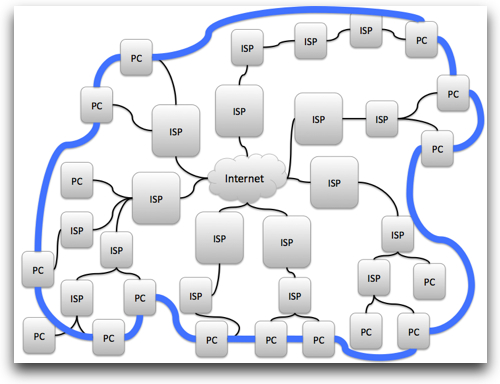
Peer-to-peer (P2P) applications are consuming a significant fraction of the total bandwidth of Internet service providers (ISPs). The increasing P2P traffic is becoming a financial burden to the ISPs and if not well addressed may lead ISPs to block or put strict rate limits on P2P traffic.

An Interesting Idea: PCP Framework

PCP: ISP-compliant, Peer-friendly P2P

We address this important issue by proposing a new framework, PCP, for designing P2P applications that smoothly fit into the global Internet. In the framework, an ISP decides on how much of its bandwidth is to be allocated to P2P applications, and P2P nodes inside the network query the allocated bandwidth and adopt a peer-friendly algorithm to fairly share the allocated bandwidth.

How PCP can help both ISPs and P2P?

Using the typical percentile-based charging model widely used in the Internet and real traffic traces, we show that an ISP can allocate a large amount of bandwidth to P2P traffic without increasing its financial cost. We also show that a distributed, peer-friendly algorithm can be implemented to share the allocated P2P bandwidth.

(…)

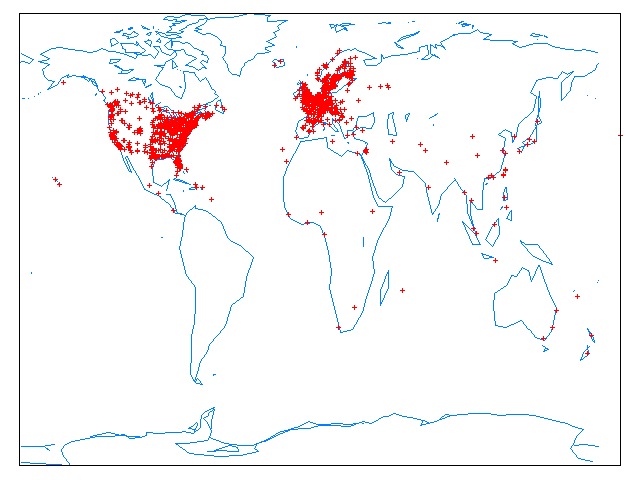
A Detailed World Map of Skype Super-Nodes

What is wrong ?

It has been increasingly popular to build voiceoverIP (VoIP) applications based on peertopeer (P2P) networks in the Internet. However, many such VoIP applications freeride the network bandwidth of Internet Service Providers (ISPs). Thus their success may come at a cost to ISPs, especially those on the edge of the Internet. Their performance may degrade if ISPs take proactive measures to prevent freeriding.

Using largescale end-to-end measurements, we first conduct a systematic analysis of Skype supernode network. We then investigate the impacts of the access capacity constraint and the AS policy constraint on the VoIP quality of Skype. We show that even when freeriding is no longer possible for only 20% of supernodes that are located in stub ISPs, the overall VoIP quality of Skype degrades significantly, and a large percentage of VoIP sessions will have unacceptable quality. This result clearly demonstrates the potential danger of building VoIP applications based on P2P networks without taking into account operational models of the Internet.

How to make it right?

Time diversity in traffic patterns can be used to be (implicitly) ISP-compliant. We show that when using time diversity in traffic patterns in choosing supernodes, about 75% of supernodes in stub ASes can still be active after using time diversity in the experiment; as a result, about 15% of previously inactive supernodes become active, leading to approximately 60% increase in the relay capacity, which results in the observed VoIP quality improvement.

=====

Another source that helped me a bit to understand what might be the problem with SKYPE is “A Brief Primer on the Tech Behind Skype, P2PSIP and P2P Networks” dating from November 2010. We may try to understand at least what the technology is we are using and at the same time make some sense of the fights over new regulations of the Internet in the USA that also touch on technologies described here…

De toenemende protocolisering van handelingen waarvoor in het pre-digitale tijdperk enig sociaal contact nodig was, hetzelfde effect in het onderwijs waarbij gemakkelijke verwerking van toetsingen geleid hebben tot het herleiden van kennisvaststelling door middel van het aanvinken van een voorgekauwde reeks vragen (multiple choice), het formaliseren door middel van digitale formulieren van vrijwel iedere bestuurlijke bemoeienis waarbij het individuele beoordelingsvermogen van ambtenaren zo veel mogelijk uitgeschakeld wordt, maken dat in dit tijdperk – als we nog iets van inhoud vast willen houden van de idee van democratie – het inzetten van digitale middelen voor vernieuwing of verbetering van de democratie nu juist datgene is wat NIET dient te gebeuren.

Pieter Jansz Post zijn weergave van een lijfelijke vergadering op het Binnenhof in het jaar 1652.

Is het niet zo dat – gelukkig – onze vertegenwoordigende organen in openbare vergaderingen op reëel bestaande vergaderplaatsen bijeenkomen, argumenteren, debatteren en dat dan volksvertegenwoordigers enkel bij lijfelijke aanwezigheid kunnen stemmen? Duidt dit niet op de ingebouwde mogelijkheid en veiligheid om tot op het laats mede- en tegenstanders te kunnen vinden voor een bepaalde beslissing en het debat over de inhoud van zulke beslissingen in alle openheid, direct in elkaars aangezicht, te kunnen voeren?

Als dit dan onomstotelijk zo is in de huidige praktijk, dan is dat niet zozeer door het vasthouden aan een traditie, maar om bij het bedrijf van regeren dat afstand schept, toch haar menselijke basis te laten behouden. De delegatie van macht door middel van verkiezingen heeft die lijfelijke aanwezigheid voor het nemen van beslissingen  nodig om niet te verworden tot een onderneming die zou gelijken op dat wat zich afspeelt op de beursvloer bij de speculatieve handel in aandelen: ‘wie of wat scoort het hoogst in de opiniepeilingen’.

Deze tijd behoeft een ‘fysieke democratie’, geen digitale.

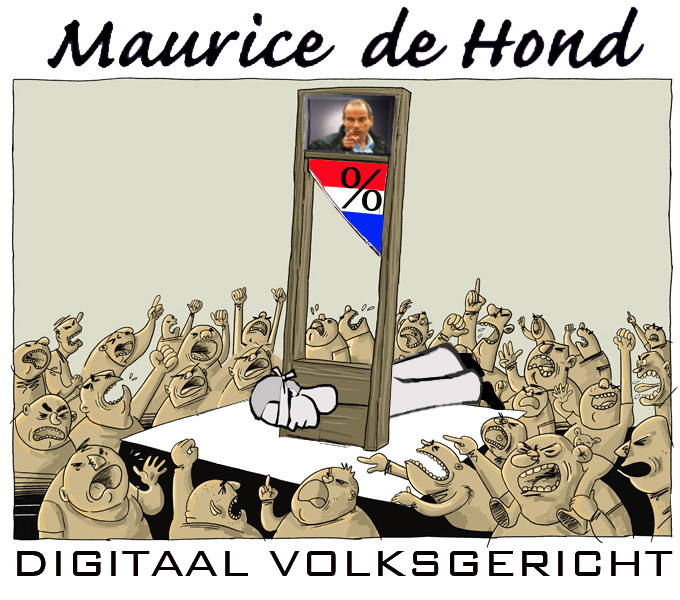
De vorm van die vertegenwoordiging, de wijze van zich verkiesbaar stellen en verkozen worden en de mogelijkheid om een gegeven mandaat door een kiezer ook te kunnen weerroepen als er anders gehandeld wordt als dat eerst beloofd werd, dat alles en meer zou overwogen moeten worden, maar ‘digitale fora’ democratie à la Maurice de Hond vormen eerder een bedreiging dan een verbetering van wat wij nu aan democratische praktijk hebben.

Het Volksgericht van Maurice de Hond is weer actief: “Een meerderheid van de Nederlanders (72 procent) vindt dat de hoofdverdachte in de grote Amsterdamse zedenzaak, de 27-jarige Robert M., een levenslange gevangenisstraf zou moeten krijgen. Dat blijkt uit een zondag gepubliceerde peiling van Maurice de Hond” schrijft het Parool.

Wie pakt deze hijgerige digitale turfer van het ‘gezonde volksgevoel’ zijn digitale potlood af? Wie roept de stokerige journalisten die Maurice de Hond gretig blijven publiceren tot de orde? Het is volgens De Hond en zijn pers-uitlaatkleppers, alsof wij geen onafhankelijke wetgevende instanties in dit land hebben, die strafbare feiten eerst onderzoeken, dan het ten laste gelegde proberen te bewijzen, dit ter zitting brengen en daarna pas beoordelen en uiteindelijk – als de onomstotelijk bewijs gevonden wordt  – tot veroordeling overgaan, met afweging van al het gene dat aan omstandigheden naar voren is gebracht.

*

De gangbare rechtsgang wordt ter zijde geworpen door bovengenoemde opiniepeilers en massabespelers. Voor hen zijn enkele eenvoudige vragen voldoende om tot een oordeel te komen. Dit is even verwonderlijk als verwerpelijk , daar het enkele jaren terug dezelfde Maurice de Hond was die een gerechtelijke uitspraak in twijfel trok en gedurende zeer lange tijd in twijfel bleef trekken. Dat laatste is een ieders burgerrecht, zo ook dat van Maurice de Hond, maar als het gerechtelijk apparaat dan al kan dwalen, waarom dan steeds maar weer dit digitale volksgericht met zijn overgesimplificeerde vraagstelling inzetten? Met het enkel mobiliseren van kwaadheid en angst uitgedrukt in een dubieus percentage eindigen we in een rechterlijk verdwalen… Gaat het de Hond en de media die zijn berichten klakkeloos overnemen, wellicht om een voorzet voor de eis van de Officier van Justitie, die tegenwoordig de onrust in de samenleving mag laten meewegen bij het bepalen van de geëiste strafmaat?

Eergisteren was het de vraag of een PVVer met een strafblaadje al dan niet moest opstappen uit de Tweede Kamer. Gisteren wat te doen met een van pedofiele handelingen verdachte persoon. Hunkert De Hond naar het einde van de rechtstaat? Droomt hij van een directe digitale democratie waarbij computer fora via multiple choice vragen het land alsook het recht bestieren? (**)

De gedachte ‘meetbaarheid van de samenleving’ houdt ook een verwachte stuurbaarheid van de bevolking in. De grensovergangen tussen ‘opiniepeiling’, ‘opinievorming’ en ‘opiniesturing’ zijn onzichtbaar. Het is betreurenswaardig dat wij door de media door dit soort gemakkelijke en letterlijke en figuurlijk ‘goedkope berichten’ overspoeld worden. Een meer moed vereisende analyse en debat over wat nu crimineel en straffen is, of waarom de organisatie van opvoeding en onderwijs onvoldoende blijkt te zijn om seksueel misbruik  te verminderen, zou beter zijn geweest. Waarom niet eerst de  vraag stellen of er – statistisch gesproken – nu echt sprake is van een toename van het zich vergrijpen aan kinderen? Dat zijn cijfers die meer bijdragen aan een publiek debat over misbruik van kinderen, dan haastig vergaarde digitale meningen. De dames en heren journalisten zouden – door middel van journalistiek speurwerk – zulk soort informatie boven tafel moeten zien te krijgen, in plaats van weer een persbericht van het Digitale Tribunaal van Maurice de Hond letterlijk en zonder commentaar ‘prominent’ over te nemen.

——

(*) Een ‘détournement’ van een spotprent van Bas Köhler die – in oorspronkelijke vorm – gericht was op de PVV als guillotine en de rode roos – het symbool van de PvdA – als geëxecuteerde; prent gevonden middels het zoekwoord ‘volksgericht’.

(**) Maurice de Hond schrijft op zijn web site: “Mijn stelling is dat het Nederlandse bestuurssysteem niet meer aansluit op de eisen die de huidige samenleving stelt. Veel van wat er in Nederland de afgelopen jaren is gebeurd, zie ik als kenmerken van het naderend einde van het Democratisch systeem dat Thorbecke in 1848 heeft geschapen. Of dat goedschiks of kwaadschiks zal gebeuren hangt af van een aantal externe factoren. Maar ik verwacht dat dit proces zich in de komende tien jaar zal gaan voltrekken.”

In een via zijn site toegevoegd document in PDF formaat (Schets burgerdemocratie) wordt dat nader gepreciseerd en zoals Maurice het ziet is het zoiets als keuzes maken via je pinpas voor de bank:

“Iedere kiesgerechtigde Nederlander krijgt een kiesnummer en een eerste “pincode”. Om te mogen stemmen zijn ze verplicht één keer in hun leven hun kiesnummer activeren. Verwacht mag worden dat tussen de 80 en 85% van de Nederlanders deze activering vroeger of later tot stand zal brengen.”

Ik ga hier niet de details van het over-simpele plan van De Hond herhalen, beter is het in zijn eigen woorden te lezen. Wel moet mij van het hart, dat het met name de huidige praktijk van De Hond zelve is die mij het ergste doet vrezen als ik zijn meer simpele en dynamischer systeem van volksvertegenwoordiging lees. Volksreferenda – die in de gedachtegang van De Hond gemakkelijker en vaker kunnen plaats vinden – zijn vaak uitvergrote opiniepeilingen, waarbij het aan de orde zijnde voorstel meestal geprofileerd wordt als ‘conflictpunt’ inclusief de daarbij behorende versimpeling en verharding van standpunten. De tot volksgericht wordende opiniepeiling, die ik vandaag weer signaleer, wijst daarmee ook naar een mogelijke ‘Volksdemocratie’ (het woord is eigenlijk dubbel op) die dusdanige gevaren in zich bergt dat al de rompslomp en vertraging van het huidige systeem, betere democratische garanties geeft dan het directe, meer impulsieve digitaal gestuurde model van De Hond.

Interessant is het tot slot te melden dat Spinoza-kenner en vertaler Wim Klever (1930-) in een eveneens in eigen beheer uitgegeven publicatie met de lange titel “Met oude Grieken, van Den Enden en Spinoza naar echte Directe Democratie” (Uitgeverij Vrijstad, 2007) met weer andere ideeën komt voor wat hij een “Virtuele volksvergadering door middel van informatie- en communicatietechnologie” noemt (p.1258 e.v.). Klever komt met nogal wat ouderwets aandoende beperkingen van wie aan die wel of niet aan die virtuele volksvergadering mag meedoen. Nu de vergelijking tussen deze twee visies en andere digitaal gestuurde democratie modellen  te maken gaat deze reactie op een actualiteit ver te buiten. Daar is meer studietijd voor nodig.


tj.


Uitglijden = to slip and modern Dutch society always eager for making a big bug without showing any courtesy is at its merciless best these days with regular snowfall.

The main shopping arcade street, Kalverstraat – good for a turn over of many millions these holy consuming days – has a parade of hundred thousands of unstable tripping shoes as not a penny is invested in doing anything about the slippery mass on the pavement.

One may observe fragile older people making their unescorted foray for their daily milk and bread up the slippery stairs of the biggest luxurious supermarkets of Albert Heijn in the inner town (because often that are the only shops left in the area), with the multinational food chain not making any effort to help these customers, handicapped by the uncommon weather conditions…

This is turning a ‘happy white christmas’ into ‘a white terror’ for those who have come to an age where a slip will not be followed by getting up again for a long while… The Netherlands stronghold of discourtesy. The Netherlands paradise of eager egoists.

Whereby an extra stimulus for falling is offered by the polished expensive natural stone surfaces in these fashionable shops which have never been tested in such thousands of wet shoes entering conditions. My guess is that architects nowadays do not know anymore about the need of a good grip of a shoe sole on pavement and floors… and liability because of neglect of shopkeepers or municipality in such circumstances is hardly a known phenomenon in the Low Countries.

The Supreme Court of the Netherlands has ordered a retrial in the case of a Libyan national – Ahmed Issa Al Jeballi – convicted of starting a fire that in 2005 killed 11 immigrants in a detention facility near Amsterdam’s Schiphol airport. This news of today evoked the following vision….

27th of October 2011 Minister Donner welcomes Colonel Gaddafi on Schiphol just before Ahmed Issa will hand 'The Eternal Burning Dossier of the Schiphol Prison Fire' to Minister Donner. Miraculously Donner will accept the dossier but will not burn his fingers. If this can be seen as a Judicium Dei or not is hotly debated. Donner is known as a staunch believer both in the hereafter and in the heretofore on earth - in the last realm, his reign still sways. (click picture for full size view)

The ‘Migrant To Migrant’ volunteer support group (M2M) that has put up unmeasurable efforts to support the surviving migrants did send the following reaction (in Dutch) on this decission:

Commentaar van M2M (14 December 2010)

Cassatie Schipholbrand: vreemdelingenbeleid gevangen in paradox

De Hoge Raad heeft op 14 december bepaald  dat de rechtzaak over de schuld aan de Schipholbrand moet worden overgedaan. Dat is goed nieuws voor de enige verdachte, maar wat betekent het dat niemand aansprakelijk is te houden voor de dood van elf gevangen ongedocumenteerde vreemdelingen?

Misschien wel de beroemdste illegaal van Nederland is Ahmed Issa Al Jeballi, oftewel “De Libiër”. In september vorig jaar is Ahmed in hoger beroep schuldig verklaard aan het veroorzaken van de Schipholbrand en direct daarna als ongewenst vreemdeling het land uitgezet. En daarmee leek de Schipholbrand juridisch “uitgeprocedeerd” met als conclusie dat niemand schuldig was aan de dood van elf ongedocumenteerde vreemdelingen die stikten in de rook in hun cellen van het detentiecomplex op Schiphol-Oost.
Ahmed was door het slordig wegschieten van een peuk schuldig aan het ontstaan van de brand, maar de catastrofale gevolgen vielen hem niet te verwijten. Het ongetrainde personeel dat de deur open liet waardoor het vuur om zich heen kon slaan werd wel verhoord maar nooit vervolgd. Evenmin hoefde de directeur van de inrichting zich voor de rechter te veranwoorden en ook de directie van Justitie in Den Haag werd na enig wikken niet vervolgd door het Openbaar Ministerie. Inmiddels wordt in de Haarlemmermeer voortvarend gewerkt aan de bouw van een nieuw detentiecomplex dat volgens de gemeenteraad garant moet staan voor een humane vreemdelingenbewaring. Eerder gingen al nieuwe complexen open in Alphen aan den Rijn en op vliegveld Zestienhoven. Volgend jaar kan het complex op Schiphol Oost gesloopt worden en verdwijnen ook de restanten van de brand in blok K.

De stilte die rond de Schipholbrand was ingetreden werd verbroken toen op 5 november de advocaat-generaal advies uitbracht aan de Hoge Raad inzake het verzoek om cassatie van de veroordeling van Ahmed Issa.

De advocaat-generaal is van mening dat de veroordeling moet worden vernietigd. Het hof heeft de veroordeling mede gebaseerd op het rapport van een deskundige die op zijn beurt weer geput heeft uit het rapport van de Onderzoeksraad voor veiligheid. Volgens de advocaat-generaal mag dat niet gelet op de Rijkswet Onderzoeksraad voor veiligheid. Ook acht de advocaat-generaal het bewijs van het opzet op brandstichting onvoldoende. Tot slot is de afwijzing van het verzoek van de verdediging om een deskundige te horen volgens hem ontoereikend gemotiveerd. (bron: persbericht Hoge Raad)”

Het bewijs is onvoldoende. In het proces bleek dat justitie twee middelen had tegen Ahmed Issa: de eliminatie-methode  en het leerstuk van de voorwaardelijke  opzet. Om aannemelijk te maken dat Ahmed Issa de brand had veroorzaakt moesten alle mogelijke technische oorzaken worden uitgesloten. Er waren talrijke aanwijzingen voor een andere oorzaak, variërend van gevangenen die wisten van haperende apparaten tot een eerder brandalarm dat loos leek maar dat mogelijk niet was. Uiteindelijk hangt dit bewijs door eliminatie aan een flinterdun draadje in een nachtlampje dat al dan niet aan was.
Het voorwaardelijke opzet houdt in dat Ahmed had moeten beseffen dat zijn weggeschoten peuk tot brand kon leiden. Hij nam bewust een risico door niet na te gaan of de peuk echt uit was. Dit veronderstelt dat een gevangene informatie heeft over de beveiliging van zijn cel en dus ook kennis over de nalatigheid van de directie bij het naleven van de voorschriften.
Om meer dan slordigheid ten laste te kunnen leggen heeft het OM en het Hof de informatiepositie van een gevangene op Schiphol Oost tot het absurde moeten overschatten.

De Hoge Raad  versterkt het beeld: Niemand is schuldig aan de ramp, het was geen misdaad maar een ongeluk, een bedrijfsongeval.
Maar het beleid zelf blijft paradoxaal: je zet mensen vast die je weg wil hebben en je behandelt mensen als criminelen ook al worden ze nergens van verdacht.
De beleidsmatige verantwoordelijkheid voor de Schipholbrand is weggemoffeld om deze paradox te verhullen. Daarvoor moest een slachtoffer als Ahmed als zondebok gebruikt worden.
Nu de Hoge Raad het vonnis heeft vernietigd wordt het misschien mogelijk in te zien dat we hier te maken met een systeemfout.
Een systeemfout die is ontstaan door de creatie van de illegaal: een mens die zich bevindt op Nederlands grondgebied, maar buiten de rechtsorde wordt geplaatst. “U hoort hier niet en dient zich onverwijld te verwijderen.” is de boodschap. En zodra je je vertoont moet je weg, dat wil zeggen het land uit of  in vreemdelingenbewaring. Het is de logica van de ontkenning. Voor mensen die hier niet horen ben je als overheid ook niet verantwoordelijk, het klinkt ook logisch. Alleen gaat de logica mank als diezelfde overheid de vreemdeling opsluit: de cipier bewaakt de gevangene, maar behoort ook over diens leven te waken. Buiten de gevangenis is de illegaal voor zijn blote bestaan op zichzelf aangewezen, die keus kun je als mens maken. Maar eenmaal in het gevang is de staat verantwoordelijk.
De vraag is dan of de overheid een probleem oplost door mensen daartoe te veroordelen.  Opsluiten maakt het voor een illegaal niet makkelijker om te bewegen, dus ook niet het land uit. En illegaal verblijf tot misdaad verklaren, zoals de regering Rutte wil,  zal in het onzichtbare en opgejaagde leven van de vreemdeling zonder papieren weinig verschil maken.

Een nieuwe rechtszaak in de Schipholbrand is interessant, maar echt spannend wordt het pas als we met vreemdelingen kunnen leven zonder ze in bewaring te stellen.

=========
See also: “The day Colonel Gaddafi made a courageous humanitarian gesture and came to Schiphol to pick-up his countryman Ahmed Al-J. (Ahmed Isa)”  on this blog.


Asphalt-Art in the Dutch dunes at Wassenaarseslag picture taken summer 2010: flames have burned this schablone of peaceful walking into the hot asphalt of the meandering road to the beach, to put everybody in their own protected trajectory: pedestrians and bicycles alike, both having joint access to this path.

As with all pictures there is a new reading of the image, not at all intended by its designers – say three or four decades ago. The new reading = pedophilia… this because yet another case came up of a man misusing his position in a children care center in Amsterdam. This time it is not the Catholic Church… so they must be a tiny bit happy in the Dutch bishops rooms and Rome…about the latest news  it is not only “us” misbehaving.

Yes indeed, effects of human desire can be as bad as that and as nice as if in heaven…. Little nude angels are haunting churches and museum walls alike all over Europe for centuries, but innocence has always been hard to protect here on earth. If the sensational news coverage of such criminal behaviour – as now in Amsterdam case – will have any positive effective can be doubted.

How do societies deal with deviance in general? How do they deal with sexual deviance? Children can be endangered both at home and in any institution. We should be so honest at least to recognise such a fact. Maybe we lack time and interest in studying and getting to know our own human behaviour in all its manifestations… Maybe we are too childish to prevent child abuse.

Tuesday December 14th. 2010

click picture to go to Volkskrant web page with this article....

‎”Men and child nurseries a charged combination” is a heading of the Dutch daily “De Volkskrant” today. A comment on a recent case of child abuse by a man working as a child care taker. Gender discrimination is unsubtle introduced by a journalism that tries to wip up an exception to such an extant that it seems to have become the rule.

Bygone are the days of gender emancipation, like the White Childrfen Plan (witte kinderenplan) born from the Amsterdam Provo movment in the mid sixties. I was one of the parents volunteering one or two mornings a week to care for our children in the creche in the Keizersstraat. Later this volunteer roulating system has been taken over by a man, Siem, who has been a fantastic child care taker for several decades (Siem died a few years ago at a too young age)…

The proposed solutions for controlling deviant behaviour now-a-days tend to be of the same order: screening, video cameras, databases. The absurd end of such a pedo-fear driven policy line would be ‘in vitro’ conception of children and gender and age apartheid.

An edited version of my article “Wilders and the Dutch press: scapegoater hunted down as a witch” has been republished by OpenDemocrcy.net on November 30. There are 14 reactions on this article, some proving that readers comments are a new form of hunting in itself. The editorial introduction to the article reads:

“Judgmental journalism directed at members of parliament is an orchestrated form of ‘mob-justice’ in the Netherlands today. Self-appointed media watchdogs present a bigger danger to society than the persons they pursue.”

http://www.opendemocracy.net/tjebbe-van-tijen/wilders-and-dutch-press-scapegoater-hunted-down-as-witch

A neo-McCarthyism is flooding the Low Countries these days with the islamophobe law & order PVV party of Wilders being hunted down by almost the whole spectre of “respectable” Dutch news media. Five of the 24 PVV members of parliament appear to have some sort of criminal record, though most of these for minor violations. The hunters of the PVV, chasing what they see as persons and behaviours that threaten their image of what the Netherlands should be, have now become prey themselves. The media that have served Wilders and the PVV and helped them to rise to power,  have now turned against them. Party chief Wilders started today to send around one of his famous Twitter comments to newspapers complaining about what he feels as an orchestrated persecution.

It makes me feel queasy. The burrowing of the media into the past of PVV members, starts to look like an ordinary witch hunt. So, we will not any more assist this.

When one reads and sees the sensational front page articles and prime time television programs these last days, the implicit conclusion is that members of parliament should have have had no intercourse with real life in their past. Parliamentarians should be as innocent as lambs. Like in the shivering years of the early Cold War every member of parliament is checked and each side step in a career of any politician is dug up from the deep and smelly waste heap of history. A few days ago, one of the commercial television companies RTL formally asked all the parties in the Dutch parliament which of their members in the Second Chamber (Tweede kamer) had a criminal record. Of the 150 members 149 answered this question, one member refused at first, but later gave in when confronted with some driving with too much alcohol incident, a decade or so ago. This call to confess by RTL Television News, may have its origin in complaints about their alleged bias toward Wilders and  the PVV. The outcome has been 7 members of parliament with a formal criminal record of which – as said before – 5 belong to the parliament fraction of the PVV.


In the year 2008 the other side of the political spectre has been attacked by the same media that always propose themselves as the legitimatized representative of the abstraction called ‘public opinion’, as the watch dogs  that protect the needed ‘credibility’ of ‘representatives of the people’. A politician of the Green Left Party, Wijnand Duyvendak, felt compelled to give up his seat in parliament because of his – previous known – involvement in radical direct actions against nuclear energy a few decades before. A tactical chosen moment of amplification in the media of this dated public knowledge, was sufficient to make him fall. All this media hunting is done with the implicit intention of supporting ‘democracy’ by cleansing the house of representatives of anybody having whatever ‘criminal record’. The assumption of these ‘righteous press campaigns’ is that elected representatives should have no criminal or any other kind of controversial past. The house of parliament appears – in this vision – to be some kind of church solely populated by purified and canonized saints.

This premise, is more undermining than supporting a system of elected representatives. Society has more to offer than innocent lambs and national crime statistics show this clearly. Sanctions (sancties) and sentences (veroordelingen) range in the hundreds of thousands. There is positive potential in the experience of “unclean” members of parliament. First of all the definition of ‘crime’ is a shifting notion, like squatting becoming a criminal act in the Netherlands only recently and, maybe soon, softdrug blowing becoming a punishable offence, whereas these activities were tolerated before. Ex-criminals and ex-offenders in parliament may help to tone down hard liners with neither social understanding nor human empathy. Acceptance of deviancy in some one’s career – also in the political party domain – must first be established. The prevailing witch hunt mentality we see now has the opposite effect. Politicians try to cover up and hide their past and tend even to pursue more extreme repressive policy measures (if only to hide their own past or inclination).

click picture for link to the Statistical Bureau web page with details on criminality in the Netherlands

The notion of what ‘crime’ can be, has so many shadings of colour as can be found in a rainbow: from almost legal white collar crime committed by those who mostly manage to stay out of prison, to the ‘blue collar criminals‘ that are picked up from the streets and make up the main population of our state prisons. When any citizen has committed a crime and when it comes to a conviction and a subsequent punishment, the social rule can only be, that a specific case of law-breaking has been settled,  that the ‘criminal’ has become an ‘ex-criminal’, who should be helped to reintegrate in society. Such basic humane understanding of social relations have disappeared from  the media scope and has been replaced with the practice of eager journalists acting like 21st century inquisitional witch hunters.

Meeting of Witch Hunt and Scapegoating

Wilders and his “Party of Freedom” (PVV) – known for their scapegoating of Muslims and other ‘Non-Western-Allochtones’ – are now targets themselves. Sudden changes of  the direction in which the cleansing wind of media attention blows, may occur. The ‘line of legality’ is  never straight, bending this or another way constantly as power relations in society change. Side stepping from what is supposed to be ‘the correct path’ may happen to anyone. There is an established juridical system to judge both the perpetrators and the laws they  may have ignored. Additional levels of punishment should be avoided. A democracy can not allow eternal damnation of one of its citizens because of a ‘faux pas‘. Even in the case of a felony, once a person has been convicted and has ‘done time’, a case should be closed. Disqualification from active voting and passive voting (being a candidate for parliament) can be imposed by a court decision, but the cases in which this is possible are very much restricted. The right to vote and to be elected are constitutional rights. Criminal acts against the head of state or the overthrow of a government are specifically mentioned as a basis for exclusion from voting. There are hardly any cases of disqualification from voting and election in the last decades in the Netherlands.

I see the judgemental journalism about members of parliament as a kind of orchestrated ‘mob-justice’, presenting a bigger danger to society than the persons pursued by it. Over the years I  have come to the understanding that ‘the enemies of my enemies are not necessarily my friends’. I will rejoice in the demise of Wilders and his PVV, but  I would prefer that this happens on the basis of a more generalized  understanding of the faulty ways of their xenophobic arguing. The PVV is at all time ready to take up their role of lower and middle  class underdogs. Victimhood always have been an effective political weapon.

The former Prince of the Netherlands, husband of the deceased Queen Juliana, had a long history of trespassing over the line of the law, from causing car accidents to accepting smear money  for weapon deals and being involved in conspiracy against an other state, to only mention a few of his deviating deeds. All this has been accommodated over decades in such a way that the Prince did not have to face any public court. It is a grotesque example of the double standards of  the law abiding officialdom in the Netherlands who – on the other hand – may unscrupulous prosecute someone with less royal credentials.

Structurally speaking, the whole cleansing operation fury does function as a media smoke screen for the draconic economic measures under way of this peculiar minority government coalition of VVD liberals (31 seats) and  CDA christians (21 seats), with the extra-govermental PVV of Wilders conditionally supporting the government – in hostage – with his voting machine of 24 seats, “criminal” or not, a total amount of 76 seats creates what is called a ‘democratic majority’ (half of the 150 seats +1) .

However dislikable Wilders and his PVV movement is, their involvement in ‘white collar’ and ‘fountain pen’ crime is – as to this moment – neglectable in comparison with the older more embedded parties with their long histories in the governance of the country (be they on the right, left or in the middle of the political spectre). Some gigantic forms of stealing like the channelling away of 25 milliard Euro in the nineties from the reserves of the major Dutch Pension Fund for the civil workers, ABP, as will be disclosed coming saturday in a television program by a former investment director of that fund – Jean Frijns –  will most probably not even rank as an ‘economic crime’, it will – almost certain – be classified as ‘a governmental budget policy measure’  of that period.

Critical self-reflection of Dutch media on their role in the recent blaming campaigns is rare, and when it occurs it is only launched as a side show, like an editorial comment on the Wilders Witch Hunt by the national News Hour television program (Nieuwsuur), not in their broadcast, but in writing, somewhere hidden on their web blog…

Chief editorial comment: criminal record should not necessarily break up a member of parliament

TNT = privatised Dutch ex-national post system is on strike once again… one would think that it does not hurt a world that has gone digital, but it still DOES hurt as lots of burocrazies demand signed and stamped authorised letters to be dropped in their physical mail boxes before such and such a date…otherwise they will get you or will not read you!

The profit of the third quarter of 2010 of TNT is said to be “only 75 million euro” (the banner reads TNT = CUNT /sorry I am just translating) a curious picture with the predominant male postmen crowd… as far as I remember most political parties in all divisions of the political spectrum have at one moment or another in the last decade supported the breaking up of the state monopoly on postal services… “Tante Pos” (auntie of the post) used to be the old naming of what was once known as PTT… The old lady seems to have died. The dying hobby of carrier pigeon holders might be a sector of society that will be stimulated by all this… Or should we not even exploit the homing urge of certain birds and start to deliver all our messages ourselves? Imagine the amount of traffic jams that it would give… or maybe it would finally put a hold on our urge to communicate so frequent all that is unnecessary… like this message.

Duivenmelker (keeper of carrier pigeons) in the Amsterdam Jordaan neighbourhood in the times television was still received through a forest of antennas on the rooftops.


De reinheid van onze volksvertegenwoordiging is onlangs dankzij het  zuiverend optreden van RTL Nieuws weer voor lange tijd verzekerd. De zondaars hebben nu allen opgebiecht wat zij aan het alziend oog van het televisie medium onthouden hadden en zo kan, middels de publieke biecht en het maken van tekenen van deemoedigheid, het blazoen van de Tweede Kamer der Staten Generaal van het Koninkrijk der Nederlanden weer in alle heerlijkheid schitteren en heel de natie tot lichtend voorbeeld zijn. Nu kunnen die kamerleden, die onder hun angstvallige geheim gebukt gingen, middels de absolutie van de publieke biecht weer “met onbeklemde borst” van zich laten horen…

Daar zien wij: de drie struisvogelveren symbool van voorzienigheid; de drie acht puntige sterren die de vastberaden balans van de regeringspartijen tot uitdrukking brengen; het brandend hart voor het Vaderland; en de blanke bloemen van vreemde smetten vrij. Ach de dichter van onze versmade nationale hymne Hendrik Tollens wist dit alles al in 1815 in het eerste couplet van zijn prachtig lied zeker te treffen…

Wien Neerlandsch bloed in de aders vloeit,
Van vreemde smetten vrij,
Wiens hart voor land en koning gloeit,
Verheff’ den zang als wij:
Hij stell’ met ons, vereend van zin,
Met onbeklemde borst,
Het godgevallig feestlied in
Voor vaderland en vorst.

“Wie vrij van zonden is werpe de eerste steen” …

…ik volg nu al een paar dagen de affaire rond het tweede kamerlid voor het PVV Lucassen (agressief gedrag en veroordeling wegens ontucht)  en alhoewel ik een hardgrondige afkeer van het PVV heb, is mijn afkeer van huichelarij nog groter. Wie zette deze roep om aftreden van een wat woest PVV kamerlid die ooit veroordeeld is en er met een voorwaardelijke straf vanaf is gekomen in gang, vraag ik mij dan af. Is de verstoring van het wankele evenwicht van het democratisch model  ‘de meerderheid die beslist = de helft +1’ niet de belangrijkste reden? 

Het oude adagium “de vijanden van mijn vijanden zijn mijn vrienden niet” komt dan weer bij mij op.
Politicus Lucassen als bedrijver van seks met ondergeschikten en beticht van het bedreigen van zijn buren… Wie was één van de malformateurs van dit kabinet in opdracht van koningin Beatrix? Jazeker huisvriend van het paleis, Ruud Lubbers, die in Washington een secretaresse in de billen kneep en daar voorwaardelijk onderuit wist te komen. Wie is nu kersvers Minister van Immigratiebeperking en het Reisbureau Wilders? Jazeker opgestapte burgervader van Maastricht Leers vanwege zijn handel en wandel in Bulgaarse villa’s. Wie is nu toezichthouder bij de ABN/AMRO na eerst het zicht verloren te hebben op de DSB bank? Was dat niet de beste minister van financiën ooit? 

Als in het politieke landschap van Nederland hoge bomen buigzaam sterke winden weten te doorstaan, waarom zou een verkozen kamerlid met een eenvoudige stamboom (*) als ex sergeant Lucassen dan gekapt moeten worden? Iemand die ooit in de fout is gegaan, betrapt en veroordeeld is, kan daar van geleerd hebben en dient niet tot in eeuwige dagen uit publieke ambten geweerd en uitgestoten te worden.

Ooit (mei 2006) gebruikte ik deze stenigingsprent ter verdediging tegen huichelpraktijken die een andere politica uit de tweede kamer betroffen, wier standpunten eveneens niet de mijne zijn,  Hirsi Ali, omdat zij door VVD minister Rita oneigenlijk behandeld werd: “Hirsi Ali voor kinderen verklaard” was de titel van een gedichtje dat ik schreef met deze deze twee eerste coupletten, waarbij verstoting en verbanning ook aan de orde waren: 

Ieder kind weet het,
al was het maar uit het jeugdjournaal:
barbaarse Afghanen, primitieve Nigerianen,
en ander fanatieke moslims:
zij stenigen…
en dan met name vrouwen.
Dat mag niet. Dat moet niet!
Wij Nederlanders stemmen daar niet mee in.
Wij sturen zelfs een beschavingsleger
naar de uitlopers van het Himalajahgebergte
om daar verandering in te brengen. 

Nederlanders zijn altijd nette mensen geweest.
Als iemand afwijkt van de juiste weg
zijn verstoting en verbanning onze middelen bij uitstek.
Kijk er de vaderlandse geschiedenis maar op na.
Steniging besmeurt onze schone stoep.

In mijn gedachten doemt nu kamerlid Lucassen op achter dit zelfde beeld, zei het slechts als inzicht opwekkend ‘zinnebeeld’: Steniging van de heilige Stephanus uit “Schouwtooneel der martelaren” 1738 getekend door Jan Luyken (1649-1712).


klik beeld voor grotere versie…

=======
(*) De CV van Lucassen zoals op 12 november 2010 nog steeds te vinden op de web site van de PVV

Op zondag 21 november is de CV van Lucassen op de web site van de PVV nog steeds niet geactualiseerd; dat hij uit de kamercommissies voor onderwijs en defensie, alsook het NAVO overleg gezet zou zijn door partijleider Geert Wilders, is niet zichtbaar gemaakt op de publieke web site van de PVV. Al dat wat de partijleiding onwelgevallig is wordt zo buiten het zicht gehouden. Of is het gewoon dilettantisme?  [tj.]

http://www.pvv.nl/index.php/fracties/tweede-kamer/eric-lucassen/cv.html

Biografie

Eric Lucassen maakte de verloedering en islamisering van onze wijken van dichtbij mee. Hij groeide op in een Amsterdamse volksbuurt die in hoog tempo veranderde in een achterstandswijk. Al van jongs af aan wilde Eric zich inzetten voor de vrijheid en veiligheid van ons land. Aansluitend aan zijn dienstplicht koos hij daarom voor een loopbaan als beroepsmilitair bij de Koninklijke Landmacht. Hierna heeft hij zijn twee grote passies kunnen combineren: muziek en les geven.

Als woordvoerder Arubaanse en Antilliaanse zaken gaat hij de overgang naar een nieuwe status van deze eilanden scherp in de gaten houden. Er mag geen Nederlands belastinggeld meer verdwijnen in die bodemloze tropische put. Verder gaat hij zich inzetten voor een gezonde woningmarkt. Er moet snel een eind komen aan de softe aanpak van de verloederde wijken in ons land.
Als lid van de vaste commissie voor Defensie zal hij zijn ruime kennis en ervaring op dat gebied inzetten voor de PVV.
“De mannen en vrouwen van onze krijgsmacht kunnen rekenen op onze steun.”

Commissies
Nederlands-Antilliaanse en Arubaanse Zaken
Wonen, Wijken en Integratie
Defensie

Parlementaire Assemblee
NAVO

Onderwijs
Secundaire Vorming Onderofficieren KL
Algemene en Hogere Instructiebekwaamheid
Koninklijke Militaire School
Atheneum

Loopbaan
Lid Tweede Kamer der Staten-Generaal
Docent digitale muziekproductie
Onderofficier Koninklijke Landmacht


Just saw a history television program (VPRO Andere Tijden/Other Times) on the rise of the new type of elderly home in the Netherlands in the seventies of last century and remembered a reportage I wrote for our radical weekly newspaper (Amsterdams Weekblad) must have been 1972 on a sad old man who had been transported to the new pre-graveyard high rise structure, from the inner town to the outskirts of the city…. He was looking from his high rise coffin onto a high road serpentining to a grey horizon… Just checked the municipal archive for a photograph of that particular elderly home (Flevohuis) and found it. The picture illustrates the atmosphere perfectly… the Public Works photographer gave a visual clue by the black frame ribbon that goes with this historical document of Old age Apartheid in the Netherlands; the Welfare Home Lands for the elderly…. freeing young and productive families from the burden of having parents….

'TEHUISLAND FLEVO' (Elderly Home Country) at the border of the city, at the edge of a former cemetery. Fotoarchief van de Gemeentelijke Dienst Volkshuisvesting; eldery home Kramatweg, Indische Buurt (Indian neighbourhood pointing to the old Dutch East Indies) Amsterdam.

laten we een wandeling maken door Amsterdam
het over marihuana hebben
de avond spreidt zachtjes de gesprekken uit
de avond omsnoert stevig de blikken

laten wij ons haasten om naar de jazz van de regen te luisteren
in het ‘Alto’ van nachtelijk Amsterdam
ouderwets met zijn tweeën bij de schoorsteen
zonder liefdesverklaring… dat voor

de noot regen
vloeide samen met de noot jazz
tot de compositie van nachtelijke extase
de noot regen
haalde de gril van de snaar er tot het uiterste uit
om de toonladder ‘wij’ te spelen

laatste versie van de visualisatie van het gedicht…klik beeld voor grotere weergave

Vanmorgen vond ik in mijn brievenbus het Tijdschrift voor Slavische Literatuur van oktober/november 2010, eenvoudig uitgeven, altijd met verfijnde inhoud en deze keer trof mij het werk van de in Amsterdam wonende Russische dichteres Ljoedmila Chodynskaja (Людмила Ходынская) met een inleiding van Denis Ioffe in een vertaling van Willem Weststeijn. De stad waar ik woon, gezien en gevoeld door onNederlandse ogen en andere zintuigen, heeft mij altijd aangetrokken, omdat ik vaak moeite heb deze stad nog met een blik zonder oordelend weten te kunnen zien. Als lezer van de ervaring van een ander, kan ik mij op deze wijze weer een eigen beeld van de stad Amsterdam maken. Tijdens het lezen kwam mij een recente – onbeduidende – foto die ik op een late avondwandeling maakte in gedachte, zo’n foto waarbij de sfeer van het moment je omarmt en tegelijk vervliegt als je dat met een camera probeert te vangen…


…en met een paar Google Image zoektochtjes en Photoshop-handelingen vloeiden enkele – wellicht al te letterlijke – beeldassociaties daar doorheen. Het eerste probeersel staat hieronder en kreeg direct al de zelf-dis-qualificatie ‘kitsch’ door de erotische suggesties van het gedicht middels het gezicht van een genietende dame en het teveel aan andere toegevoegde beeldelementen. Het bekende probleem van het dupliceren van wat in de tekst staat met beeld, alsook het onvermogen van beeld om de werking van poëzie te imiteren. Picturale bouwstenen laten zich niet volgens dezelfde principes als woorden stapelen: avondbeeld van de Amsterdamse grachten + silhouette van hand in hand wandelend stel + gesolariseerd beeld van een marihuanaplant + door ritmische muziek gestuurde lichtpatronen + vrouwengezicht tijdens het bedrijven van de liefde (eigenlijk een pornografisch beeldcliché). Dit alles bij elkaar leverde onderstaande soeppige prent op.


Hieronder de vereenvoudigde latere versie…. direct onder het gedicht staat steeds de laatste versie. Klik platen voor groeter beeld.

Bij al de mogelijkheden die de elektronische montage en collage te bieden heeft  is het zo dat – gelijk aan muziek en poëzie – de suggestieve ruimte tussen de klanken, tussen de door woorden opgeroepen beelden – het doelbewust weggelatene – even belangrijk is als dat wat aan beeld ingebracht wordt. De selectie gevolgd door de deselectie. Theoretisch gesproken weet ik het al lang, het gaat meer om de opgeroepen persoonlijk gemaakte (idiosyncratische) associaties met een tekst dan om de verdubbeling van het geschrevene en gelezene, zoals bij de toelichtende tekening, de illustratie, de al te letterlijke ‘ licht werpende verduidelijking’. Daar waar ik mij een associatief beeld wenste ben ik geëindigd met een illustratief beeld. Het resultaat van mijn oefening om dat wat met een mooi woord ‘psychogeografische  visualisering’ genoemd kan worden, toe te passen op een gedicht van Ljoedmila Chodynskaja blijft onbevredigend. In eerdere visualisatie-studies van teksten van anderen, gebruikte ik meestal niet een rechthoekig kader, maar een perspectivische bol, zoals in de studie van de ‘literaire pyschogeografie’ van Edo Tokyo. De vertekening van de (glazen) bol, geeft in zijn vorm al aan dat het om een ‘reflectie’ en niet om een ‘projectie’ gaat. Wellicht moet ik die methode ook voor dit gedicht proberen toe te passen. Jammer genoeg is mijn camera met een vissenoog lens kapot en zal ik het door middel van een meetkundige vervorming met gebruik van software moeten proberen. Dat is voor later. Eventuele resultaten zal ik toevoegen aan deze zelfde ‘posting’ op dit blog (via Comments RSS functie button – die enkel zichtbaar is  als er één enkele post bekeken wordt – kunt u toevoegingen laten signaleren). Degene die zich geroepen voelt het zelf anders en/of beter te doen…. aarzel niet, files kunnen naar info@imaginarymuseum.org.

Hieronder documenteer ik de visualisatie-oefening, iets wat ik eigenlijk nooit doe, dit om de redeneringen tijdens het maken van beeld – die anders in het hoofd blijven – nu eens met woorden proberen weer te geven:

[Zondagavond 7 november: Toch nog het element uit het gedicht van de snaar erbij gestopt… heel letterlijk iemand die jazz gitaar speelt “haalde de gril van de snaar er tot het uiterste uit”.  Elegante handen die de snaren beroeren en vrouwelijke rondingen, ook weer zulke onontkoombare beeldassociaties.


[Maandag 8 november tijdens een koffiepauze: Het hand in hand wandelen silhouet blijft een irritant ‘banaal’ element, ondanks de lichte transparantie met de achtergrond. Wat maakt iets ‘banaal’ is dan de vraag, die beantwoord moet worden. Het tussendoor onderzoek gaat verder tj.]

[Maandag 8 november in de vroege avond: het silhouet zag er ‘banaal’ uit door de houterigheid van de vereenvoudigde uitsnede. De linker figuur meer uit het beeld geplaatst waardoor het afwijkend perspectief van deze ingeplakte figuren minder zichtbaar is; iets transparanter gemaakt en wat in kleur verschoven ten opzichte van de doorschijnende achtergrond. De golflijn van de gitaar komt er nu mooi doorheen en verbindt de hand in han d wandelaars met het gitaarspel; dat effect wat versterkt door het contrast van de beeldlaag met het bespelen van de gitaar wat te verhogen.]

Voorbeeld van een psycho-geografische visualisatie van een passage uit NATSUME Soseki (1867-1916) zijn roman "Sanshiro" (het meertje op de campus van Tokyo University is later naar de schrijver genoemd) Klik plaat voor grotere versie....

Een van staatswege gecanoniseerde eenduidige geschiedsrepresentatie is een 19e eeuws idee. Het voorstel voor een nieuw Nederlands Historisch Museum in Arnhem is daarmee een 19e eeuws plan voor de 21e eeuw. Als er iets mis is met het historisch besef in Nederland dan hebben al die honderden al decennialang bestaande musea zich onvoldoende van hun taak gekweten en dienen we eerst uit te zoeken waaraan dat ligt. Een van de belangrijkste knelpunten is volgens mij het ‘huichelhollander’ complex: zich humaanvoelend en vooruitstrevend wanend in weerwil van enkel met de grootste moeite omzeilbare historische gegevens die weinig voedsel kunnen geven aan zoiets als ‘nationale trots’ en daarom verhult worden. De nu bestaande musea dienen eindelijk eens te beginnen om ook de keerzijde van het Hollands heldendom te tonen: de slavenhandel permanent in het Scheepvaart Museum, een aparte zaal over de Oost-Indische slachting en kunstroof op het eiland Lombok in het Rijksmuseum, de ontmaskering van de Batavierenmythe in het Allard Pierson, de gewelddadige aspecten van zowel Christendom als Islam in het Bijbels Museum, waarom Nederland de meeste Joden verloor in het Joods Historisch Museum en het Paleis Soestdijk met 2x de geschiedenis van de Oranjes: in monarchistisch en republikeins perspectief. – Ad Libitum. Kortom, geschiedenis als meervoudige waarheid. Geschiedenis die doet twijfelen. Geschiedenis als aanzet tot zelfstandig denken en handelen. Er zullen heel wat mensen zijn die dat weer ‘een tautologische stelling’ zullen vinden, geschiedenis kan immers enkel meervoudig zijn, maar… probeer dat de initiatiefnemers voor het aankweken van een ‘nieuw nationaal besef’ in de Lage Landen maar eens uit te leggen.

Aankomst der Batavieren in Nederland

klik plaat voor grotere versie

Good News from the BAD POLITICAL FRONT: the building of a newNational Historical Museum of the Netherlands” has been cancelled by the new Dutch government. This is excellent news! Who wants Double Dutch History cast into lots of building materials? Who wants to institutionalize persistent Dutch denialism of their colonial past? Who wants the governmental ‘imagined community’ of the Low Countries to be even further Disneyfied? Who wants to look at the glorified Dutch self-image through the canonized windows of state dependent historians? We have plenty of museums in the Netherlands offering such kind of idealized Dutch-centric history representations, already for decades… the whole idea is a belated 19th century concept of constructing a past that never actually was, to forge a ‘new Dutch national consciousness’ in post-national times.

"Daaag Geschiedenis..." ~ "Byeee History..." is what I imagine hearing when seeing the waving bronze woman. The Dutch text is a promotion text in a special design as produced by the launching organisation of the National Historical Museum and reads: "The National Historical Museum stimulates the historical imagination." The orange building in the back is the actual design for the new building now stalled; the white building in front is the former palace 'Soestdijk' of the deceased Queen Juliana by some proposed as another possible national historical museum site; the statue shows the Queen and her husband Prince Bernhard, Juliana waving as she used to do each year when a 'defilé' of Dutch citizens came to congratulate her with her birthday on 'Queensday', the 30th of April.


The image shows the design for the National Historical Museum in the Eastern border town of Arnhem and the palace of former Queen Juliana in Soestdijk (in the heart of the country) the last one has also be proposed as a seat for such a new National Historical Museum. The idea for such a museum has been strongly propagated by Jan Marijnissen, the party leader of the Socialistiese Partij (SP). His proposal – dating from 2003 – was later also supported by the Christian Democrat Party CDA, a party now in government and deciding to stall the whole museum building project. As it is a ‘national Dutch’ project, I fail to find English language links on the subject. That in itself may be seen as symbolic for the whole undertaking, a sign of the isolating tendencies in Dutch politics of the last decade, moving away from a more internationalist position before.

Jan Marijnissen opens his original proposal with  “a nation without history does not exists”  and speaks about “the nowadays confusion about our moral, cultural and political identity” which finds its origin – partly – in “the missing of a historical consciousness in broad layers of the population.”

Een volk zonder geschiedenis bestaat niet. Elk volk, ook het Nederlandse volk, heeft dus een geschiedenis. De hedendaagse verwarring over onze morele, culturele en politieke identiteit vindt voor een deel haar verklaring in het ontbreken van historisch besef in brede lagen van de bevolking.

Marijnissen acknowledges the existence of many museum institutions and the cornucopia of objects and methods of display on Dutch history, offered by them, but he regrets that nowhere “the rise of society in the Low Countries at the Sea (he uses the conjunction ‘wordingsgeschiedenis’ = history of coming into being)  is told. In other words he is longing for a singular narration of national history.

Echter, hét verhaal van de wordingsgeschiedenis van (de mensen die wonen in) “de lage landen bij de zee” wordt nergens verteld. In het kader van een herwaardering van het belang van historisch besef zou het goed zijn als dat wel zou gebeuren.

His longing for a singular ‘grand narration’, a genesis of the the Low Countries, is something that frightens me because put in practice, it will be more a product of ‘imagination’ and ‘believe’ than of ‘history’. Such a singular story is the opposite from what I envisage as the practice of history: dynamic confrontations of differing views.  It will more hamper  than help, the finding of a ‘social identity’. In my vision we need not put our energy in redefining what is ‘Dutchness’,  but better come to an understanding of the multiple identities and the plurality of the social territories in which we are living. The times of the fenced off Garden of Holland (Het Hof van Holland) with a gate defended by a lion with a sword, lay far behind us. Already in its time this was an allegory  of a non-reality. Man is both a migratory and a sedentary animal. Nations are ‘imagined communities’ and the new narratives we need, do not fit in any ‘national building’.

"Houdt op in mijn tuin te wroeten Spaanse varkens!" (Stop burrowing my garden Spanish pigs!) A Dutch engraving 1578/1582 in the collection of the Rijksmuseum, Amsterdam (object code: RP-P-OB-77.682). One sees the Dutch lion defending the fence around the garden with a sword or club. Click Picture for bigger view...

======
Old Dutch text has been reconstructed as:

Houdt op in mijn thuyn te wroeten Spaensche beesten
wilt uwen verckens-cop toch achterwaerts trecken
oft mijn Guesche-cndse [cnodse ?] salt u soo verleeren
die u thooft sal breken oft den hals doen recken;
den edelen prince daer ghij meed’ woudt ghecken
sal u te water en land’ bespringhen all;
vertreckt met u vuijl soghen en jonge specken
loop guyten loop oft Geux u daertoe dwinghen sall.

=======
An interesting photograph of the inauguration of the statue of the former Queen Juliana and her husband Prince Bernhard by queen Beatrix can be found on a royalist web site and the photograph below, showing the unveiling in the year 2009, while the wind blows the orange drapery into the shape of the tower with its shifting floors as can be seen in the design for the new National Historical Museum. The design of the Historical Museum dates from 2007 and is by one of the founders of the architect association Mecanoo, Francine Houben (1955-).

Statue designed and made by Kees Verkade (1941-) in 2009.

Building designed by Francine Houben (1951-) in 2007 and stalled in 2010.

STORAGE DAYS as leaves are falling in the Northern hemisphere I am reviving old computer storage and transferring Terrabytes of data these days… if only the transport of data between disks would be faster (that is a bottleneck of any economy… the road system cluttering). Just looked at a 8 or 16 Terrabyte DROBO box… but I am hesitating… because of the limits of the connecting data transport devices... while looking at this one realises the fragility of our whole society based on data… Over time DATABASED society will develop into DATAERASED society, throwing us back to times before the digital stone of Rosetta…

AutumnStorage

for full view click picture…

MONUMENT VOOR DE ONBEKENDE GRAVENVERZORGERS
klik op foto voor groter beeld....

Piet van Harn helpen begraven op maandagmiddag 25 oktober 2010 op de Oosterbegraafplaats te Amsterdam… Lopend met zijn allen (zo’n 100 mensen) over de herfstpaden naar het graf… en daar zag ik een onbedoeld prachtig functioneel Monument Voor De Onbekende Gravenverzorgers. “Je bent pas dood” zei zijn broer – die voor de vuist weg sprak en daarbij ook met zijn vuist op Piet zijn in de aula opgebaarde kist sloeg – “als niemand meer aan je denkt.” En van die gedachte is zo’n rijtje gieters met een muntjesautomaat zoals bij de winkelwagentjes in de supermarkt, de meest effectieve artistieke verbeelding.

[Zo gaat het met herinneren: na gebruik teruggebracht krijg je je inleg weer terug, klaar voor een volgend keer]

het leven als een lust, het leven zeer bewust, één van ons kortstondig  aktieverbond, een binding, meer aan een idee,  dan aan een territoire, onuitwisbaar, herinnerd door ons die blijven: voor Piet van Harn 1946 - 2010 van Tjebbe van Tijen

Ik leerde Piet van Harn kennen in de vroege jaren van de Aktiegroep Nieuwmarkt omstreeks 1972. Hij had een pandje gekraakt in de Lange Keizersdwarsstraat, terwijl ik - om de hoek - in de Keizersstraat woonde. Kende hem ook als journalist en schrijver van brochures en boekjes voor de organisatie Sjaloom in Odijk. 'Kosmos-story' heette de brochurereeks waaraan hij werkte. Hij leerde ons in 1973 dat de multinational ITT slecht en de baas van Joegoslavië Tito een "revolutionaire realist" was. Wat dat laatste betreft woonde Piet niet alleen letterlijk een straatje verderop, voor mij die zojuist "De Nieuwe Klasse" van Milovan Djilas gelezen had, een kritiek op de Joegoslavische 'klassemaatschappij' onder bewind van de Communistische Partij. Tegenover de verschillen tussen ons over hoe de strijd in ver gelegen Tweede en Derde Wereld landen te duiden, stond een eensgezindheid als het om het ons 'eigen' gemaakte straatje en buurtje ging. Piet had een vaste en vlotte pen en schreef menig aktiepamflet en beter nog badinerende strijdliederen en conferences. Hij behoorde ook tot de 'geheime staf' van de Aktiegroep Nieuwmarkt die de inzet van 'tactische wapens' tijdens de ontruimings-veldslagen in 1975 regelde. Operaties georganiseerd vanuit de premisse dat wij niet van plan waren "te sterven voor een straatje." Veldslagen die er welliswaar zeer gewelddadig uitzagen, maar waarbij geen enkele dode viel en de verwondingen uiteindelijk beperkt bleven tot blauwe plekken, bloedneuzen en traangasgehoest. Maar vooral... Piet gaf zwier aan het activistenleven dat wij ons toen aangemeten hadden. Plezier als doel en middel. Vertier als drijvende kracht. Dat maakte mede dat wij niet verwerden tot verbeten doctrinaire samenzweerders tegen de sloop en bouwplannen van De Gemeente, maar standvastige en opgewekte actievoerders. Die 'joie de vivre' is wellicht één van de doeltreffendste wapens tegen de autoriteiten geweest. Dat is zoals ik mij Piet vooral herinner. Piet van Harn kreeg het afgelopen jaar enige ernstige kwalen en overleed op vrijdag 15 oktober 2010.

[klik plaat voor grotere versie]

Piet van Harn wordt maandag 25 oktober begraven op de Oosterbegraafplaats te Amsterdam om 14:00 uur.


NO MORE BACK-CHAMBRE BUT BACK-SCRATCHING POLICY

quid pro quo

"Aan de Wilde Kust" Stedman 1777 herzien in het jaar 2010 (1) Zoek de 7 verschillen... Klik zoekplaat voor grotere versie.

Kortgeleden dook een tot nog toe onbekende hernieuwde editie van het beroemde 18e eeuwse werk van John Gabriel Stedman‘s “Reize naar Suriname” (2) op met enkele uitzonderlijke  met de hand ingekleurde prenten die op treffende wijze ‘de constante’ en ‘de verandering’ van de geschiedenis illustreren. In dit buitengewoon groot formaat foliant werd ook een ingestoken briefje gevonden met in houterig handschrift een gezelschapsspel vraag: “Men zoeke de zeven verschillen tuschen dezen twee platen.” Nu het is aan de trotse bezitter van dit boekwerk om dit spel door zijn gasten te laten spelen. Wat het woord “gedoogvrouw” moge betekenen hebben wij tot op heden niet kunnen achterhalen, zo konden verscheidene kunsthistorici en biologen ook geen antwoord geven op de vraag wat voor een soort vogel op de rechter plaat te zien is. Een Belgisch historicus die bij toeval ook met deze laatste vraag geconfronteerd werd, zei te vermoeden dat het om de Blauwvoet meeuw ging en wist zelfs enkele strofes uit een Vlaams strijdbaar studentenlied – aan dit dier opgedragen – te citeren:

Ja wij zijn der Vlamen zonen,
sterk van lijve, sterk van ziel,
en wij zou’n nog kunnen tonen,
hoe de klauw der Klauwaars viel.

Op ons vane vliegt de Blauwvoet,
die voorspelt het zeegedruis,
en de Leeuw er met zijn klauw hoedt
mijn lieve dierbaar kruis.

Weg de bastaards, weg de lauwaards.
ons behoort het noordzeestrand,
ons de kerels, ons de Klauwaars,
leve God en Vlaanderland! (3)

Hoe dit alles te rijmen en waarvandaan nu het verband komt met Suriname – dat toch een wereldzee ver van de “blonde noordse stranden” verwijder is, is nu moeilijk meer te achterhalen… zeker is dat afbeeldingen in hun eigen tijd gezien en begrepen dienen te worden, dat zal iedere gestudeerde iconograaf beamen.

——————-
(1) Prent oorspronkelijk op verzoek gemaakt voor ‘Oerdigitaalvrouwenblad‘ een uitgave onder redactie van Henna Goudzand Nahar, een feministisch getint digitaal blad dat een sterke band heeft met Suriname. De vraag was of ik een prent wilde maken die ging over de positie van vrouwen in de huidige politiek, waarbij bij mij direct de persoon en de recentelijk ingenomen positie van CDA politica Ferrier voor ogen kwam. Ferrier, dochter van de eerste president (1975-1980) van Suriname Johan Ferrier (1910-2010). Zij maakte het – na aanvankelijke oppositie, mogelijk om de vereiste de helft +1 meerderheid in het parlement voor de nieuwe regering Wilders/Rutte te verkrijgen. Van dissidente oppositievrouw werd zij tot gedoogvrouw. “De Wilde Kust” verwijst naar de oude benaming van de drie Zuid Amerikaanse Guianas, gelegen aan de kust gaande van  de Orinoco in het huidige Venezuela tot de Amazone-rivier in Brazilië, waarbinnen ook  het huidige Suriname lag. “Avonturen aan de wilde kust” is ook de titel van de historische vertellingen van Albert Helman over ditzelfde gebied, gepubliceerd in 1982.
Deze Stedman historische zoekplaat is ook gepost op het mooie ‘letteren’ blog ‘Caraibisch uitzicht’.

(2) De gebruikte editie van de plaat uit het boek van Stedman is een met de hand ingekleurde (latere 1818) Italiaanse editie in het bezit van de Universiteits Bibliotheek Amsterdam.
Auteur/Vervaardiger: Stedman, John Gabriel (1744-1797) & Lescallier, Daniel (1743-1822)
Uitgever Te Amsterdam : by Johannes Allart
Jaar: 1799-1800
Uitgever/Drukker Amsterdam Allart, Johannes (1773-1812) 077133641
Collatie: 4 dl ill., portr., krt in-8
Annotatie: Met 42 platen en krt. deels uitsl., gen. I-XLII
Vert. van: Narrative of a five years’ expedition, against the revolted negroes of Surinam, in Guiana, on the wild coast of South America, from the year 1772 to 1777 …. – London : J. Johnson & J. Edwards, 1796
Inhoud: Bevat ook twee aanhangsels over Suriname en Cayenne, door Daniel Lescallier, ontleend aan de Franse vertaling.- Paris/Lausanne, 1799
Referentie : Tiele (Bibl.) 1046

(3) De Blauwvoet is het bekende strijdlied van de katholieke Vlaamse studentenbeweging. Het wordt ook Het lied der Blauwvoeten of tegenwoordig het lied der Vlaamse zonen genoemd, naar de eerste regel van het lied. Het was oorspronkelijk het strijdlied van de 19e eeuwse studentenbeweging Blauwvoeterij. Het lied werd door Albrecht Rodenbach gedicht op 25 september 1875. De muziek werd gecomponeerd door Emiel Hullebroeck. Er bestaat ook een minder bekende toonzetting van Johan Destoop. Het lied past in de strijdlyriek van de 19de-eeuwse Romantiek, maar komt ook terug in de latere Vlaamse nationalistische beweging, zoals die zich bijvoorbeeld nog doorzet in de IJzerbedevaart.
De volledige (moderne) tekst variant staat op: http://nl.wikisource.org/wiki/De_Blauwvoet

De meeuw als symbool van vrijheid van Albrecht Rodenbach tot Geert Wilders… klik plaat voor grotere versie.

Het Historisch Nieuwsblad publiceerde eerder (2009? niet na te gaan omdat deze historici vergeten zijn om hun artikelen op hun web site te dateren!) een nogal oppervlakkig stukje over de frappante gelijkenis tussen de meeuw van de Partij voor de Vrijheid PVV en de meeuw zoals gebruikt als symbool door de NSB op een affiche in 1941 “Wat wilt u vrijheid of knechtschap.” Een dier als ‘totem’ is natuurlijk een zeer algemeen voorkomend fenomeen, dus ook bij politieke partijen, van ezels en olifanten tot beren en leeuwen. De zeemeeuw wordt evenzeer als typisch Nederlands in Nederland, als typisch Japans in Japan ervaren…dat heb je met zeevogels en kusten. Voor ons aardgebonden tweevoeters is de door het zerk flitsende meeuw die tegen een donkerende lucht en daar doorheen schietende zonnestralen het licht op zijn witte bast weerkaatst, een mooi symbool van ‘de idee van vrijheid’. Dit is op talloze wijzen in beeld en schriftcultuur terug te vinden. Of dieren er enige ideologie op na houden die vergelijkbaar zou zijn met onze ‘ismen’ valt te betwijfelen. Dierenfabels zijn mensenproducten.  De kop van het artikel in dit door historici gemaakte digitale blad, “Wilders gebruikt ‘besmet’ logo”, dekt de al te beperkte lading van het artikel goed. De historici laten immers na, de gebruikte meeuw-symboliek verdergaand cultuurhistorisch te duiden. De door mij genoemde associatie met de Belgische ‘Blauwvoeten’ beweging, die eveneens de meeuw als symbool gebruikte, bedoeld dan ook niet die Vlaams nationalistische beweging simpelweg als ‘rechts’ of ‘fascistisch’ weg te zetten en daarmee de PVV partij van Wilders te defameren. Het vereenvoudigen van historische overeenkomsten is een specialiteit van Geert Wilders. Het kan niet zo zijn dat de opvattingen van Wilders met een zelfde methode bestreden kunnen worden. Mij fascineren eerder de gelijkenissen in de ideaalbeelden van deze twee politieke bewegingen. Dat wordt dus het onderwerp van een nieuwe studie.

DUTCH REBUS: this morning I wanted to offer my friend, who is non-Dutch, a nice piece of 'farmer's cheese' I bought on the market for breakfast, so I asked her for fun in Dutch if she wanted some 'Boerenkaas'... which made her ask in surprise "burkas?"... the subtitle on the cheese shown in the picture = "De smaak van pure traditie" (the taste of pure tradition). It also made me think of the the side effect of the proposed mandatory full integration for everyone in the low countries and the imminent loss of the pleasures of 'creative misunderstanding.' Click image for full rebus-view.

… over het te vormen nieuwe kabinet…. 5000 CDAers namens 16 miljoen Nederlanders.

Van de 16 miljoen Nederlanders hebben er  9.416.001 gestemd en het nu voorliggende concept-regeerakkoord tussen VVD en CDA met gedoogsteun van de PVV is gebaseerd op een totaal van 4.665.954 geldige stemmen. De andere partijen kregen bij elkaar 4.750.047 stemmen.

Het CDA kreeg 1.281.886 stemmen, waarvan de meesten geen lid zijn van de partij. Volgens het Documentatie Centrum Nederlandse Politieke Partijen in Groningen had het CDA in het jaar 2010 een aantal leden van 67.592. Op het CDA Congres in de Rijnhal in Arnhem over de al dan niet te vormen nieuwe regeringscoalitie zijn volgens de dagbladen van vandaag 5.000 (stemgerechtigde) leden aanwezig.

De dwaze situatie – die inherent is aan de rekensommetjes waarop onze parlementaire democratie gebaseerd is – maakt nu dat vijf duizend mensen vanmiddag aan het bepalen zijn wat in de komende vier jaar het regeerbeleid zal worden. Enkel deze vijf duizend mensen kunnen zich uitspreken over wat er in en tussen de regels van dit Concept Regeerakkoord geschreven staat.

De rest mag ademloos toekijken en tegelijkertijd de mond houden, hetgeen – fysiek gesproken – niet gemakkelijk is.

Het CDA was nu net die partij die bij de afgelopen verkiezingen een grote verliezer was met een zetelverlies van maar liefst 20 zetels, zij gingen van 41 in het jaar 2002 naar 20 zetels bij de laatste verkiezingen in 2010.

In de Rijnhal te Arnhem wordt/is vandaag  het toneelstuk opgevoerd:

DE VERLIEZER MAG BESLISSEN

en zo gebeurde het dat de verliezers van dit debat 1600 in getal het aflegden tegen 3400 voorstemmers (ik heb de in de kranten gegeven percentages 68% voor, 32% tegen omgerekend naar aantallen stemmers).  Zijn degene die niet behoren tot de aanwezigen in de Rijnhal te Arnhem  op zaterdagmiddag 2 oktober 2010  nu goed vertegenwoordigd door die 3600 CDA-conres voorstemmers? Was er enig mandaat van al die miljoenen die niet bij de stemming aanwezig waren, c.q. aanwezig mochten zijn? Het antwoord moet ontkennend zijn. In veel van de minuut-speeches die er via de directe NOS verbinding met het congres door ons buitenstaanders te horen waren, werd een grote tevredenheid geuit over het ‘democratische’ karakter en gehalte van dit ‘historisch’ geachte  CDA congres. Alle deelnemers aan deze voorstelling waren zo verblind door de competitie van standpunten dat geen van hen – laat mij weten als iets mij hier ontgaan is – een woordje over had voor al diegenen die geen stem in dit kapittel hadden, terwijl dat wat besproken werd hen toch evenzeer emotioneert en raakt. Zij zagen die miljoenen niet- stemgerechtigde CDA-leden die bij toeval buiten het debat gehouden worden in het geheel niet staan. Het is dan ook niet verwonderlijk dat coalitietrekker Maxim Verhagen na het behalen van wat zonder meer ‘zijn overwinning’ genoemd kan worden, het congres durfde te kenschetste als “een feest voor de democratie.” Zo is het vaak bij feestjes, die zijn even leuk voor degenen die mee mogen doen als sneu voor de anderen die dit geluk niet mogen smaken. Laten we maar aannemen dat Verhagen duidde op de ‘CDA partij democratie” en niet de ‘Nederlandse democratie in het algemeen’ bedoelde. Dat zou opperst cynisme geweest zijn. (*)

Terugkijkend naar dit ‘schouwtoneel der democratie’ zal later wel blijken dat er weinig winnaars en vele verliezers zijn, maar dat mag een ieder zich zelf in de eerste plaats verwijten omdat regeringen meer het product zijn van een samenleving dan andersom.


Link met live verslag van het CDA Congres… waarop nu om 16:58 uur te lezen valt:

16.56 uur

De resolutie is verworpen. Dat betekent dat een meerderheid vóór het regeerakkoord is.

16.54 uur

Wegens onduidelijkheden wordt de resolutie opnieuw in stelling gebracht.

16.51 uur

De meest vergaande motie is in stelling gebracht. CDA-leden moeten stemmen of ze voor of tegen samenwerking zijn met de PVV. Bij het hand opsteken waren de verschillen niet duidelijk genoeg, dus de ‘stembiljetten’ worden opgehaald en met de hand geteld.

16.40 uur

De vergadering is voor vijf minuten geschorst. Over vijf minuten zal gestemd worden. Alle stemmen zullen stuk voor stuk worden geteld.

=============
(*) Op de Opiniepagina van Trouw staat maandagmorgen na het congres een artikel van Jouke Douwe de Vries en Johannes Goossen, fractievoorzitters CDA Dongeradeel resp. CDA Duiven; initiatiefnemers Nieuw Collectief, een christelijk-sociale beweging binnen het CDA:
“Toen zaterdag duidelijk werd dat een meerderheid van de CDA-leden voor samenwerking met de PVV was, verscheen Maxime Verhagen als grote winnaar op het podium. En dat terwijl hij net een derde van zijn leden voor zich verloren had. Hij noemde het zelfs ’een feest’. Hoe misplaatst kan een reactie zijn? Zijn triomfantelijke overwinningstoespraak maakte pijnlijk duidelijk dat hij geen besef heeft van de totale ontreddering waarin hij de partij achterlaat. “

oeps… dit staat al op mijn blog terwijl ik nog aan het schrijven ben… (artikel is na per ongeluk on-line gekomen te zijn terwijl het nog niet af was… nu even weggenomen hier om later deze week alsnog gepubliceerd te worden; dit mede omdat na de toespraak in New York van Wilders er nu ook de Berlijnse toespraak is die commentaar behoeft.

Onderstaande opgewekte tableaus zijn geïnspireerd op de krantenberichten van vandaag waarin enkele tot dusver zorgvuldig voor ons geheim gehouden onherhandelingsresultaten van de door Wilders aangestuurde regeringscoalitie Rutte/Verhagen naar buiten kwamen… (klik de tableaus om ze groot formaat te bekijken)

Zo willen de partijen gezinshereniging zo moeilijk mogelijk maken en lieten zij tientallen opties, van klein tot groot, onderzoeken. Zoals het weigeren van een vergunning voor ongetrouwde partners. En de eis dat een buitenlandse partner bij aanvraag een sterkere economische en sociale band met Nederland zou moeten hebben dan met het land waar hij vandaan komt. Ook wilden de partijen kinderen ouder dan vijftien uitsluiten van gezinshereniging. Immigratie en integratie is een van de gevoeligste onderwerpen van een minderheidskabinet van VVD en CDA. Binnen het CDA bestaan grote zorgen over de tweedeling in de samenleving door de invloed van de anti-islamitische PVV. Toenmalig CDA-onderhandelaar Ab Klink verliet om deze reden de Tweede Kamerfractie. Het is nog onduidelijk welke van deze maatregelen beleid worden, maar dit dossier zal zaterdag een belangrijke rol spelen op het CDA-congres over het regeerakkoord.

Het rookverbod voor kleine horeca wordt opgeheven.

Het budget voor ontwikkelingssamenwerking gaat van 0,8 naar 0,7 procent van het nationaal inkomen. Bepaalde uitgaven voor vredesmissies zullen uit deze begroting worden gefinancierd.

Ondanks dat moet worden bezuinigd, gaat het aanstaande kabinet Rutte jaarlijks honderden miljoenen euro's extra besteden aan de aanleg van wegen. Dat staat in het conceptregeerakkoord dat de Kamerleden van VVD, CDA en PVV woensdag te zien krijgen, schrijft De Telegraaf.

“Le chat” was broadcasted yesterday on TV5, a most oppressive movie by Pierre Granier-Deferre based on a novel by Simeon, with Jean Gabin and Simone Signoret, made in 1971. It brought me back to my study of urban changes in Paris in the same year… with La Défense as the most alienating example. The deterioration of the relationship of an old couple is coupled with images showing the demolition of a typical 19th century suburban town of Paris La Courbevoie, now vanished and called La Défense.

It is all about erasure on the basis of a simple story of a ‘marriage à trois’ with a cat as one of the partners. The cat is murdered first and as the expropriation and eviction letters are shoved under the front door by the bailiff the last act of the drama of a consumed love and a mutual anchored destiny enfolds…. This movie should be seen as a classic example of a cinematic study in psycho-geography: the influence of the outer surroundings on the mind and the projection of inner feelings onto the landscape.


The research on changing Paris of the early seventies I did  was published in a special issue of  the magazine TABK (Tijdschrift voor Architectuur en Beeldende Kunst/magazine for architecture and visual arts) at that time edited by Ruud Brouwers. That magazine edition was solely dedicated to the impact of mass transport subway and elevated railways on cities. The new super métro the RER was then constructed with its devastating effects on the urban structure: the razing of suburban areas like Courbevoie for the new high rise business centre La Défense and at the other end of the line the digging of what Parisians called at that time ‘le grand trou’ (the big hole) what is now Le Châtelet/Les Halles. It razed ‘Les Halles’ of the architect Baltard to the ground, an end of the 19th century elegant construction of cast iron arches housing the city’s main food market, and replaced it with a cheaply designed subterranean labyrinthian shopping area. The photographer Willem Diepraam was send in 1972 for this publication  to Paris to make a reportage on some of the most dramatic vistas of what was at that time summarised in a Mai 68 poster: “Rénovation – Spéculation – Déportation”, an international phenomenon that need not to be translated.

Opening page of the TABK publication showing the RER line and La Défense. The header says ‘the organisation of the general alienation”, which is a citation form Situationists texts on what they called ‘LUrbanisme Unitaire’. The photograph is by Willem Diepraam. Click picture for bigger view of the page.

Some more trailers of the movie can be found on the internet, like this Spanish cinema blog. Some more pages of the TABK issues are on my web site (the article is in Dutch).


Eergisteren nog luisterde Prins Willem Alexander de Nationale Burendag op met het opgooien van een ontroerend goed balletje…. de sloop van enkele historische boerderijen op zijn Wassenaarse landgoed ‘De Horsten’. Het balletje viel jammer genoeg niet in goede aarde bij de Koninklijke Vereniging Heemschut die zegt ons erfgoed goed te willen beschermen en daarvoor ook de hulp van Hare Majesteit moeder van de prins als beschermvrouwe heeft. De armlastige prins wil namelijk op de grond van de te slopen historische boerderijen op zijn landgoed luxe villa’s bouwen en verhuren of verkopen om zijn in ongerede geraakte huishoudgeld te kunnen aanzuiveren. De Rijksvoorlichtingsdienst (RVD) probeerde nog media-strategisch de sloop wit te wassen door te laten vermelden dat het om al jaren niet meer in gebruik zijnde en verwaarloosde boerderijen gaat, alsof de ‘Leegstandswet’ niet voor het bezit van het Koninklijk Huis geldt. Ook stuurde de RVD een pittig commentaar aan de Volkskrant naar aanleiding van een ‘close reading’ sessie van het koningshuis niet gunstig gezinde verslaggeving over de affaire.

Pro-sloop filmpje geproduceerd door de Rijksvoorlichtingsdienst op de website van het koninklijk huis... klik plaatje voor link naar RVD filmpje

De buren van de prins weten wellicht niets van de burgerzin doelstellingen die door middel van de Nationale Burendag aan den volke getoond worden, dat kan mede veroorzaakt worden door de ongunstige woonsituatie van de prins waar letterlijk ‘in velde noch wege’ buren te zien zijn.  De buiten het prinselijk zicht verblijvende buren  hebben zich dan ook niet ontzien om  een bezwaarprocedure tegen Prins’ sloopplannen aan te kondigen.

De onroerend goed affaires van de prins zijn niet enkel lokaal, maar hebben ook mondiale proporties aangenomen, zich afspelend op drie continenten: Afrika, Zuid Amerika en Europa. Na de nederlaag op het strand bij het villa-ontwikkelingsproject Machangulo in Mozambique en zijn ontwijkende troepenbewegingen in de bergen van Villa La Angustura in Patagonië wacht de onroerende Prins nu een nederlaag – vlak bij het eigen kamp – bij de Wassenaarseslag.

Wij kunnen nu weliswaar met de digitale piloot van Google Maps en Google Earth naar en over al die met het prinselijk paar gerelateerde onroerend goed ondernemingen vliegen, maar de betekenissen van ieder van die plaatsen wordt daarmee nog niet blootgelegd. Deze interactieve computer kaart ontbeert een sociale en historische ‘legende’ en om dat goed te doen heb je een royale toelage nodig om al de relevante bronnen in het nodige detail te kunnen bestuderen en daar een evenwichtige samenvatting van te kunnen geven. Ik noteer hieronder – als hinkende bode – enkel wat kijkend naar die kaarten weer in mijn herinnering opkomt en prik heel schuchter in de eerste lagen van verder te ontsluiten achtergrondmateriaal…

Schoolplaat zoals ik die tot in de zestiger jaren van de vorige eeuw nog gebruikt werd om een nationaal volksbesef te kweken..

Aangeland in 1813 op het Scheveninger strand en volgens de nationale canon met gejuich door het volk ontvangenen om vervolgens op een boerenwagen door de duinen naar de hofstad getrokken te worden, om niet veel later van in exil verblijvende prinsen behorende tot een verloren gegane republiek tot erfelijke koningen te worden, is er die bijzondere band van de Oranjes met de duinen en het strand ontstaan van Scheveningen tot de Wassenaarseslag. Zo had koningin Wilhelmina haar  duinhuis op de ‘Ruigenhoek’ even ten noorden van Scheveningen waar zij ‘eenzaam maar niet alleen’ het duinleven aquarelleerde  en had haar schoonzoon een jachthuis even verderop bij Wassenaar, waar hij met zijn ‘belle Hélène’ de vrije liefde bedreef, waaruit zijn dochter ‘Alexia‘ werd geboren, enkele maanden na de geboorte van zijn kleinzoon Willem Alexander . Of die tweede naam ‘Alexander’ enkel een toevallige naamsovereenkomst is blijft ongewis. Wel koos Willem Alexander hetzelfde nabijgelegen duingebied om er zijn meer burgerlijk huwelijkse  bestaan in te richten.

De Ruigenhoek Scheveningen, landgoed van H.M. de Koningin zegt het onderschrift bij deze slechte reproductie van een briefkaart. Als een jongetje op bezoek bij mijn Oma fietste ik vaak door de duinen richting Wassenaar en dan kon je net zo de kap van de villa van Wilhelmina zien. Juliana gebruikte het huis nog als vakantieoord voor leden van haar hofhouding en onder Beatrix kwam het verwaarloosd leeg te staan en brandde uiteindelijk in 1983 geheel af.

Locatie van de omtrekkende beweging bij Villa La Angustura in Patagonië in het natuurreservaat bij het Nahuel Huapi meer en het investeringsproject ‘Mueu de Piedra’. Of  de echtgenote van prins Willem Alexander maxima hem heeft weten te vertellen wat voor een uiterst bijzonder plek dit is, ik kan er nergens verwijzingen naar vinden. Oorspronkelijk het land van de Tehuelche, Puelche en Pehuenche indianenstammen, in 1620 ontdekt door door met het zwaard van god rondtrekkende Jezuïeten, verloren gegane expedities die een mythe laten ontstaan van een door Spaanse schipbreukelingen gestichte wonderbaarlijke stad een evenknie van het gezochte ‘El Dorado’ een hoog in de bergen gelegen meer tussen twee bergen, de een van goud de ander van diamanten… ik zal mij er in verdiepen met andere bron dan de over elkaar heen duikelende speculatieve web sites: “Cronica historica del Lago Nahuel Huapi” door  Juan M Biedma en er later verslag van doen….

Locatie van de slag bij het strand van Machangulo in Mozambique

Het schiereiland van Machangulo met aan de Indische Oceaan kant het villapark waar prins Willem Alexander zijn villa kocht en die inmiddels weer te koop heeft gezet na een stroom van negatieve berichtgeving...

Newspaper read this morning: Dutch designer Aldo van den Nieuwelaar (1944-2010) died and I did not remember his name, but when I saw one of his designs de TC6 lamp from 1968 I immediately remembered it for its elegant austerity… Always had a sensitivity for industrial design which finds it base in living in a commune with three industrial design students (*) early sixties, so another lamp was switched on in my memory by the Milano designer Joe Colombo (1930-1971): a piece of bended plexiglass transporting the source of light through its sculptural curve, designed in 1962. I well remember me visiting his studio in 1965 when I was a young student in Milano and being introduced to him because I wanted to use plexiglass for one of my sculptures. I needed to bend a fat slab of plexiglass and Colombo knew how that could be done and where.

Both lamp designs were meant for a mass market and not for the happy few. At that time there was this utopian view of nice and sincere industrial products to literally ‘enlighten’ the living spaces of everyone… alas they can only be found now as ‘vintage designs’ in exclusive shops of specialised dealers and in design museum… or?  Well I should scout for them for my own home but only at a non speculative price for an industrial product (time for a study how mass products are ‘exclusified’ in the vintage design market) … until found as a homage to the good intention of these designers a twin picture of their lamps…

===
* Theo Botschuijver, Nico Nijland, Maarten van Lelyveld

Uruzgan was de “Vijfde Politionele Actie” van Nederland in Azië. ‘Politionele Actie’ een Hollands eufemisme om het werkelijke imperiale streven van de inzet van Nederlandse troepen te verhullen: Pogingen eerst om het koloniale rijk in Den Oost te behouden: de Indonesische eilanden en Nieuw Guinea. “Politionele acties” 1 en 2 van 1947 tot 1949 op Java en Sumatra met inzet van vrijwilligers later ook dienstplichtigen; nummer 3 was de koude anti-comunistische Korea Oorlog 1950-1953 met uitzending van soldatenvrijwilligers; nummer 4 Nieuw Guinea 1959-1961 waarbij dienstplichtigen gedwongen werden deel te nemen in een krampachtige poging dit strategisch gelegen mineraalrijke eilandsdeel voor het Koninkrijk der Nederlanden te behouden. Laatste in dit rijtje is het eveneens grondstofrijke Afghanistan met inzet van beroepssoldaten, de VIJFDE NEDERLANDSE POLITIONELE ACTIE IN AZIë, die in NAVO-jargon ‘Task Force Uruzgan‘ genoemd wordt.

Traditiegetrouw wordt iedere beëindiging van zulk een typische Hollandse ‘politionele actie’ met stille trom gevierd en rest enkel nog de nazorg van de familieleden van de omgekomen Nederlandse militairen en de getraumatiseerde soldaten die het overleefd hebben. Zij kunnen – hier ten lande-  op meer begrip rekenen, dan de even getraumatiseerde achterblijvende Afghanen. Jammer genoeg moeten de laatsten bij hun eventuele reisplannen, om-er-even-uit-te-zijn, rekening houden met deze, op de website van de Partij Voor de Vrijheid te vinden, reisbeperking: “Invoering quotum asielzoekers van maximaal 5.000 per jaar, opvang in eigen regio.”

Deze recente cartoon is - heel verrassend - op de officiële Nederlandse geschiedenis canon web site te vinden die anders weinig uitblinkt in het kritisch weergeven van het Hollands koloniaal verleden. In mijn hoofd zie ik vrijwel dezelfde prent met twee Hollandse dienders tegen een bergachtige achtergrond, één van de mannen op het bankje heeft een Afghaanse muts en de rechtse bromsnor zegt: "... zitten we een beetje de Taliban te spelen soms?." Klik cartoon om het canon-venster te zien....

Het wachten is nu op de lange en vertraagde  nasleep met details en cijfers over het totale aantal doden en andere slachtoffers van deze “vredesmissie” – ongeacht of zij nu het stempel Taliban of niet opgedrukt gekregen hebben. Nu de ingebedde journalisten met ander werk uitgescheept gaan worden, zal met het verloop van de tijd het nog verzwegene alsnog gaan spreken. Weer “een venster in de nationale geschiedenis canon” erbij waarvan het gordijn nog opgeschoven moet worden.

IMAGES THAT PREVENT US FROM THINKING… is the subject of an article in Le Monde Diplomatique of this month. The article starts with the the portrait of Bibi Aisha, on the cover of the july 29. issue of Time magazine, the Afghan woman with her nose cut off by her father in law because of an affront to his authority, an act supported by a local – supposedly Taliban – official. The display of this horrific picture triggered a fierce debate, because of the emblematic way it was used with the descriptive accompagning text: “What happens if we leave Afghanistan.” One may confront this implicit argument for Western involvement in Afghanistan and its continuation, with images of civilian casualties by NATO and American forces, especially the structural case of ‘collateral damage’ as a result of always imprecise air attacks.

In the words of Serge Halimi of Le Monde Diplomatique: “Will there be more mutilations “if we leave Afghanistan”? Well, “our” presence has not prevented the people of Afghanistan from being mutilated. The Taliban have plenty of pictures of civilians who have lost limbs or been killed by western missiles. Perhaps Time will publish one. Will it make the front cover? And what caption will it carry?”

July 2010 front cover of Time magazine and a elsewhere published photograph of a demonstration in Kabul August 2010: "Afghan protesters hold placards during a demonstration against U.S. forces and NATO in Kabul, Afghanistan Sunday, Aug 1, 2010. More than 400 demonstrators have marched toward the presidential palace in Kabul to protest the alleged killing of 52 civilians by a NATO rocket strike in the south. NATO has disputed the report of civilian deaths."

The photograph of the Kabul demonstration has been published (just one example of its usage) by an American news web site cleveland.com with the header: “Holland bails out on Afghanistan war, adding pressure on Germany, UK to scale back.”

In Holland itself this news item on a demonstration against US Forces and NATO has – as far as I can conclude after 15 minutes of precise web searches –  not been published. Which is in line with the general strategy of embedded journalism and evasive reporting on civilian casualties,during the years of military involvement of the Netherlands in Afghanistan. I can not recount any serious attempt of the Dutch press to come up with a civilian body count of the Afghan War. Quiet some money must have been invested in embedded reporting, but serious ‘open source’ research (which is much cheaper to do) of casualties of this war other than “our own” boys and girls have not been undertaken. A case of death by ‘friendly fire’ of Dutch soldiers in Afghanistan may be found back in the national Dutch news lines over weeks, but the fate of the the local population during all kind of disastrous incidents and the needed debate of how casualties are counted at all, just does not exist. It makes me remember the ‘news’ on the Vietnam War before 1975 (the Fall of Saigon) and how it was often implicit that when a town or village was under attack, the victims that fell in such an operation could only be ‘insurgents’, Vietcong or their allies. The same thing seems to happen now, with only another insurgent stamp: Taliban.

This being said does not mean that either the Vietcong or the Taliban were or are to be exempted from any criticism on their deeds. We may better try to be conscious of the underlying process of  imposing an emblematic picture  of ‘the enemy’, a phenomenon for which the German language has one single word ‘Feindbild’ (Ennemy-Picture). A ‘Feindbild’ is a generalised picture and mostly pre-cooked in written language and later on may get a visual expression. Often the caricaturist lends a helping hand to typify the ‘enemy’ by enlarging what is seen as typical features of the face, the rest of the body and the way of clothing. The racist and non-racist dividing line in the  depiction of  face and ethnicity  is often hard to draw.